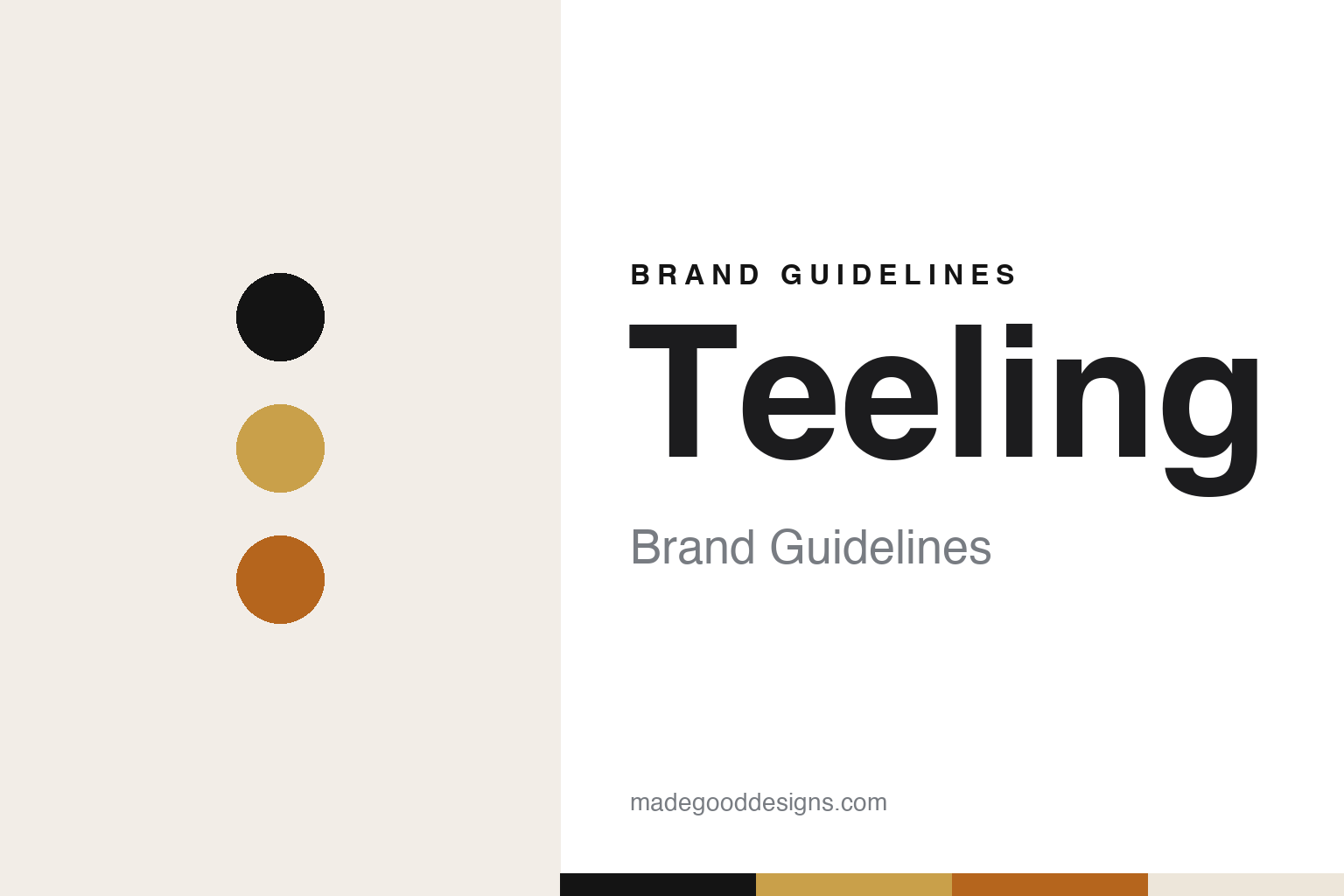
Teeling Brand Guidelines
The phoenix whiskey that brought distilling back to the Liberties.
Aa
Two constants: a Liberties black, phoenix gold and still copper palette and a condensed industrial sans register. Abstract homage — not a Teeling product or mark; no label, logo or bottle is reproduced.
Back to the Liberties
A family name, a stock of casks and a new Dublin distillery.
The Teeling Whiskey Company was launched in Dublin in 2012 by Jack Teeling, who was later joined by his brother Stephen Teeling. The company traces its family story to 1782, when, it says, Walter Teeling set up a small distillery on Marrowbone Lane in Dublin’s Liberties, then the industrial heart of the city’s distilling trade. English Wikipedia says that distillery was eventually bought by a larger neighbour, William Jameson & Co., which closed in 1923.
The modern business grew out of another one. In 1987 the brothers’ father, John Teeling, bought a former state-built industrial alcohol plant at Cooley, County Louth, and reopened it as the Cooley Distillery in 1989, the first new distillery in Ireland after the closures and consolidations of the 20th century, English Wikipedia says. Jack and Stephen worked there with their father until Cooley was sold to Beam Inc. in 2011. As part of that sale, Difford’s Guide and English Wikipedia say, the family negotiated the purchase of 16,000 casks of aged whiskey, and with that stock Jack Teeling launched the Teeling brand.
A distillery followed. The company says its first new copper pot stills arrived in Dublin in December 2014, and in 2015 it opened the Teeling Whiskey Distillery on Newmarket Square, a short walk from the old Marrowbone Lane site. The company describes it as the first new distillery in Dublin for over 125 years; English Wikipedia adds that the last of the city’s original distilleries had closed in 1976. The building, which includes a visitor centre, café and shop, was the subject of a four-part TV3 documentary, “Whiskey Business,” in 2015, the Irish Independent reported. In August 2018 the company announced an auction of the first whiskey distilled at the new site.
Colour
A phoenix, a fixed strength and a run of awards.
The emblem is a phoenix rising from a pot still. Difford’s Guide, cited by English Wikipedia, says it symbolises the re-establishment of the Teeling whiskey name, and the company’s own site lists the “phoenix device” and the brand’s trade dress among its trademarks. The bird recurs on special releases: on 100 Archive, the agency Brand Hatch Creative and designer Christopher Lee are credited with the 2024 Vintage Reserve 40 Year Old, whose gold badge carries the phoenix and whose bottle has the phoenix sandblasted on the back.
House rules double as brand signals. The company says it brings its whiskey down from cask strength to a signature 46% ABV and bottles it without chill filtration, and English Wikipedia notes that all Teeling whiskeys to date are 46% and non-chill filtered. The core range spans a Small Batch blend finished in ex-rum barrels, a Single Grain matured in Californian Cabernet Sauvignon barrels, a Single Malt and a Single Pot Still, and the company has also released a poitín, the traditional Irish clear spirit.
Awards came quickly. At the 2016 World Whiskies Awards, English Wikipedia lists Teeling wins for Best Irish Single Malt with its 24 Year Old, Best Irish Single Malt without an age statement, and Best Irish Single Grain. On 28 March 2019 the 24 Year Old was named World’s Best Single Malt at the World Whiskies Awards in London, which the Irish trade magazine Checkout reported was the first time an Irish whiskey had won the award. Jack Teeling, as founder and managing director, said the win reflected “the global resurgence and revival” of both Teeling and Irish whiskey.
Typography
Design and documentation.
The seven brands in this group are all Irish whiskey names: Redbreast, Teeling, Powers, Kilbeggan, Writers’ Tears, Green Spot and Midleton. Irish whiskey brands in general sit at many different points in the trade, from family firms that still carry a founder’s name to labels that now belong to much larger drinks groups, and a single brand can be sold everywhere from a corner shop to a hotel bar.
An Irish whiskey brand’s identity is usually carried less by a single bottle than by a label, a name and the place it promises, because the company behind the name may have changed hands, moved its production or grown far beyond the place where it started. That makes the questions behind each name worth asking plainly: who started it, who owns it now, and where its whiskey is actually distilled, matured and bottled.
Each guide separates what independent sources record from what the company says about itself — its founding story, its owners over time, where its whiskey is made and how its labels have changed — and marks plainly what rests only on the company’s own word.
Aa
A condensed industrial sans for a city-distillery label. (Specimen set in Barlow Condensed, a sans-serif STAND-IN; NOT the Teeling logo.)
Teeling
A partner from Bermuda, and a family still at the helm.
The company took on a large partner within five years of launch. Bacardi took a minority stake in the Teeling Whiskey Company in June 2017, its first move into Irish whiskey, and in December 2023 took majority control, The Spirits Business reported on 15 December 2023. Bacardi did not disclose the size of its stake; Jack and Stephen Teeling kept part of the business and continued to run it day to day. Teeling became Bacardi’s only Irish whiskey brand, in a portfolio that also includes Patrón tequila, Grey Goose vodka and Dewar’s Scotch whisky. From January 2024, the same report said, Bacardi would take over distribution of Teeling in markets including the United Kingdom, the Netherlands, Germany and Austria.
The family names need a little care. The Teeling Whiskey Company is separate from the Cooley Distillery that John Teeling founded, which passed to Beam in 2011 and now belongs to Suntory Global Spirits, English Wikipedia says; and the Newmarket distillery is a new building, not the eighteenth-century Marrowbone Lane distillery that shares the family name. The brand’s own site is teelingwhiskey.com.
For a design guide, Teeling shows how a family name, a phoenix and a fixed bottling strength can rebuild a city’s whiskey identity around a single new distillery in the Liberties. Compare Bushmills, the County Antrim distillery behind the 1608 licence, and Tullamore D.E.W., the Irish whiskey named for a Midlands town. For this guide we use Liberties black, phoenix gold and still copper with a condensed sans, an unofficial interpretation; no product or logo is reproduced.
Explore & save
Keep Teeling’s identity on hand — save it to a board in the Made Good inspiration library.
Teeling identity set
Pin the Teeling Liberties black, phoenix gold and still copper palette and the condensed industrial sans register to your own board.