Ménage à Trois Brand Guidelines
The three-grape blend from St. Helena, launched 1996.
Aa
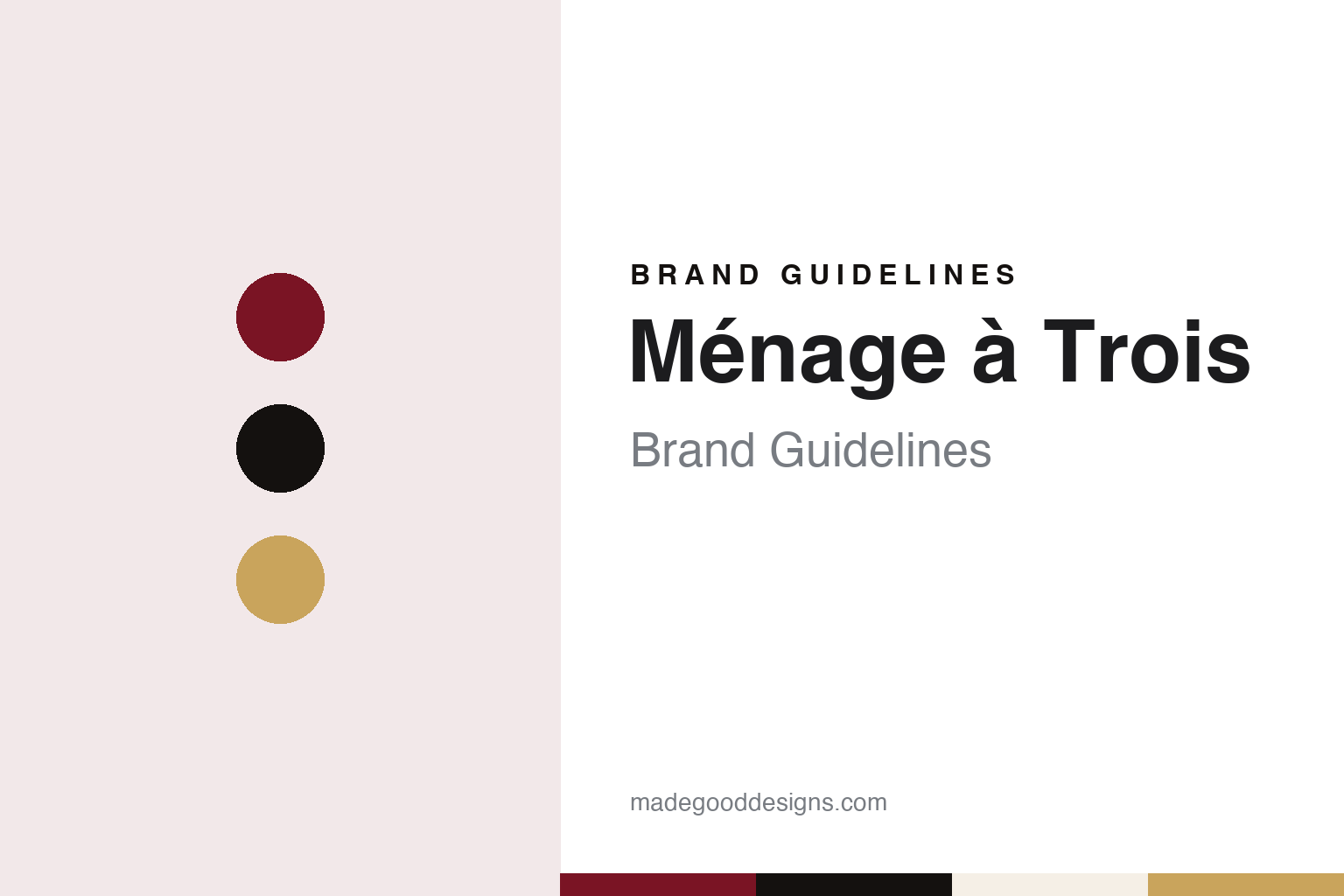
Two constants: a blend red, inkblot black and antique gold palette and a classical display serif register. Abstract homage — not a Ménage à Trois product or mark; no label, logo or bottle is reproduced.
A winery named after a shared delusion
Two psychiatrists, a Napa winery and a blend of three grapes.
Ménage à Trois was born inside another wine brand. Its parent winery, Folie à Deux, was founded in 1981 by two psychiatrists, English Wikipedia says, who took the name from the psychiatric term for a fantasy or delusion shared by two people. The winery sat in St. Helena, in the Napa Valley, on a site off Highway 29.
By the mid-1990s it had changed hands. Wine Spectator reported in April 2004 that a private group led by Richard Peterson had bought Folie à Deux out of bankruptcy in 1995, and that the winemaker Scott Harvey, a former owner of Renwood Winery, had overseen production since 1996.
That was the year the new brand appeared. Trinchero Family Estates, the company that owns it today, says Ménage à Trois launched in St. Helena in 1996 with a blend of three red grapes, Zinfandel, Merlot and Cabernet Sauvignon, at a time when blends were not yet a fashion in American wine; a red and a white blend were soon on sale. Harvey’s own biography credits him with creating the Ménage à Trois line. The name is a play on that recipe: the brand describes itself as blending three distinctly different grapes into one wine, and the Sonoma Index-Tribune noted in 2020 that the wine is named after the three grape varieties used in it.
The small winery found a buyer in 2004. Wine Spectator reported that spring that Trinchero Family Estates, the St. Helena family company behind Sutter Home and its White Zinfandel, had offered to buy the Folie à Deux brand, the winery, most of its inventory and a 12-acre Cabernet vineyard on the property. At the time Folie à Deux made about 30,000 cases a year across its own label and Ménage à Trois. Wine Spectator reported the purchase complete in June 2004, quoting Sutter Home’s president Bob Torkelson as saying the deal “fits our portfolio.”
Colour
Twin dancers, an inkblot and a blend for every taste.
The label’s central image comes from the parent winery’s psychology theme. Trinchero describes the Ménage à Trois artwork as twin dancers inspired by Rorschach inkblots, the symmetrical shapes used in the well-known psychological test, and the company says the art is meant to give the brand an alluring, playful personality. The brand pairs the dancers with the name in French, accents included, which sets a slightly old-world tone for a modern California blend.
Under Trinchero the brand grew quickly. The company says Ménage à Trois “increased significantly” after joining its portfolio in 2004. Laurie Daniel reported in the San Jose Mercury News in February 2010 that the brand had sold 1.6 million cases in 2009, and the beverage trade magazine Market Watch named it its Wine Brand of the Year for 2009. Paul Franson wrote in the Napa Valley Register in April 2010 that Ménage à Trois Red had become the top-selling red wine product in the United States.
The range spread out from the first blends into single grapes and new styles. The brand’s site today lists reds including Cabernet Sauvignon, Merlot and Pinot Noir alongside several red blends; whites including Sauvignon Blanc, Chardonnay and Pinot Grigio; a sweet collection with a Moscato; a lighter range; and a Prosecco DOC. The brand still gives St. Helena as its home.
The brand’s playful tone has also met a regulator. In February 2020 the Independent Complaints Panel of the Portman Group, the British drinks industry’s self-regulatory body, upheld an anonymous complaint about the label of Ménage à Trois Midnight, finding that its wording linked the drink to sex, The Drinks Business and the Morning Advertiser reported. The panel accepted that the name itself refers to the three grapes, and Trinchero said that although it did not agree with the panel’s reading of the code, it would revise the label.
Typography
Design and documentation.
The seven brands in this group are all wine names: Chateau Ste. Michelle, Bogle, 14 Hands, Dark Horse, Cupcake, Ménage à Trois and Chandon. Wine brands in general sit at many different points in the trade, from family houses that still carry a founder’s name to labels that now belong to much larger drinks groups, and a single brand can be sold everywhere from a corner shop to a restaurant list.
A wine brand’s identity is usually carried less by a single bottle than by a label, a name and the place it promises, because the company behind the name may have changed hands, moved its production or grown far beyond the place where it started. That makes the questions behind each name worth asking plainly: who started it, who owns it now, and where its wine is actually made and bottled.
Each guide separates what independent sources record from what the company says about itself — its founding story, its owners over time, where its wine is made and how its labels have changed — and marks plainly what rests only on the company’s own word.
Aa
A classical display serif for a French name on a California blend. (Specimen set in Cormorant Garamond, a serif STAND-IN; NOT the Ménage à Trois logo.)
Ménage à Trois
A blend that became a family company’s second big idea.
Ménage à Trois sits inside one of the larger family wine businesses in the United States. English Wikipedia, citing SevenFifty Daily in 2018, describes the Trinchero business as the second-largest family-owned winery in the world. The family’s story starts with Sutter Home, the old St. Helena winery that the Trinchero brothers bought in the late 1940s and where Bob Trinchero’s White Zinfandel took off in the 1970s; in 2004 Wine Spectator reported that Sutter Home White Zinfandel made up about 95 percent of the company’s roughly 10 million cases a year. Buying Folie à Deux was part of a push for a bigger presence in the Napa Valley, the magazine reported.
The two names belong together. Folie à Deux, the parent winery, took its French name from a psychiatric term for a delusion shared by two people; Ménage à Trois, its offshoot, is named for the three grapes in its original blend; and the Rorschach-inspired dancers on the label borrow the imagery of a psychological test. Trinchero has kept both names: Folie à Deux remains part of its portfolio, English Wikipedia says.
The name needs a little care online. The phrase is also an ordinary French expression with no connection to wine; the brand’s own site is menageatroiswines.com, and Trinchero lists it among its brands at tfewines.com.
For a design guide, Ménage à Trois shows how a blend of three grapes, a French name and a pair of dancers drawn from an inkblot can carry a wine from a small St. Helena winery to one of the best-selling red wines in the United States. Compare Sutter Home, its sister brand in the Trinchero family, and Barefoot, another Californian wine brand built on a single memorable image. For this guide we use blend red, inkblot black and antique gold with a serif, an unofficial interpretation; no product or logo is reproduced.
Explore & save
Keep Ménage à Trois’s identity on hand — save it to a board in the Made Good inspiration library.
Ménage à Trois identity set
Pin the Ménage à Trois blend red, inkblot black and antique gold palette and the classical display serif register to your own board.