Acqua Panna Brand Guidelines
The Tuscan still water from a former Medici estate.
Aa
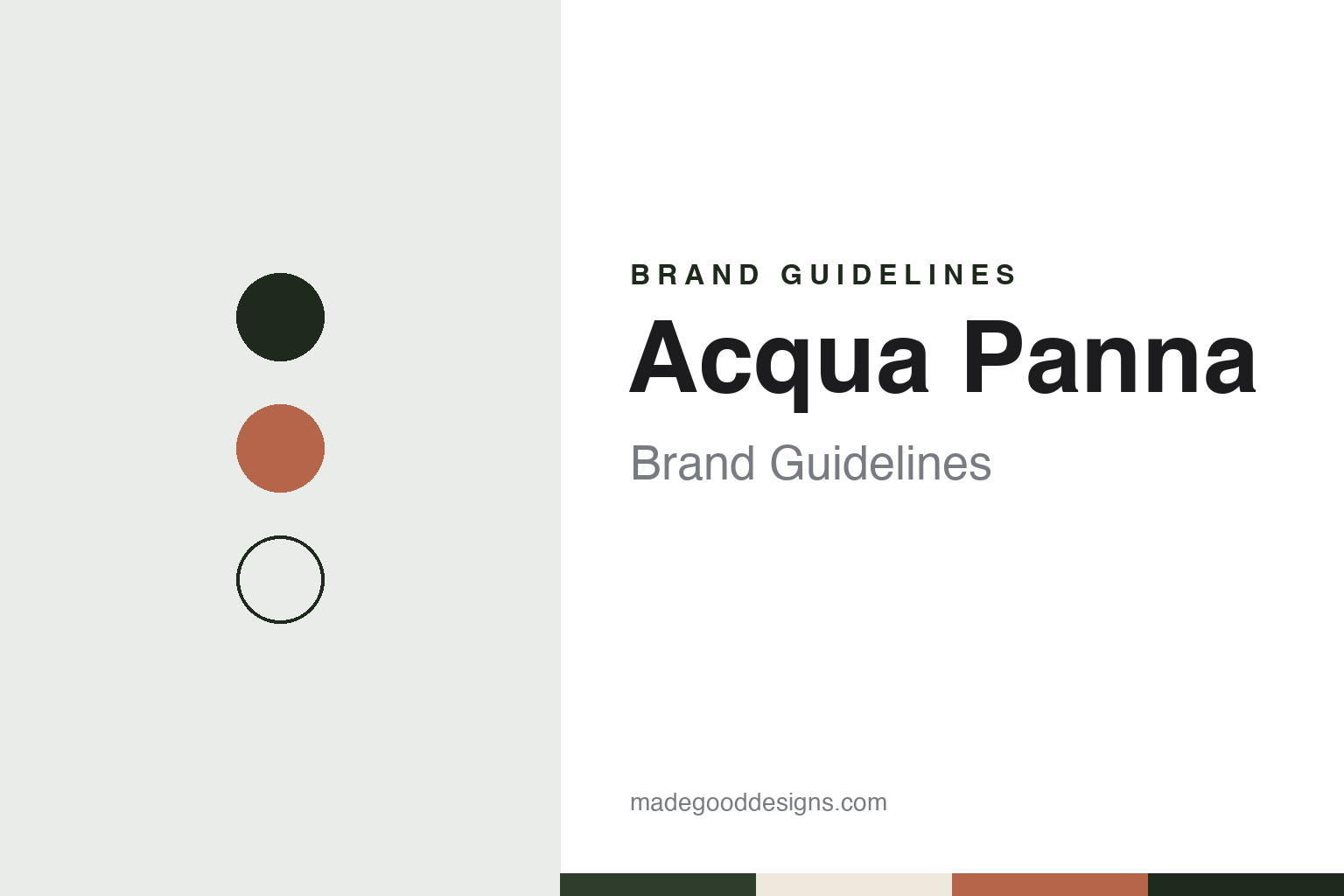
Two constants: a cypress, stone and terracotta palette and a Tuscan serif register. Abstract homage — not an Acqua Panna product or mark; no bottle, label or logo is reproduced.
Villa Panna
A Medici hunting ground in the hills north of Florence.
Acqua Panna takes its name from Villa Panna, on an estate in the Apennine hills north of Florence. Italian Wikipedia places the source in the comune of Scarperia, now Scarperia e San Piero, about 35 kilometres from the city, and English Wikipedia, citing the Springer reference book Springs and Bottled Waters of the World (2012), gives its height as about 1,130 metres. Italian Wikipedia describes the villa as an old hunting reserve of the Medici, now set in a nature reserve of 1,300 hectares near the springs, and as the historic seat of the bottling works.
The company tells the longer story. It says the land was bought by the Medici in the early 1400s and joined to their Cafaggiolo hunting estate, and that on 15 July 1564 an official proclamation fixed the boundaries of the property, including the Panna estate. That is the date the brand uses for its heritage, and the company says the estate has stayed almost intact since, though its owners have changed. English Wikipedia, citing a 2009 Italian book by Sandro Danesi, says the Medici fenced the spring off as private property in the 16th century.
The water business came later. According to the company, in 1860 the owners of the day, the Marquises Torrigiani, turned the farmhouse on the estate into Villa Panna, a summer residence with a lake, a belvedere and statues, and converted the main farm area into a mineral-water works. Italian Wikipedia also gives 1860 as the founding date, citing Danesi; English Wikipedia says the water was first bottled in 1880, citing the Springer book, so the two accounts differ by two decades. In the early years, the company says, the water went out by cart in demijohns of 54 litres and was delivered to homes as far away as Florence; around 1910 the demijohns were phased out and Acqua Panna was sold in one-litre bottles for the first time.
Between the late 1920s and the early 1930s, the company says, the estate passed to another aristocratic family, the Contini Bonacossi. They founded Società Panna in 1938, and its work was cut short almost at once by the Second World War. The company tells a story from those years: bottles were hidden at the bottom of the villa’s artificial lakes and fished out and cleaned once the war was over. With the war damage repaired, a new plant opened in 1951.
Colour
From demijohns to plastic, then PET.
Acqua Panna’s modern history begins with a sale. In 1957, the company says, Società Panna was bought by the Società delle Terme di San Pellegrino, the company behind S.Pellegrino sparkling water, now called Sanpellegrino. Italian Wikipedia’s history of Sanpellegrino credits Giuseppe Mentasti, who took over the direction of the company in December 1957, with bringing Acqua Panna into the group. The company says the new owner put capital into a series of improvements over the following decades.
Packaging is the clearest thread in those decades. The company says it introduced plastic bottles in 1970 and PET bottles in 1994, and English Wikipedia, citing the Springer book, says Acqua Panna was the first still, uncarbonated water to be produced in plastic bottles in Italy. Glass stayed in the range: English Wikipedia lists glass bottles of 25, 50 and 75 centilitres and one litre alongside plastic bottles of 33, 50 and 75 centilitres and one litre, citing the brand’s own bottle page.
The water is still, and the brand sits beside its sparkling sister in the same group. English Wikipedia calls Acqua Panna one of the world’s largest bottled-water brands and says it is sold in Europe, the Americas and Asia. Italian Wikipedia records a piece of advertising history: the music behind Acqua Panna’s television spots in the 1980s was part of “I Sing the Body Electric,” from the soundtrack of the 1980 film Fame, written by Dean Pitchford and Michael Gore.
The estate itself has become part of the brand’s story. In 2020, the company says, a partnership with the Federation of Italian Parks and Nature Reserves made the Panna estate a “living laboratory” for biodiversity research, where plants and animals are monitored and protected.
Typography
Design and documentation.
The seven brands in this group are all bottled water names: Acqua Panna, Highland Spring, smartwater, San Benedetto, Poland Spring, Essentia and Buxton. Bottled water brands in general sit at many different points in the trade, from family companies that still run their own springs to labels that now belong to much larger drinks groups, and a single brand can be sold everywhere from a corner shop to a restaurant table.
A bottled water brand’s identity is usually carried less by the water itself than by a label, a name and the place it promises, because the company behind the name may have changed hands, added new sources or grown far beyond the place where it started. That makes the questions behind each name worth asking plainly: who started it, who owns it now, and where its water is actually sourced and bottled.
Each guide separates what independent sources record from what the company says about itself — its founding story, its owners over time, where its water is sourced and bottled and how its labels have changed — and marks plainly what rests only on the company’s own word.
Aa
A Tuscan serif — an estate brand with Renaissance roots. (Specimen set in Cormorant Garamond, a serif STAND-IN; NOT the Acqua Panna logo.)
Sanpellegrino and Nestlé
A Tuscan estate inside a Swiss group.
Acqua Panna is not an independent company. Italian Wikipedia describes it as an Italian brand of natural mineral water in the Sanpellegrino group, itself part of Nestlé, and the copyright line on the brand’s website names San Pellegrino S.p.A. as the business behind it. Sanpellegrino, which Italian Wikipedia says was founded in 1899 at San Pellegrino Terme near Bergamo, also controls the Alpine water Levissima.
Sources give different dates for Nestlé’s arrival. English Wikipedia says the S.Pellegrino business has been part of Nestlé since 1997, when it was bought by Perrier Vittel SA, a division of Nestlé that also owns the Perrier and Vittel brands. Italian Wikipedia describes Sanpellegrino’s complete absorption into the Nestlé group in 1999. Either way, Acqua Panna has belonged to the Sanpellegrino company since 1957, and to the Swiss group since the late 1990s, while being bottled on the Tuscan estate where the company says the source rises.
The brand’s dates come in layers. The company dates its heritage to the 1564 proclamation, its water business to 1860 and its present company to 1938, while English Wikipedia gives 1880 for the first bottling.
For a design guide, Acqua Panna shows how a water brand can lean on a place and its history: a villa, a Renaissance estate and a date from 1564 carry more of the story than anything in the bottle. Compare Levissima, its sister brand in the Sanpellegrino group, and Vittel, a French spa water in the same Nestlé family. For this guide we use cypress green, Tuscan stone and terracotta with a serif, an unofficial interpretation; no product or logo is reproduced.
Explore & save
Keep Acqua Panna’s identity on hand — save it to a board in the Made Good inspiration library.
Acqua Panna identity set
Pin the Acqua Panna cypress, stone and terracotta palette and the Tuscan serif register to your own board.