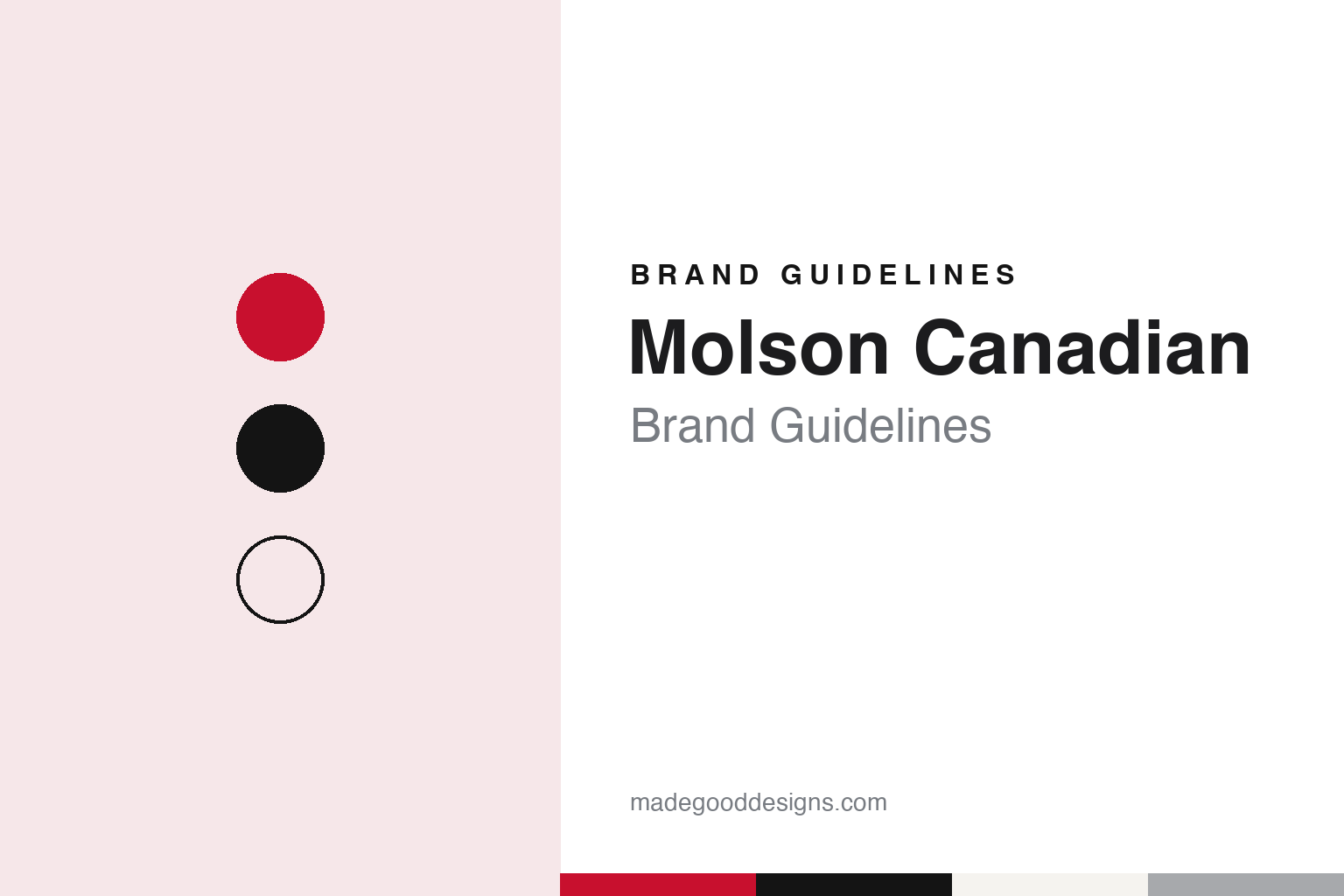
Molson Canadian Brand Guidelines
The 1959 lager that turned a slogan into a national rant.
Aa
Two constants: a Molson Canadian red, white and ink palette and a condensed sans register. Abstract homage — not a Molson Canadian product or mark; no can, label or logo is reproduced.
John Molson’s brewery
An ale on the St. Lawrence shore, 1786.
Molson Canadian belongs to one of the oldest brewing companies in North America. Its founder, John Molson, left England and landed in Montreal in 1782, aged 18, English Wikipedia says. In 1784 he sued a brewer, Thomas Loyd, over a debt, and in January 1785 he used money inherited from his parents to buy what had been Loyd’s brewery on the shore of the St. Lawrence, outside the town’s fortifications.
In 1786, about six weeks after taking charge, Molson delivered his first brew — an ale. In 1816 he went into partnership with his sons John Jr., Thomas and William; an 1815 map of Montreal, reproduced by Wikipedia, already marks “la brasserie Molson, rue Notre-Dame.”
The brewery grew through the twentieth century. In 1903 Herbert Molson and the brewmaster John Hyde created Molson Export, an ale. The company became a public, limited-liability enterprise in 1945 and opened a brewery in Toronto in 1955, according to English Wikipedia. In 1989 it merged with Carling O’Keefe and became Canada’s largest brewer.
Colour
Joe, a movie theatre and a maple leaf.
Molson Canadian was introduced in 1959, English Wikipedia says: a North American–style lager. Today the family of beers includes Molson Canadian Light and Molson Canadian 67. The lager has collected trade medals over the years, among them a silver at the 2002 World Beer Cup and gold in the North American–style lager category at the 2006 Canadian Brewing Awards, as well as several Monde Selection gold awards between 1989 and 2002, Wikipedia records.
The brand is best known for an idea rather than a recipe. Molson Canadian used the slogan “I Am Canadian” from 1994 to 1999, with the agencies Maclaren Lintas and then MacLaren McCann, and again from 2000 to 2005 with the agency Bensimon Byrne, according to English Wikipedia.
The best-remembered spot was “The Rant,” first aired in March 2000. The Nova Scotian actor Jeff Douglas plays “Joe,” an ordinary Canadian who walks onto a cinema stage and, with images of the country on the screen behind him, sets Canadians apart from American stereotypes, and from American stereotypes about Canadians, such as living in igloos, before ending: “My name is Joe, and I am Canadian.” The spot was written by Glen Hunt and was tested on moviegoers in Ottawa before it ran, Wikipedia says.
It was a sixty-second commercial that escaped advertising. In May 2000 the Christian Science Monitor reported that audiences applauded it in bars and cinemas, that it had been performed at a Stanley Cup game in Toronto, and that viewers were reciting it along with the actor; radio stations made provincial versions, and William Shatner parodied it. Not everyone was charmed: the historian Michael Bliss told the Monitor it was “nationalism without content.” In 2002 the text was included in John Robert Colombo’s Penguin Treasury of Popular Canadian Poems and Songs, Wikipedia says.
The idea kept returning. A 2013 Molson Canadian ad built around a red beer fridge circulated again on social media in 2017; in 2022 the actor Simu Liu opened the Juno Awards with a riff on the Rant; and in March 2025, amid the trade dispute with the United States, an updated version with Douglas was posted on YouTube, according to English Wikipedia.
Typography
Brewing in Canada.
The seven brands in this group are all Canadian beer and whisky names: Molson Canadian, Labatt Blue, Sleeman, Moosehead, Kokanee, Alexander Keith’s and J.P. Wiser’s. Beer and whisky brands in general sit at many different points in the trade, from family companies that still carry a founder’s name to labels that now belong to much larger drinks groups, and a single brand can be sold everywhere from a corner store to a bar rail.
A beer or whisky brand’s identity is usually carried less by a single bottle than by a label, a name and the place it promises, because the company behind the name may have changed hands, moved its production or grown far beyond the place where it started. That makes the questions behind each name worth asking plainly: who started it, who owns it now, and where its beer or whisky is actually made.
Each guide separates what independent sources record from what the company says about itself — its founding story, its owners over time, where its beer or whisky is made and how its labels have changed — and marks plainly what rests only on the company’s own word.
Aa
A tall, condensed sans for a loud, national register. (Specimen set in Oswald, a condensed sans STAND-IN; NOT the Molson Canadian logo.)
Molson Coors
A Montreal name inside a transatlantic group.
The family brewery did not stay independent. Molson and the American brewer Coors announced a merger in July 2004 and completed it in February 2005, forming the Molson Coors Brewing Company, English Wikipedia says. Shortly afterwards Molson retired the “I Am Canadian” campaign. In October 2019 the group announced it would rename itself Molson Coors Beverage Company, a change made in 2020; its principal executive offices are listed in Golden, Colorado, and in Montréal.
Inside the group, Molson Canadian is brewed by the Molson Brewery, Molson Coors’s Canadian division. The brewery John Molson founded on the Montreal waterfront has now closed. Molson confirmed in July 2017 that it would move to Longueuil, across the river, French Wikipedia says, and dates the move to 2022; English Wikipedia gives 2021 for the closing of the Montreal brewery “after over 200 years.” English Wikipedia lists Molson’s current breweries as Longueuil in Quebec, the former Carling O’Keefe plant in Toronto, St. John’s in Newfoundland and Labrador, and Chilliwack in British Columbia, alongside craft breweries the group has bought, such as Creemore Springs and Granville Island.
Through the years the brand has also leaned on sport and public stunts. In February 2011 Molson announced a partnership with the National Hockey League, which, after a court dispute, began with the 2011–12 season, and the same year it launched the Red Leaf Project, a tree-planting and park clean-up programme, English Wikipedia says.
For a design guide, Molson Canadian shows how a mainstream lager can borrow a whole country’s identity — red, white and a maple leaf — and make a slogan more famous than the beer. Compare Labatt Blue, its oldest Canadian rival, and Miller Lite, now a stablemate under Molson Coors. For this guide we use leaf red, ink and snow white with a condensed sans, an unofficial interpretation; no product or logo is reproduced.
Explore & save
Keep Molson Canadian’s identity on hand — save it to a board in the Made Good inspiration library.
Molson Canadian identity set
Pin the Molson Canadian red, white and ink palette and the condensed sans register to your own board.