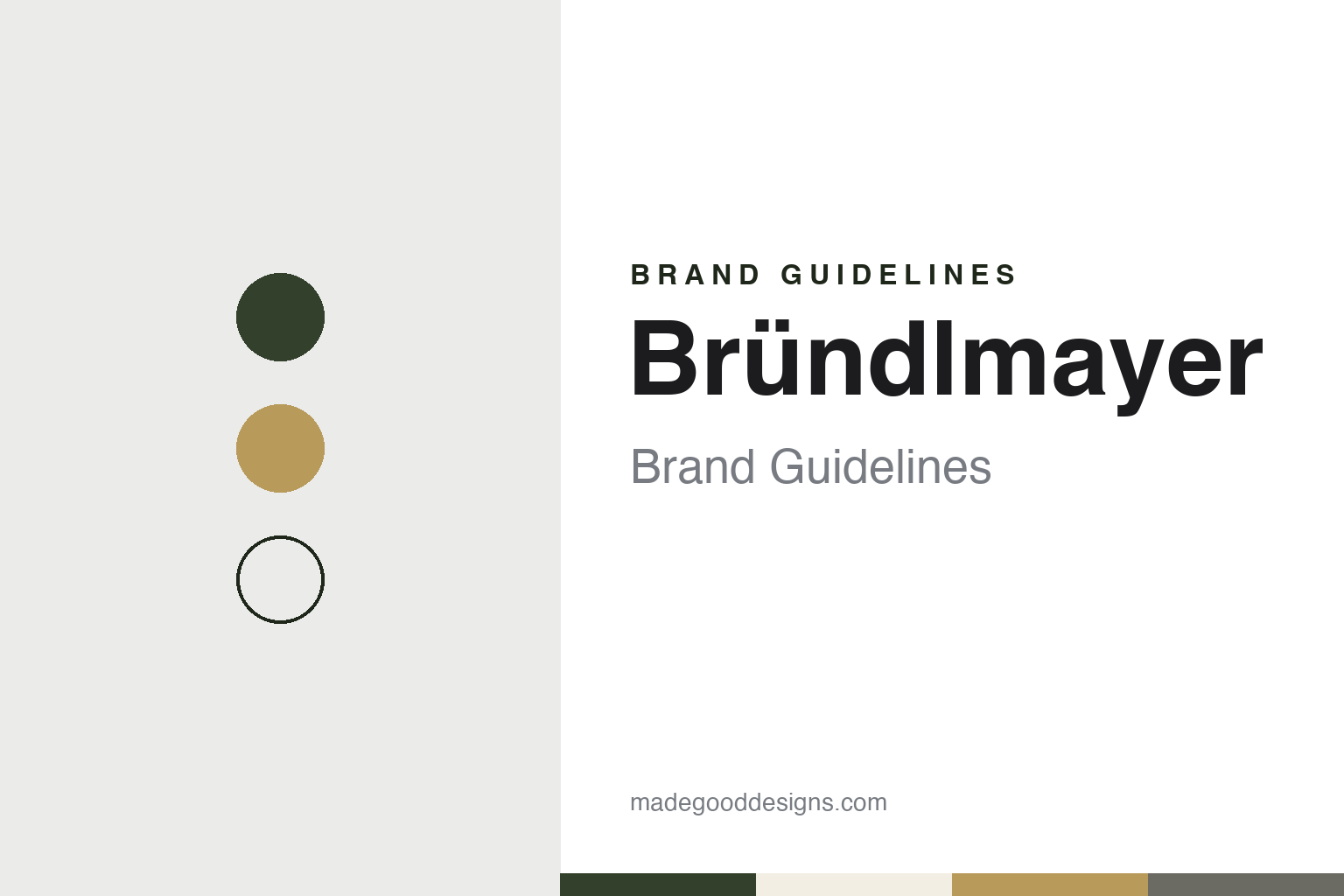
Bründlmayer Brand Guidelines
The Langenlois family estate behind Heiligenstein Riesling and Austrian Sekt.
Aa
Two constants: a vine green, loess gold and label cream palette and an old-style book serif register. Abstract homage — not a Bründlmayer product or mark; no label, logo or bottle is reproduced.
A family estate in Langenlois
Terraced hills where the Kamp valley opens towards the Danube.
Weingut Bründlmayer is a family wine estate in Langenlois, the wine town of the Kamptal in Lower Austria. The company describes its vineyards as lying on the hills around the town, about 70 kilometres west of Vienna, where the valley of the Kamp river meets the Danube valley, with the forests of the Waldviertel sheltering them from cold north-westerly winds. Its sites, it says, are hillside and terraced plots on gneiss and paragneiss, complemented by deep loess and clay. The magazine Discover Germany, in a 2016 profile, said the family had produced its wines for generations.
The modern estate is tied to one name. Willi Bründlmayer took over management of his parents’ winery in 1980, after studying viticulture and political economy at the University of Vienna, according to his member profile at the Académie Internationale du Vin; the company says he sits on the Académie’s board. That same year he married Edwige, who came from Paris and has worked with him to build the estate, the Académie says. In a 2021 interview with News.at, Willi Bründlmayer said his first placement in viticulture had taken him to Burgundy, and named Paul Draper of Ridge in California as his model as a winemaker.
German Wikipedia says Willi Bründlmayer has run the business since 1980 and counts it among the largest private wine producers in Austria. Today the company says he leads the family estate with Edwige, Thomas Klinger and the Master of Wine Andreas Wickhoff. Their son Vincent Bründlmayer also works at the estate; Discover Germany pictured father and son together in 2016, and he appears on the company’s team page.
Colour
Grüner Veltliner, Heiligenstein Riesling and a Sekt made at home.
The estate’s most important grape is Grüner Veltliner, a native Austrian variety, the company says, with Riesling close behind and Chardonnay and the Pinot family as specialities. Its Grüner Veltliner runs from light-footed bottlings such as Kamptal Terrassen to single-vineyard wines from sites such as Käferberg, Lamm and Loiserberg. German Wikipedia puts the vineyard area at 90 hectares as of 2025, about 70 per cent of it planted with white varieties; the company’s press page gives a figure of about 94 hectares.
The best-known site is the Zöbinger Heiligenstein, a hill north-east of Langenlois at whose foot the Kamp bends from a north–south course to flow east towards the Danube. The company describes its soil as ancient desert sandstone and says the finest Riesling grapes ripen high on the slope, inside an enclosed nature reserve; Lamm, it says, is the hill’s eastern spur. The company lists Heiligenstein and Langenloiser Steinmassl as its 1ÖTW Riesling sites. Some of the vines are trained in the lyre-shaped Lyra system, which German Wikipedia names as one of the estate’s particular features.
The other signature is sparkling wine. The company says Willi Bründlmayer has made the Bründlmayer Brut since 1989, a hand-riddled Sekt blended from Chardonnay, the Pinot varieties and Grüner Veltliner, now joined by a Brut Rosé, an Extra Brut, a Blanc de Blancs and a Blanc de Noirs. Every step, it says, takes place in its own cellar, with wooden riddling racks and the disgorgement date printed on the back label. German Wikipedia, citing Hugh Johnson’s wine guide, says Johnson called it probably Austria’s best Sekt.
Typography
Design and documentation.
The seven brands in this group are all wineries: Barkan, Royal Tokaji, Oremus, Tement, Weninger, Jermann and Bründlmayer, from Israel, Hungary, Austria and Friuli. Wineries in general sit at many different points in the trade, from family estates that still carry a founder’s name to labels that now belong to much larger drinks groups, and a single name can be sold everywhere from a corner shop to a restaurant list.
A winery’s identity is usually carried less by a single bottle than by a label, a name and the place it promises, because the company behind the name may have changed hands, moved its production or grown far beyond the place where it started. That makes the questions behind each name worth asking plainly: who started it, who owns it now, and where its wine is actually made and bottled.
Each guide separates what independent sources record from what the company says about itself — its founding story, its owners over time, where its wine is made and how its labels have changed — and marks plainly what rests only on the company’s own word.
Aa
An old-style book serif for a family estate in Langenlois. (Specimen set in EB Garamond, a serif STAND-IN; NOT the Bründlmayer logo.)
Bründlmayer
Organic vineyards, a gravity cellar and a classification.
Bründlmayer remains a family business, trading as Weingut Bründlmayer Langenlois GmbH according to the Austrian Economic Chamber’s export directory, and its wine is grown and made in Langenlois. The company says that when Willi Bründlmayer took over his parents’ winery he introduced a policy of ecological winegrowing, giving up synthetic fertilisers from 1979, and that its vineyards have been farmed organically since 2015, certified by LACON. Its cellar, it says, works by gravity: grapes arrive and are pressed on the top floor, the must flows down into the fermentation vats, and the wines then descend again into the casks of the old earth cellar, with solar panels on the roof and geothermal pipes under the foundations.
Willi Bründlmayer also helped shape how Austrian vineyards are named. German Wikipedia says the Österreichische Traditionsweingüter (ÖTW), an association of estates from the Kamptal and Kremstal formed to classify Austrian vineyard sites, held its founding assembly on 10 June 1991 at the Kloster Und in Krems, with 18 members; he was among the founders and served as its first chairman from 1991 to 1993. The association introduced its “ÖTW Erste Lage” designation in 2010, starting with the 2009 vintage, and Bründlmayer is still a member. The Académie Internationale du Vin quotes Jancis Robinson, writing in the Financial Times, calling the estate a beacon for Austrian wine.
The range has also moved beyond wine. The company says its vineyards supply grape juice, verjus and a soft drink called Grapester, and that in February 2026 it introduced two non-alcoholic sparkling drinks, Fizz Blanc and Fizz Rosé. Its wine tavern, the Heurigenhof Bründlmayer, where current wines are poured by the glass, sits in what the company calls a preserved Renaissance vintner’s house in Langenlois.
For a design guide, Bründlmayer shows how a family name, a single famous hill and a careful vocabulary of site names can carry an estate’s identity from one generation to the next. Compare Tement, another Austrian family estate, and Dr. Loosen, the German Riesling estate. For this guide we use vine green, loess gold and label cream with an old-style serif, an unofficial interpretation; no product or logo is reproduced.
Explore & save
Keep Bründlmayer’s identity on hand — save it to a board in the Made Good inspiration library.
Bründlmayer identity set
Pin the Bründlmayer vine green, loess gold and label cream palette and the old-style book serif register to your own board.