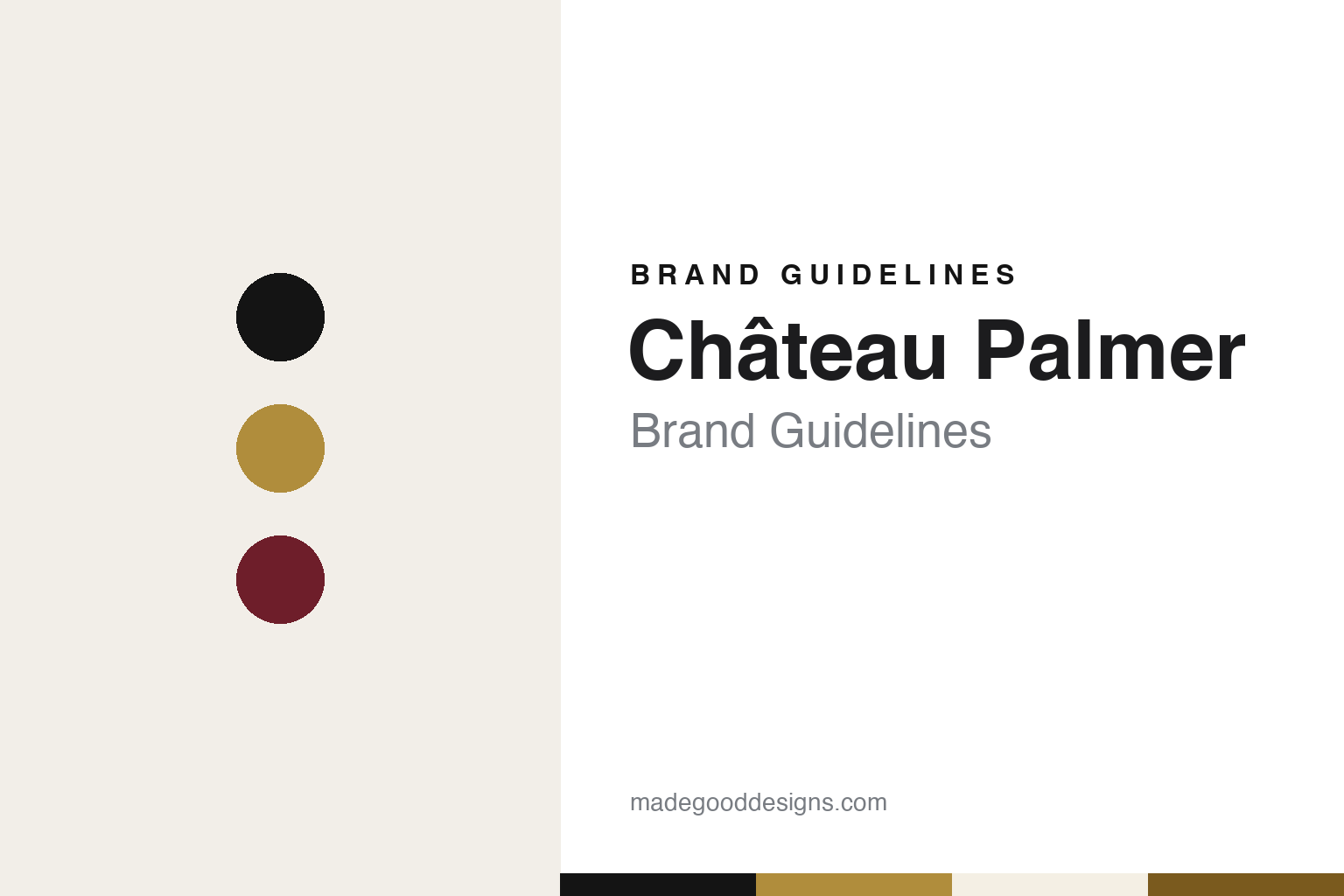
Château Palmer Brand Guidelines
The Margaux third growth named after a British officer.
Aa
Two constants: a night black, antique gold and claret palette and a high-contrast didone serif register. Abstract homage — not a Château Palmer product or mark; no label, logo or bottle is reproduced.
A general’s estate in Margaux
From the Domaine de Gascq to a British officer’s name.
Château Palmer is a wine estate at Cantenac, in the Margaux appellation of the Médoc, and it carries the name of an Englishman. French Wikipedia, citing the historian René Pijassou, says the property was known from the early eighteenth century as the Domaine de Gascq, after the Gascq family, members of the parliament of Bordeaux, whose light red clairet was already appreciated at the court of Versailles.
The change of name came in 1814. French Wikipedia says that on 16 June 1814 Charles Palmer, a British career officer then serving as a lieutenant-colonel of the 10th Hussars and later a member of parliament for Bath, bought the estate from the widow of the last Gascq owner. Between 1816 and 1831, the same source says, he bought up scattered vines and land in Cantenac, Issan and Margaux, built a property of about 163 hectares, 82 of them under vine, gave it his own name, and left it largely to managers while he lived mainly in Bath. Heavily in debt, Palmer was forced to sell the estate to a mortgage bank, the Caisse hypothécaire, in 1843.
Ten years later the estate changed hands again. The château says that in 1853 the brothers Émile and Isaac Pereire, bankers born in Bordeaux and builders of railways, bought the estate and its vineyard of 83 hectares from the Caisse hypothécaire. That same year they commissioned the Bordeaux architect Charles Burguet to build the present house, with its conical turrets and slate roofs; the château notes that Burguet had already designed Château Pichon-Longueville Baron in Pauillac, which shares those features. In the official 1855 classification of Bordeaux wines, Palmer was ranked a third growth, French Wikipedia records.
Colour
Four négociant families, and then two.
The Pereire descendants kept the estate for more than eighty years. The château says the family decided in June 1937 to sell, and that in 1938 four families from the Bordeaux wine trade joined forces to take it over: the Ginestet, Miailhe, Mähler-Besse and Sichel families. French Wikipedia says the Ginestets and then, gradually, the Miailhes sold their shares to the other two, and that the Mähler-Besse and Sichel families remain co-owners today; the château’s own history says the same of their descendants.
Day-to-day running stayed close to those families for decades. According to French Wikipedia, Jean Bouteiller, husband of Olga Mähler-Besse, managed the estate, and his son Bertrand Bouteiller led it until 2004. In the vineyard, the same source credits several generations of the Chardon family: Pierre Chardon became estate manager in 1938, and his sons Claude and Yves worked at Palmer until they retired at the end of 1996.
In 2004 the shareholders appointed Thomas Duroux, an agronomist and oenologist who had worked in Hungary, South Africa, California and at Tenuta dell’Ornellaia in Tuscany, as managing director, French Wikipedia says; Decanter was quoting him in that role in 2015.
The vineyard has its own history of change. French Wikipedia says Palmer’s vines today cover about 66 hectares of a 100-hectare estate on gravel rises, planted with 47 per cent Cabernet Sauvignon, 47 per cent Merlot and 6 per cent Petit Verdot, an unusually high share of Merlot for the Médoc. In the 1920s Merlot made up only about 3 per cent of the vines, the same source says; Louis Miailhe planted it widely from the 1940s, raising it to about 60 per cent, before Jean Bouteiller brought it back to 47 per cent in the 1950s.
Typography
Design and documentation.
The seven brands in this group are all Bordeaux châteaux: Château Haut-Brion, Château Cheval Blanc, Château Ausone, Château Palmer, Château Lynch-Bages, Château Pichon Baron and Château Cos d’Estournel. Bordeaux estates in general sit at many different points in the trade, from properties still held by the families whose names they carry to estates that now belong to insurers, industrial groups or private investors, and a single estate’s wine can travel from its own cellar to merchants and restaurant lists around the world.
A Bordeaux château’s identity is usually carried less by a single bottle than by a label, a name and the place it promises, because the estate behind the name may have changed hands, been enlarged or been rebuilt many times since it began. That makes the questions behind each name worth asking plainly: who founded it, who owns it now, and where its wine is actually made and bottled.
Each guide separates what independent sources record from what the estate says about itself — its founding story, its owners over time, where its wine is made and how its labels and buildings have changed — and marks plainly what rests only on the estate’s own word.
Aa
A high-contrast didone serif for a nineteenth-century château name. (Specimen set in Bodoni Moda, a serif STAND-IN; NOT the Château Palmer logo.)
Château Palmer
Three red wines, a white, and a farm around the vines.
The estate makes more than one wine, all of it at the property, where French Wikipedia says the wine is fermented plot by plot in temperature-controlled steel vats and bottled at the château. Alongside the grand vin, Alter Ego was launched with the 1998 vintage from the lighter gravel plots; before that, the same source says, a second wine was sold in some years as Réserve du Général. In 2004 Thomas Duroux created the Historical XIXth Century Wine, a non-vintage blend of Palmer wine with Syrah from the northern Rhône that revives the nineteenth-century Bordeaux practice of strengthening claret with Rhône wine; it does not carry the Margaux appellation on its label. A white wine from nearly vanished Bordeaux varieties, led by Muscadelle, followed with the 2007 vintage and was kept for the shareholders until 2010.
The larger change came in the vineyard. French Wikipedia says the first biodynamic trials began in 2009 on a one-hectare plot called Boulibranne, and that conversion of the whole vineyard was decided in 2014 with the owners’ approval. Decanter reported in April 2015 that Duroux said Palmer was working towards biodynamic certification from the international body Demeter and expected it in 2017, together with full organic certification from Ecocert; French Wikipedia dates the Demeter certification to 2018. French Wikipedia adds that mildew destroyed between two-thirds and three-quarters of the 2018 crop, a loss the estate accepted publicly as the cost of its commitment. Since the end of 2014 the estate has also kept herds, including the rare local Bordelaise cattle, whose manure goes into the vineyard compost, and it has added a vegetable garden and fruit trees.
The name needs a little care online: “Palmer” is a common surname and appears in many unrelated businesses. The estate’s own site is chateau-palmer.com.
For a design guide, Château Palmer shows how a nineteenth-century officer’s name, a turreted house by Charles Burguet and a long family ownership can carry an identity through two centuries. Compare Château Margaux, the first growth in the same appellation, and Pichon Baron, the Pauillac château by the same architect. For this guide we use night black, antique gold and claret with a serif, an unofficial interpretation; no product or logo is reproduced.
Explore & save
Keep Château Palmer’s identity on hand — save it to a board in the Made Good inspiration library.
Château Palmer identity set
Pin the Château Palmer night black, antique gold and claret palette and the high-contrast didone serif register to your own board.