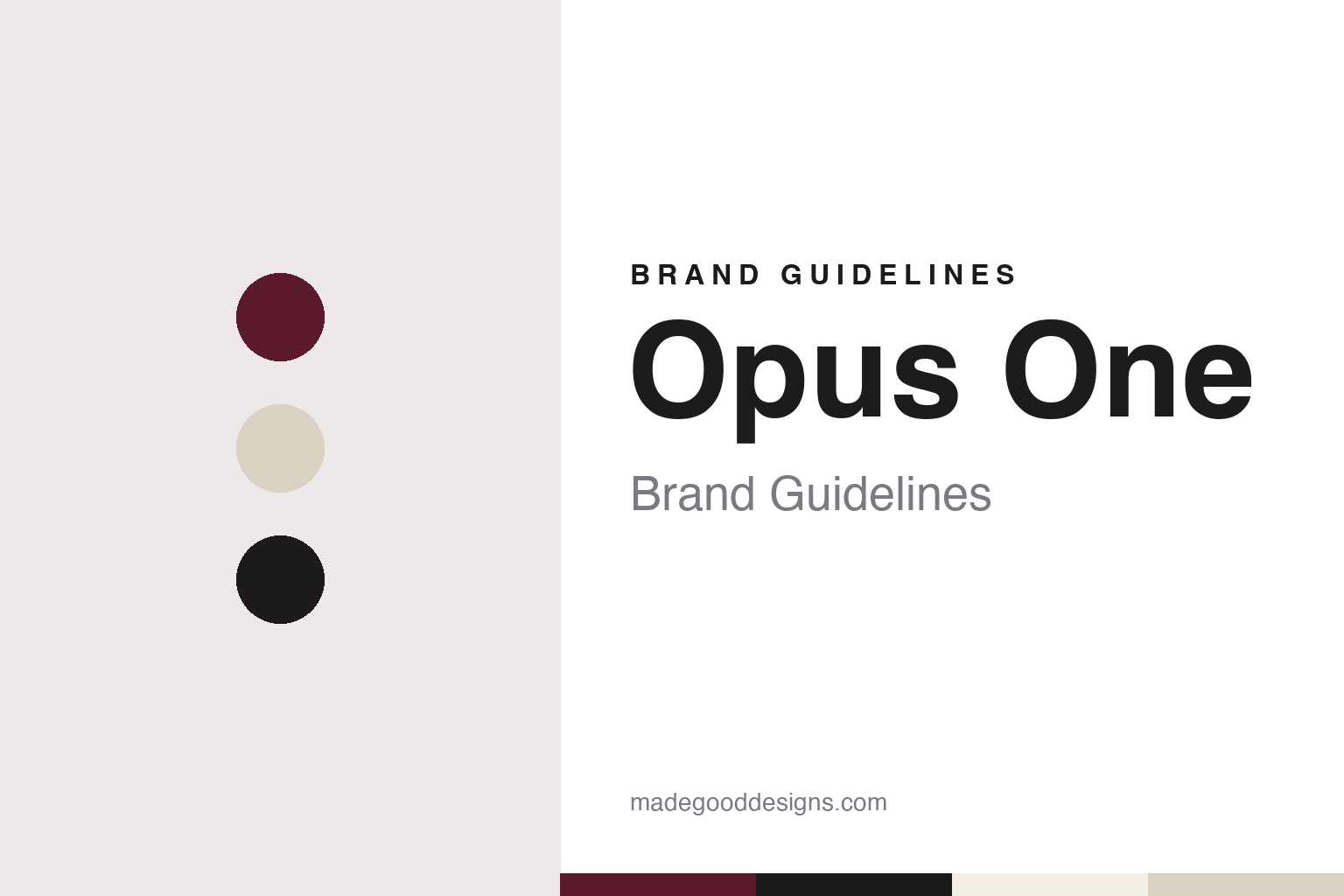
Opus One Brand Guidelines
A Bordeaux-style Napa blend from two founding families, first vintage 1979.
Aa
Two constants: a claret, limestone and cellar black palette and a classical old-style serif register. Abstract homage — not an Opus One product or mark; no label, logo or bottle is reproduced.
Two founders, one wine
A Pauillac house and a Napa winery set out to make a single wine together.
Opus One is a winery in Oakville, in California’s Napa Valley, founded as a joint venture between Baron Philippe de Rothschild of Château Mouton Rothschild and Robert Mondavi of the Robert Mondavi Winery. Its purpose was a single Bordeaux-style blend built on Napa Valley Cabernet Sauvignon. English Wikipedia, citing a milestones page once published by the Robert Mondavi Winery, says the two men first met in 1970 at the Mauna Kea Beach Hotel in Hawaii. The winery’s own account places the decisive moment in 1978, when the founders met at Château Mouton Rothschild and, the company says, settled their plan in a single hour: one wine, made by French and American winemakers working side by side from Napa Valley grapes.
The partnership was announced in 1980, English Wikipedia says, citing the winery’s archived history and the reference book Opus Vino (DK, 2010), which adds that plans had been developing between the two men since the early 1970s. The first vintage was made in 1979, with grapes from Mondavi’s To Kalon vineyard in Oakville, and in 1980 Mondavi sold the venture 35 acres of that vineyard, according to Opus Vino as cited by English Wikipedia. A company history of Baron Philippe de Rothschild SA in the International Directory of Company Histories also dates the joint venture to 1979, the year the winery itself gives on its page about the baron.
The name took a few years to settle. English Wikipedia says the wine was called napamedoc until 1982, when it became Opus One. The winery explains the choice through music: an opus is a masterpiece, and “Opus One” marks a composer’s first work, which the company presents as a tribute to the partnership’s first great work. The 1979 vintage reached the market in 1984, released together with the 1980, English Wikipedia says. Since 1993 the estate has also made a second wine, Overture.
Colour
A limestone winery, a silhouette and a collection of art.
The early vintages came before the estate had a winery of its own. The New York Times reported in July 1989, in a story cited by English Wikipedia, that Opus One was to get its own winery, and the company says Baroness Philippine de Rothschild, the baron’s daughter, and Robert Mondavi broke ground in 1989. The building opened in October 1991, in time for harvest, and the company says the estate made its first wine within its own walls that year. It stands across State Route 29 from the Robert Mondavi Winery, English Wikipedia notes.
The architecture was meant to depart from the valley’s habit. The company says Napa wineries had long been large, barn-like buildings, with the Mondavi winery’s mission-style arch and tower as the great exception, and that Opus One chose something different. The winery was designed by the architecture firm Johnson Fain, whose architect Scott Johnson appears in the company’s groundbreaking photographs. The company describes a building that blends into the landscape from outside while drawing on limestone, arcades, peristyles and the towers of the classic châteaux of the Médoc.
Art runs through the brand as it does at Mouton. The winery notes that Baron Philippe began commissioning artists to design each vintage label at Mouton in 1945, and says that the baron and his daughter, with Robert and Margrit Mondavi, shared a belief that art is inseparable from life. An art collection is part of the Oakville estate, including An Aggregation, a hanging sculpture by the Korean artist Seon-Ghi Bahk commissioned for the foyer. The mark itself is protected: the winery’s published tasting notes state that the names Opus One and Opus and a silhouette design are registered trademarks of Opus One.
The making of the wine is described in equally exact terms. The company says its estate vineyards are four parcels in the western part of the Oakville appellation, two of them within To Kalon alongside the Ballestra and River parcels around the winery, and that each vintage spends 18 months in new French oak barrels and a further 15 months in bottle before release on 1 October. The winery says it was the first to hold both Napa Green Winery and Napa Green Vineyard certification.
Typography
Design and documentation.
The seven brands in this group are all Napa and California wineries: Opus One, Silver Oak, Ridge Vineyards, Shafer, Screaming Eagle, Joseph Phelps and Heitz Cellar. Wineries in general sit at many different points in the trade, from family estates that still carry a founder’s name to labels that now belong to much larger owners, and a single wine can be sold everywhere from a winery’s own tasting room to a restaurant list.
A winery’s identity is usually carried less by a single bottle than by a label, a name and the place it promises, because the company behind the name may have changed hands, bought or sold vineyards or grown far beyond the place where it started. That makes the questions behind each name worth asking plainly: who started it, who owns it now, and where its grapes are grown and its wine is made.
Each guide separates what independent sources record from what the company says about itself — its founding story, its owners over time, its vineyards and how its labels have changed — and marks plainly what rests only on the company’s own word.
Aa
A classical old-style serif for a wine with Médoc manners. (Specimen set in Cormorant Garamond, a serif STAND-IN; NOT the Opus One logo.)
Opus One
Two owners, one estate, run on its own terms.
The ownership changed shape when the Mondavi company was sold. Constellation Brands bought the Robert Mondavi Corporation in 2004, and in September 2005 Wine Spectator reported that Constellation and Baroness Philippine de Rothschild would continue to own Opus One jointly, with the winery operating more independently of the Robert Mondavi Winery so as to strengthen its own identity. English Wikipedia, citing Opus Vino, says the Rothschild side negotiated control of marketing, vineyard management and administration. The same Wine Spectator report noted management changes: Michael Silacci, formerly of Stag’s Leap Wine Cellars, became winemaker in 2001, and David Pearson became chief executive in 2004. English Wikipedia lists the parent companies as Baron Philippe de Rothschild SA and Constellation Brands, and the winery today calls itself a union of two families.
The model travelled. The International Directory of Company Histories notes that the success of Opus One led Baron Philippe de Rothschild SA to a second joint venture, Almaviva, with the Chilean producer Concha y Toro, again pairing French expertise with local grapes.
For a design guide, Opus One shows how a wine brand can be built on a partnership rather than a place name: a musical title, a silhouette design held as a trademark, and a limestone winery that borrows the language of the Médoc for a Napa Valley floor. Compare Robert Mondavi, the Oakville neighbour across the road, and Château Mouton Rothschild, the Pauillac estate with an artist on every label. For this guide we use claret, limestone and cellar black with a serif, an unofficial interpretation; no product or logo is reproduced.
Explore & save
Keep Opus One’s identity on hand — save it to a board in the Made Good inspiration library.
Opus One identity set
Pin the Opus One claret, limestone and cellar black palette and the classical old-style serif register to your own board.