Golan Heights Winery Brand Guidelines
The Katzrin winery behind Yarden, founded 1983.
Aa
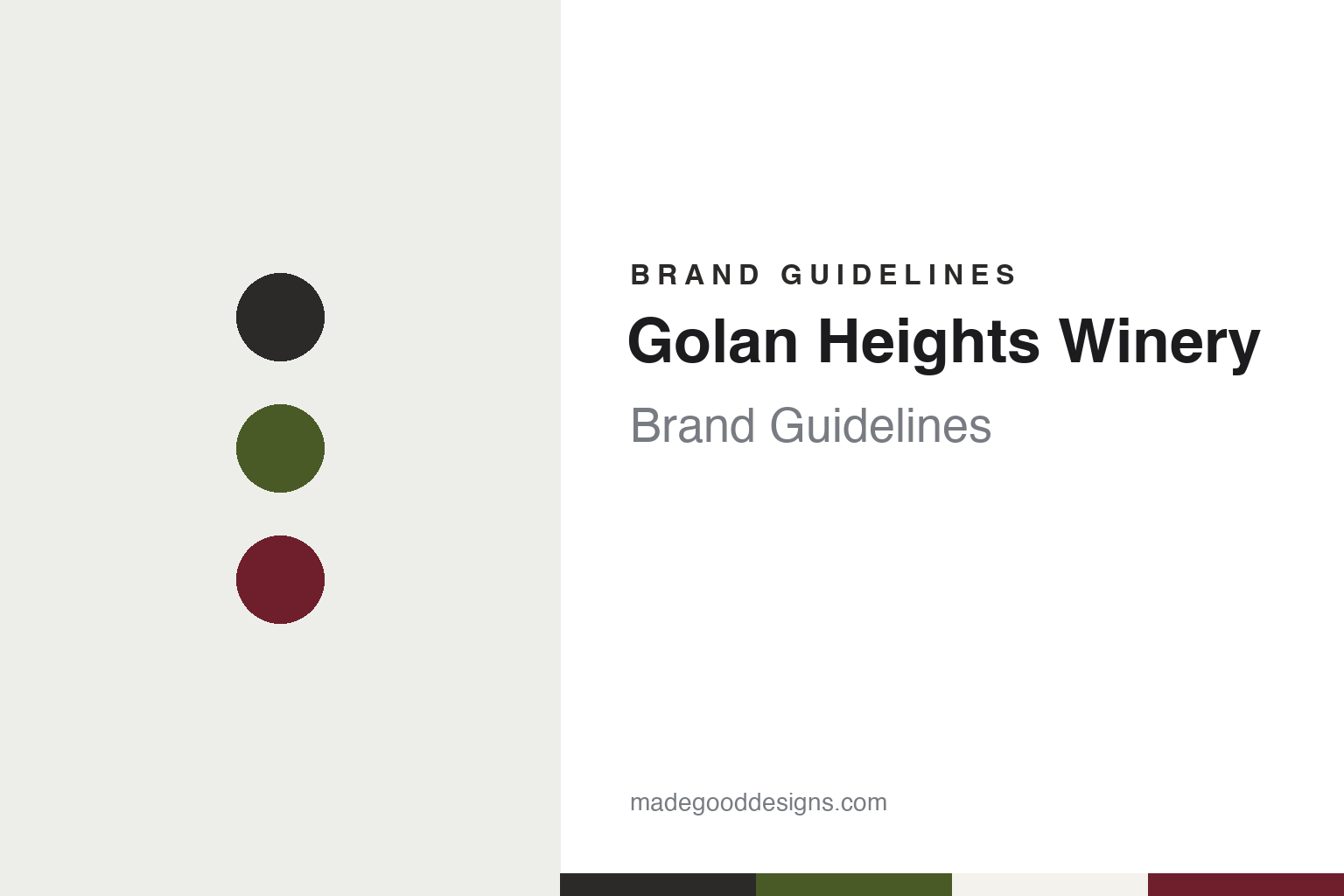
Two constants: a basalt, vine olive and red wine palette and a classical serif register. Abstract homage — not a Golan Heights Winery product or mark; no label, logo or bottle is reproduced.
Eight villages and a vineyard
From trial plantings in the 1970s to a winery in Katzrin.
The Golan Heights Winery stands in Katzrin, a town on the Golan Heights, a territory whose status is internationally disputed. Its own site says it was the first winery established on the Golan Heights, founded in 1983 by eight kibbutzim and moshavim — collective and cooperative farming villages. The company names them as Ortal, Allone Habashan, El Rom, Geshur, Yonatan, Ein Zivan, Ramat Magshimim and Ramot Naftali, the last of them in the Galilee, and Hebrew Wikipedia lists the same eight. English Wikipedia describes the winery as jointly owned by these communities, which also supply its grapes.
The vineyards came before the winery. English Wikipedia and the winery’s American importer, Skurnik, date the first plantings to 1976; Hebrew Wikipedia places those first vines at Geshur and Yonatan and the first harvest in the summer of 1980. When the winery opened in 1983 it worked from a temporary home, which the company calls Golan Fruit, a packing house; Hebrew Wikipedia says it moved to its present site in Katzrin in 1986 and that early help came from an American consultant, Peter Stern.
The company says its first wine to be released was a Yarden Sauvignon Blanc from the 1983 vintage, and the Algemeiner reported in 2012 that the first vintage reached the market in 1984. A Riesling followed in 1987 and a Chardonnay in 1988, the company says, and Hebrew Wikipedia adds that a traditional-method sparkling wine was first made in 1991. The man most associated with the wines is Victor Schoenfeld, a Napa Valley native, according to English Wikipedia, who trained at the University of California, Davis. Hebrew Wikipedia gives 1990 as the year he became chief winemaker, while Skurnik gives 1992; the winery today lists him as director of winemaking and says he has been there for more than three decades.
Colour
A river name, an oil lamp and three tiers.
The winery’s best-known name is not its own. Yarden, its flagship series, is the Hebrew name for the Jordan River, which, as Skurnik explains, runs between the Golan Heights and the Galilee. Skurnik also describes the Yarden label as carrying an ancient oil lamp decorated with mosaic tile.
Around the flagship sit other series with place names. The joint release that announced the winery’s new chief executive in October 2025 listed its labels as Yarden, Gilgal and Mount Hermon, and Skurnik describes Yarden as the premier label among those three. English Wikipedia and the company’s own site also name the Gamla and Golan series, while the current site lists a single Gamla Syrah. Hebrew Wikipedia lists a Hermon range among the brands as well, and a Mount Hermon wine appears on the company site today.
Much of the winery’s presentation leans on the vineyards. The company site sets out its plots one by one with the year each was planted, from Yonatan in 1978 and Allone Habashan in 1986 to Odem in 1989, Tel Phares in 1996 and Bar’on in 2009. Skurnik says the winery farms more than 600 hectares across 28 vineyards, divided into about 500 blocks that are picked and fermented separately, at heights from about 400 metres to nearly 1,200 metres on volcanic soils. English Wikipedia, citing figures from 2008, put production at about six million bottles a year, with about 30 percent exported.
The winery’s visitor centre includes a wine cellar where, the company says, visitors can see how its label designs have changed over the years.
Typography
Design and documentation.
The seven brands in this group are Armenian brandy houses and Georgian, Lebanese and Israeli wineries: Ararat, Noy, Tbilvino, Teliani Valley, Château Musar, Ixsir and Golan Heights Winery. Brandy and wine brands in general sit at many different points in the trade, from family houses that still carry a founder’s name to labels that now belong to much larger drinks groups, and a single brand can be sold everywhere from a corner shop to a restaurant list.
A brandy or wine brand’s identity is usually carried less by a single bottle than by a label, a name and the place it promises, because the company behind the name may have changed hands, moved its production or grown far beyond the place where it started. That makes the questions behind each name worth asking plainly: who started it, who owns it now, and where its brandy or wine is actually made and bottled.
Each guide separates what independent sources record from what the company says about itself — its founding story, its owners over time, where its brandy or wine is made and how its labels have changed — and marks plainly what rests only on the company’s own word.
Aa
A classical serif for a wine label with an antique emblem. (Specimen set in Cormorant Garamond, a serif STAND-IN; NOT the Golan Heights Winery or Yarden logo.)
Golan Heights Winery
A second winery, an award and a change at the top.
The company reached beyond the Golan Heights with a second winery. Galil Mountain Winery was established in 2000 as a joint venture with Kibbutz Yiron, according to the October 2025 release; Hebrew Wikipedia gives the year as 2001. English Wikipedia describes the Golan Heights Winery as Galil Mountain’s parent company, and since October 2025 the two wineries have shared a chief executive.
Outside recognition came from the trade press. The Algemeiner reported on 14 November 2012 that Wine Enthusiast had named the Golan Heights Winery its New World Winery of the Year in the magazine’s 2012 Wine Star Awards, crediting its use of equipment such as vineyard weather stations and soil scanning. The same report described it as Israel’s third-largest winery and quoted its chief executive at the time, Anat Levi.
Leadership changed again in 2025. A joint release from Katzrin announced that Yoram Avigad had become chief executive of both the Golan Heights Winery and Galil Mountain Winery with effect from 1 October 2025. The release said he had previously worked at Unilever and had most recently led Negev Produce as chief executive, and it described the Golan Heights Winery as a leader in Israel’s quality wine movement.
The name needs a little care online. The company’s site is golanwines.co.il, which also uses the name Ramat Hagolan Winery; “Golan” on its own is also one of the winery’s series names, and Yarden is easily confused with the river it is named after.
For a design guide, the Golan Heights Winery shows how a cooperative of farming villages built a wine brand on place names — a river, a mountain, a set of vineyards planted year by year — with an ancient lamp as its emblem. Compare Château Musar and Ixsir, two Lebanese wineries in this group. For this guide we use basalt, vine olive and red wine with a serif, an unofficial interpretation; no product or logo is reproduced.
Explore & save
Keep Golan Heights Winery’s identity on hand — save it to a board in the Made Good inspiration library.
Golan Heights Winery identity set
Pin the Golan Heights Winery basalt, vine olive and red wine palette and the classical serif register to your own board.