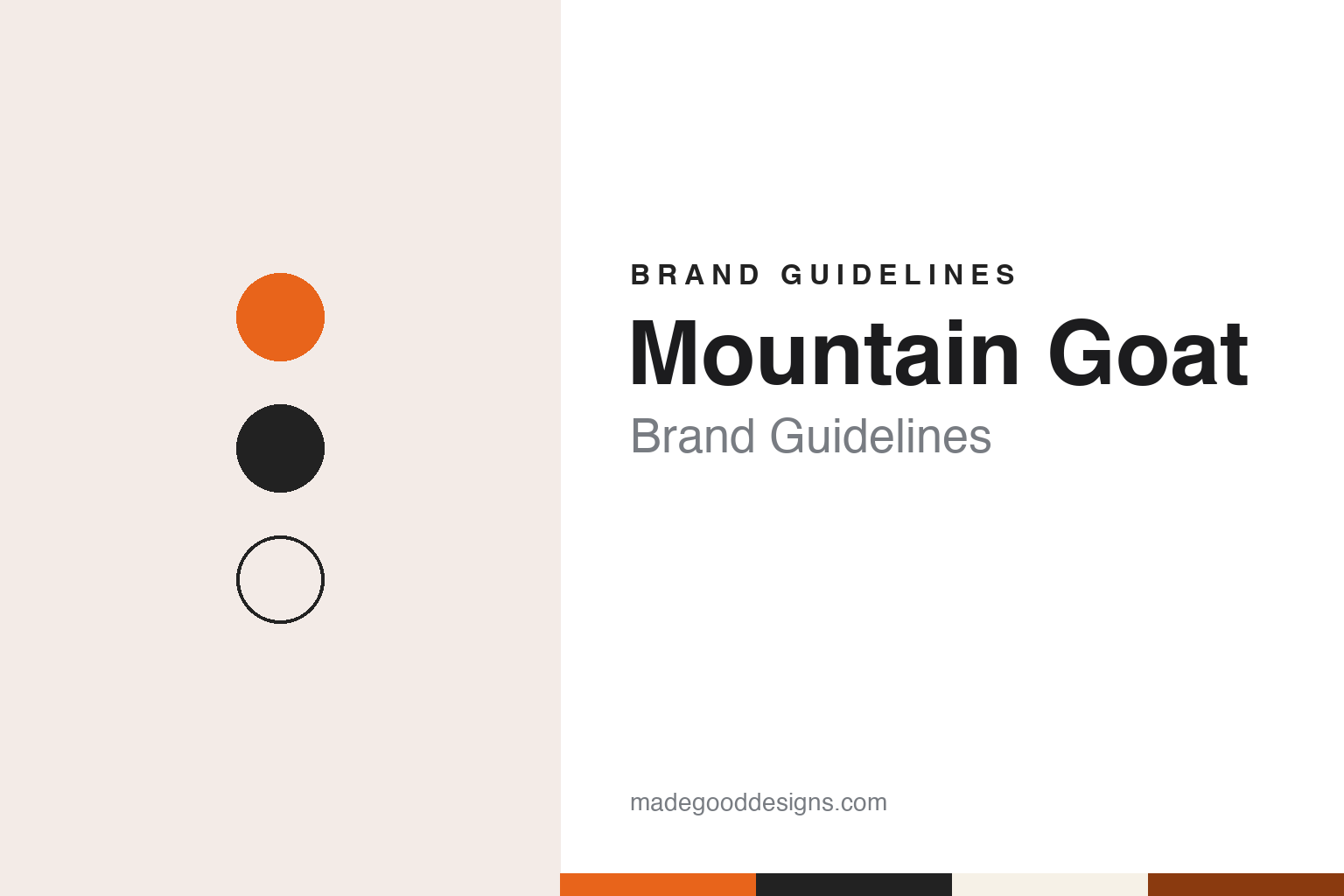
Mountain Goat Brand Guidelines
A Richmond craft brewery from 1997, Asahi-owned since 2015.
Aa
Two constants: a goat orange, rust and charcoal palette and a sturdy slab serif register. Abstract homage — not a Mountain Goat product or mark; no label, logo, can or tap decal is reproduced.
Two home-brewers in Richmond
From a backyard in Elsternwick to a warehouse brewery in Richmond.
Mountain Goat is a craft brewery in Richmond, an inner suburb of Melbourne, founded in 1997 by two friends, Cam Hines and Dave Bonighton. English Wikipedia, citing a 2002 ABC Inside Business report, says Bonighton was brewing at home in his backyard in Elsternwick in the early 1990s, while Hines had been taken with the small-batch beer he drank while travelling in North America, in Vancouver in particular. The pair could not get a bank loan, the same article says, and friends and family helped them start the company. Broadsheet reported in October 2015 that they put up three surfboards, two mountain bikes and an old EH Holden as collateral.
The name came from the animal itself: English Wikipedia quotes the founders describing the mountain goat as a big hairy animal that is never going to fall over. Three test beers were poured at a Melbourne gallery in September 1996, and the first commercial release, Hightail Ale, followed in October 1997. Before the company had a brewery of its own, English Wikipedia says, its early beers were made on spare capacity at a brewpub in Geelong and a microbrewery in Mirboo North in Gippsland.
The brewery found its first home in Crown Street, Richmond, in 1999, using equipment from a closed Hawthorn brewery, and moved at the end of 2004 to a larger converted warehouse in North Street, Richmond, which remains its base. A media release circulated by the company in October 2020 and published by Brews News gave the same history: the North Street brewery has operated since 2004, after relocating from nearby Crown Street. English Wikipedia adds that a new 25-hectolitre brewhouse from the Canadian maker DME was installed there in October 2011, and that exports to the United States began the same year.
Colour
An orange goat, a can for summer and a bigger tap decal.
Mountain Goat’s core beers are ales. Hightail Ale, the first release, was joined in July 2009 by Steam Ale, which English Wikipedia describes as a certified-organic beer in the California common style. The brewery also uses a short name for itself: in its own media releases the company calls itself simply “Goat,” and its website carries the line “Always Up To Something.”
The brewery came early to cans. The Shout reported on 11 September 2013 that Mountain Goat had brewed a new Summer Ale, a 4.7 per cent wheat-based ale with Australian and New Zealand hops, for 375 mL cans; co-founder Cam Hines told Beer & Brewer that watching the spread of cans among American craft brewers had helped the team decide. The packaging trade title Can Tech reported the same week that the cans would be unveiled on 13 September 2013. In April 2014 The Shout reported a second can, Fancy Pants, a stronger version of Hightail first sold in the brewery’s “Rare Breed” 640 mL bottle format, and said Summer Ale would return as a permanent line that September.
The bar tap has been a design surface too. The Victorian label printer Durolenz says that in 2016, when tap-top decals were typically 73 or 82 mm discs, it produced for Mountain Goat a larger, envelope-shaped decal measuring 90 by 150 mm, and it describes the brewery as wanting a way to stand out at the bar. The brewery’s current website was built by the agency Thirst Creative, according to the site’s own credit line.
Typography
Design and documentation.
The seven brands in this group are all Australian craft breweries: Little Creatures, Stone & Wood, 4 Pines, Balter, Pirate Life, Young Henrys and Mountain Goat. All seven began as independent breweries, and six of them have since been bought into one of two large brewing groups: Lion, a subsidiary of Japan’s Kirin, and Carlton & United Breweries, which Asahi bought from AB InBev in a purchase completed on 1 June 2020, BeverageDaily reported.
The sales came over more than a decade. Lion bought Little World Beverages, the Fremantle company behind Little Creatures, in 2012, according to English Wikipedia. Asahi bought Melbourne’s Mountain Goat in September 2015, The Shout reported. AB InBev bought Manly’s 4 Pines in 2017 through its venture arm ZX Ventures, and Adelaide’s Pirate Life the same year, English Wikipedia says; Carlton & United bought Balter of Currumbin in late 2019, Good Beer Hunting reported, and all three passed to Asahi with CUB in 2020. Lion announced on 9 September 2021 that it was buying Fermentum Group, the owner of Byron Bay’s Stone & Wood, Brauwelt reported. Newtown’s Young Henrys took a different route: when it announced a brewing partnership with Tribe in Goulburn in September 2019, Hospitality magazine reported that there would be no change of ownership and that the brewery remained independently owned by its founders, Oscar McMahon and Richard Adamson.
A craft brewery’s identity is usually carried by a name, a label, a can and a tap decal rather than by the building where the beer is made, and after a sale the beer may be brewed somewhere else entirely. Each guide separates what independent sources record from what the company says about itself — its founders, its owners over time, where its beer is brewed and how its packaging has changed — and marks plainly what rests only on the company’s own word.
Aa
A sturdy slab serif for a brewery that names itself after a sure-footed animal. (Specimen set in Zilla Slab, a slab-serif STAND-IN; NOT the Mountain Goat logo.)
Mountain Goat
An Asahi brewery that kept its Richmond address.
Mountain Goat has been owned by Asahi since September 2015. The Shout reported on 28 September 2015 that Asahi Holdings (Australia) had taken a 100 per cent ownership stake, quoting a statement in which the founders said they had been contract partners with Asahi for three years, that they were “sticking around,” and that Mountain Goat would continue as a stand-alone business with its brewers still brewing in Richmond. Broadsheet reported in October 2015 that Asahi had for those three years been brewing and packaging Mountain Goat’s most popular beers at its plant in Laverton, in Melbourne’s west, while the Richmond site was used for more limited releases. Asahi had bought The Cricketers Arms in April 2013, Broadsheet noted.
The owner’s own shape has changed since. Asahi completed its purchase of Carlton & United Breweries from AB InBev on 1 June 2020, BeverageDaily reported in August 2020, and said Asahi would fold its two alcohol businesses together under the CUB name; Mountain Goat was listed among the brands in the combined business, alongside Pirate Life, 4 Pines and Balter.
Four months later the brewery went interstate for the first time. Brews News, Drinks Adventures and The Shout reported in October 2020 that Mountain Goat Newtown had opened on 6 October in a former furniture warehouse on King Street in Sydney, with its own 12-hectolitre brewing system and a first local beer, Newtopia Pale Ale. General manager Mick Bentley said the brewery was turning 23 that month. The company’s website now lists two venues, Richmond and Newtown.
Online, the Melbourne brewery’s own site is goatbeer.com.au, a nod to the short name it uses for itself.
For a design guide, Mountain Goat shows how a sure-footed animal, a first ale named Hightail and a Richmond warehouse address can carry a craft brand through a sale to Asahi and on to a second city. Compare Pirate Life, the Adelaide brewery that also came to Asahi with CUB, and Young Henrys, the Newtown brewery a short walk from Goat’s Sydney pub. For this guide we use goat orange, rust and charcoal with a slab serif, an unofficial interpretation; no product or logo is reproduced.
Explore & save
Keep Mountain Goat’s identity on hand — save it to a board in the Made Good inspiration library.
Mountain Goat identity set
Pin the Mountain Goat goat orange, rust and charcoal palette and the sturdy slab serif register to your own board.


