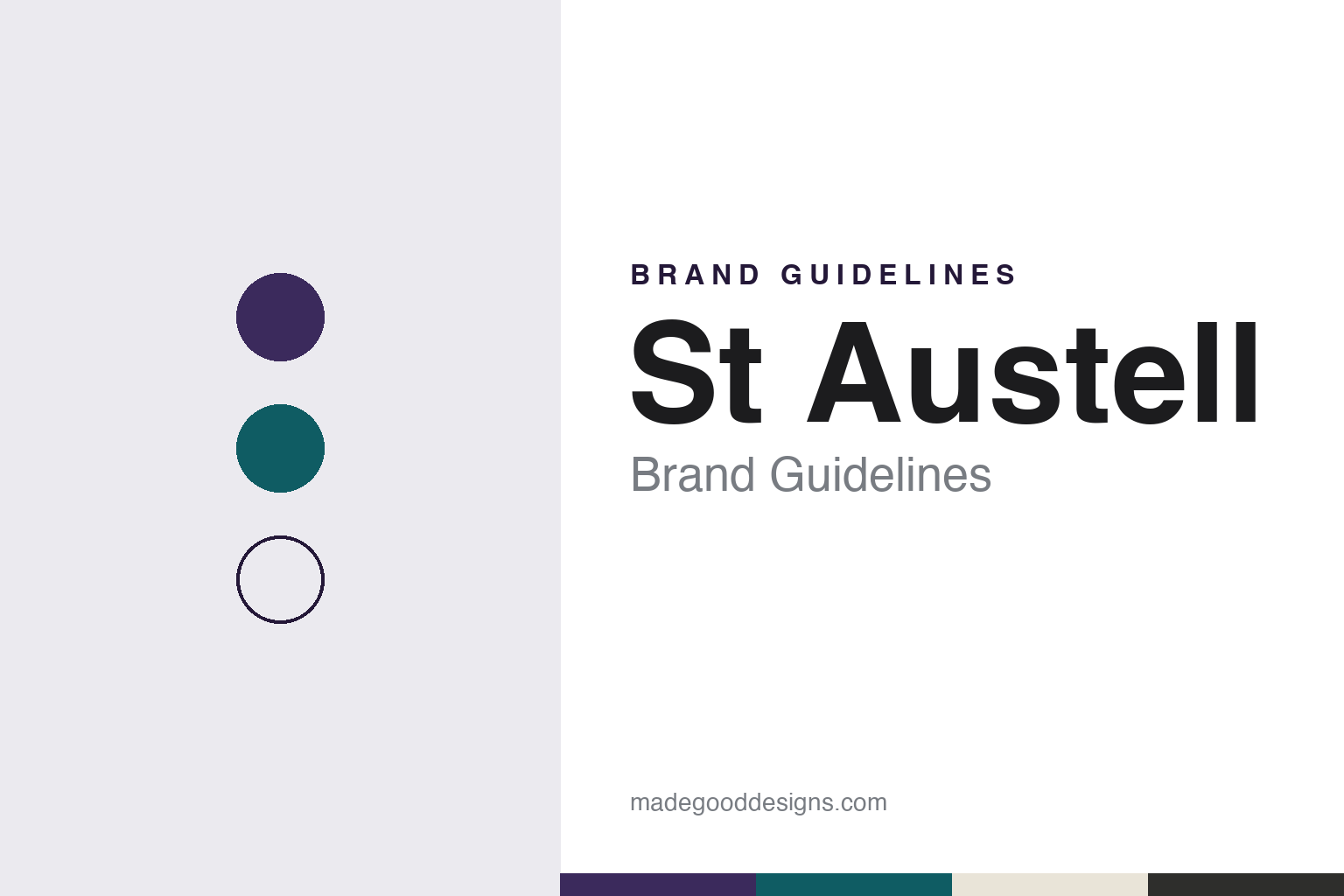
St Austell Brand Guidelines
The Cornish family brewery Walter Hicks founded in 1851.
Aa
Two constants: a purple, teal and granite palette and a bold grotesque sans register. Abstract homage — not a St Austell product or mark; no pump clip, label or logo is reproduced.
Walter Hicks & Co
A Cornish business that began with an inn.
St Austell Brewery traces itself to 1851, when Walter Hicks started the business in the town of St Austell, in Cornwall. English Wikipedia gives its first name as Walter Hicks & Co, brewers and wine merchants. The company says Hicks began brewing at the Seven Stars Inn in St Austell, and that the business later outgrew that first site.
The building at the centre of the company’s story came in 1893, when the brewhouse on Trevarthian Road was built. The company says beer is still made there, and that the brewhouse was designed around a gravity-fed system rather than pumps.
The next chapter belongs to Hicks’s daughter, Hester Parnall. English Wikipedia says she became a director in 1911 and took over running the company in 1916, and that she added nearly 80 pubs and hotels to its holdings; it was under her, it says, that the business was renamed St Austell Brewery. The company credits her with leading the brewery “through periods of expansion and change” and with helping to secure its independence for later generations.
The family link has continued. When James Staughton announced his retirement as chief executive in 2019, the Morning Advertiser described him as one of Walter Hicks’s great-great-grandsons and called St Austell a family-owned brewer. In 2026, the company’s 175th year, it published A History of St Austell Brewery, written by its archivist Paul Holden, and brewed heritage beers to mark the anniversary, the company says.
Colour
An eclipse beer, a purple livery and a sea-coloured lager.
St Austell’s best-known beer began as a one-off. Tribute was first brewed as Daylight Robbery for the solar eclipse of 1999, the company says. The name change came with a design project. In March 2001 Design Week reported that the London consultancy Design House had rebranded the “independent family brewery” and four of its cask ales for the brewery’s 150th anniversary: the identity was updated, Daylight Robbery became Tribute, Bosun’s Bitter was replaced by an IPA, and Tinners and HSD — short for Hicks Special Draught — kept their names but were given new identities.
Tribute’s look changed again in May 2013. The Morning Advertiser reported that the beer was being relaunched as a “Cornish pale ale” with a new purple livery, appearing first on pump clips and then across every format, to make it clearer to new drinkers what the beer was and where it came from. The same report said the beer used a specially grown Cornish malt.
A further round of packaging followed. The bottled range was redesigned in summer 2017, and in September 2018 the brewery introduced new pump clips for Tribute and Proper Job, its IPA, both by the creative agency CookChick, which had also led the bottle work, the trade body Cask Marque reported. The Proper Job clip set sculpted hop shapes along its edges against a bright green background, and Tribute was given what the report called a premium, three-dimensional look. “St Austell Brewery is fiercely proud of its heritage and Cornish roots, and our bold new pump clips embody this,” James Staughton, then chief executive, said at the time.
The brewery’s lager, korev, written in lower case, had its own relaunch in April 2021. Brewers Journal reported that the agency Thirst delivered a new colour scheme drawn from the sea and the brand’s coastal origins, with a new glass, font and tap handle, under the creative platform “The Coast is our Compass.” The company describes korev as a Helles-style lager brewed with Cornish-grown barley.
Typography
Family brewers and their pubs.
The seven brewers in this group are all English regional and family names: St Austell, Timothy Taylor, Marston’s, Wadworth, Hook Norton, Black Sheep and Harvey’s. Most of them are Victorian or older. John Marston set up in Burton upon Trent in 1834, English Wikipedia says; Hook Norton dates from 1849 in the Oxfordshire village of the same name; Walter Hicks founded what became St Austell Brewery in Cornwall in 1851; Timothy Taylor began brewing in Keighley in 1858 and moved to Knowle Spring in 1863, the company says; and Wadworth has brewed in Devizes since 1875. Harvey’s of Lewes dates itself to 1790. Black Sheep is the newcomer: English Wikipedia says Paul Theakston set it up in Masham in 1991, after his family’s brewery in the same town had been taken over.
Their ownership has gone in different directions. Several still describe themselves as family businesses: Timothy Taylor says the brewery remains in the Taylor family; Wadworth says it passed from Henry Wadworth to his founding partner John Smith Bartholomew and is now in the fifth generation of Bartholomew family ownership; Hook Norton’s managing director James Clarke is a fifth-generation descendant of the founder, John Harris, according to an interview with The Morning Advertiser that the brewery republishes; and Harvey’s says it has been in the custodianship of John Harvey’s descendants since 1790. St Austell says it was founded as a family-owned company, and on 1 July 2016 it bought Bath Ales, English Wikipedia says. Marston’s went the other way: in 2020 its brewing business joined Carlsberg’s UK arm in the Carlsberg Marston’s Brewing Company, Carlsberg bought out Marston’s remaining stake in July 2024, and since January 2025 the breweries have been part of Carlsberg Britvic, according to English Wikipedia. Black Sheep entered administration in May 2023 and was bought by the London investment firm Breal Capital, The Caterer reported on 31 May 2023; in January 2026 its owner, Keystone Brewing Group, was sold in a pre-pack deal to the newly formed Great British Drinks Company, The Caterer reported on 22 January 2026.
A brewer’s identity is usually carried less by a single bottle than by a pump clip, a name and the town it promises, because the company behind the name may have changed hands or changed how and where it brews. Each guide separates what independent sources record from what the brewery says about itself — its founding story, its owners over time, where its beer is brewed and how its pump clips and labels have changed — and marks plainly what rests only on the company’s own word.
Aa
A bold grotesque sans for a coastal brewery. (Specimen set in Archivo, a sans STAND-IN; NOT the St Austell logo.)
St Austell
From Cornwall to Bath, and still family-run.
St Austell has grown beyond Cornwall by buying another brewer. On 1 July 2016 it acquired Bath Ales, including its brewery, all of its beer brands and its 11 pubs, the Morning Advertiser reported, quoting the Bath Ales founder Roger Jones. English Wikipedia says Bath Ales was set up in 1995 by former employees of Smiles Brewery in Bristol and is based at Warmley, in South Gloucestershire, between Bath and Bristol, and that its labels feature a hare. St Austell says it opened a new production site for Bath Ales, the Hare Brewery, shortly after the two businesses came together, and that the company now runs breweries in both St Austell and Warmley.
Leadership has changed hands within a long-serving team. In April 2019 the Morning Advertiser reported that Kevin Georgel, then chief executive of the pub company Admiral Taverns and already a non-executive director at St Austell, would succeed James Staughton as chief executive in January 2020, with Staughton becoming honorary president. The company describes itself today as one of the South West’s leading independent, family-run brewing, hospitality and wholesale businesses.
The trade-press record of those projects names three outside agencies across two decades — Design House in 2001, CookChick in 2017 and 2018, and Thirst in 2021 — and sets the brewery’s main beers in distinct colours: Tribute in purple, Proper Job in green and korev in colours taken from the sea.
For a design guide, St Austell shows how a family brewery can let its beers wear their own colours while the founder’s initials survive in a name like HSD. Compare Adnams, another coastal family brewer, and Shepherd Neame. For this guide we use purple, Atlantic teal and granite with a sans, an unofficial interpretation; no product or logo is reproduced.
Explore & save
Keep St Austell’s identity on hand — save it to a board in the Made Good inspiration library.
St Austell identity set
Pin the St Austell purple, teal and granite palette and the bold grotesque sans register to your own board.