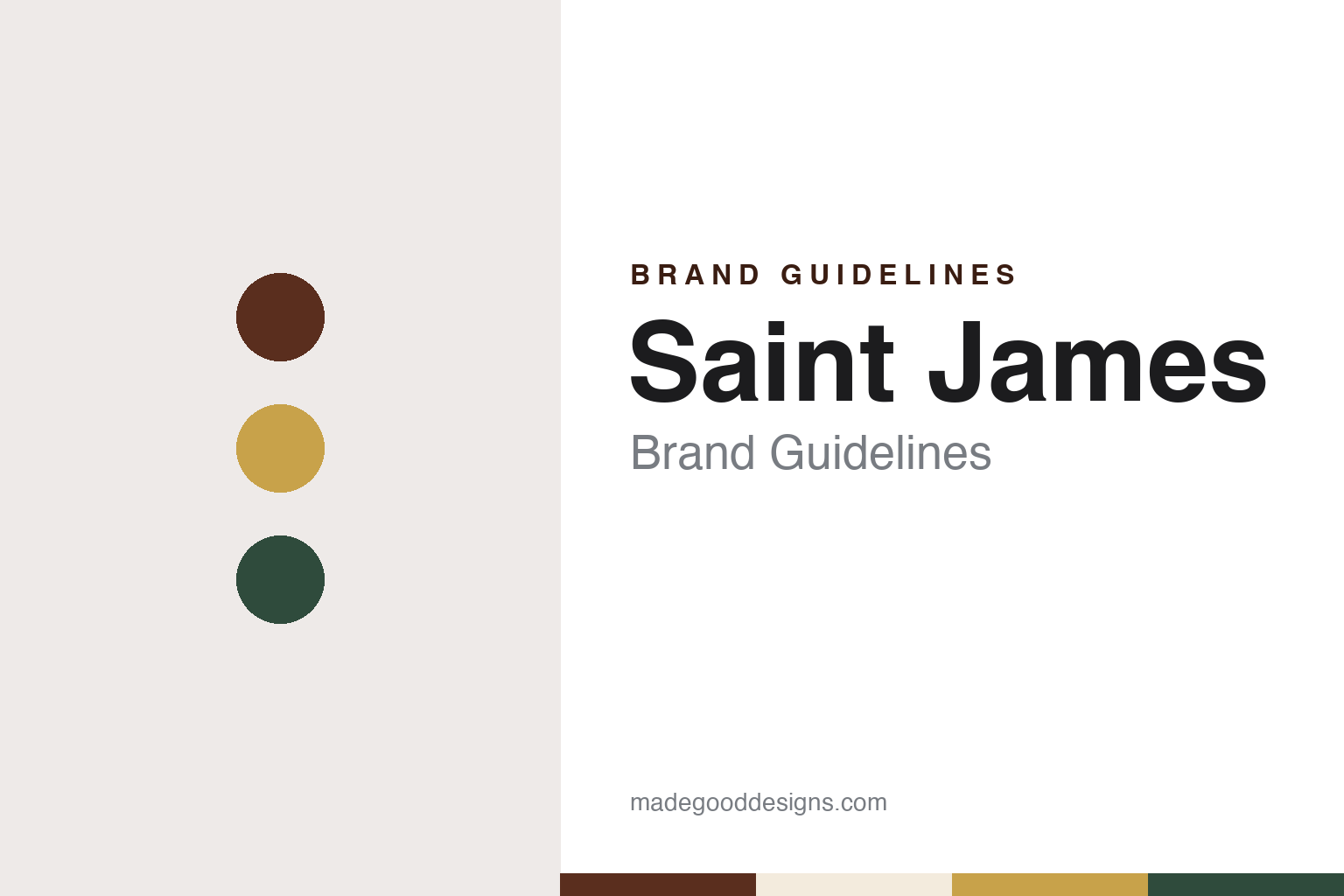
Saint James Brand Guidelines
The Martinique rhum that dates itself to 1765.
Aa
Two constants: a mahogany, vintage gold and cane green palette and a high-contrast display serif register. Abstract homage — not a Saint James product or mark; no label, logo or bottle is reproduced.
Trou Vaillant, Saint-Pierre and a name in English
A religious estate, a North American market and a Marseille merchant.
Saint James dates its rhum to 1765. The company says the first rhums were distilled that year on the Trou Vaillant estate near Saint-Pierre, at the initiative of Father Edmond Lefébure of the Frères de la Charité, and that they were shipped to North America. The name, the company explains, came from a neighbouring estate called Saint Jacques: for English-speaking buyers, Jacques became James. Rum Auctioneer, the specialist auction house, likewise says rum has been sold under the Saint James name since 1765.
The brand as a registered mark belongs to the nineteenth century. The company says the Marseille merchant Paulin Lambert acquired the Trou Vaillant estate among other properties and deposited the Saint James trademark on 21 August 1882. Rum Auctioneer also dates the French trademark to 1882, naming him François-Paulin Lambert, and says he bought the distillery in 1890. The company dates its first vintage rhum to 1885, and Rum Auctioneer records an 1885 Rhum Vieux distilled at the “Plantation des Saint-James,” fermented in open wooden vats before modern stainless-steel methods.
Lambert’s firm grew fast. The company says it opened sales branches in major European cities in 1895. Then, on 8 May 1902, the eruption of Mount Pelée destroyed Saint-Pierre; the company says the Saint James estate was only partly destroyed. The business spread across the island in the years that followed, with new sites at Saint-Joseph in 1911, Le Lamentin in 1912 and Case-Pilote in 1929, according to the company. Rum Auctioneer says the firm traded as Ernest Lambert & Co, under Paulin Lambert’s son, from 1905 until it was sold in 1955.
Colour
A square-based bottle, a giant banner and a cellar of vintages.
The visual identity was set at registration. The company says the 1882 trademark was filed with a square-based bottle and a label bearing a caiman, the two features it still presents as the brand’s heritage. Its history adds an early piece of outdoor promotion: in 1889, the company says, a banner 30 metres long and 4 metres high reading “Plantations Saint James” was put up on the hills above Saint-Pierre. Today the company’s website carries the line “Culture Rhum depuis 1765,” keeping the founding date at the front of the brand.
The rhum itself changed in the twentieth century. Rum Auctioneer notes that a Saint James Rhum Vieux from around the 1940s and early 1950s was made from a molasses wash, before the switch to agricole production, and The Spirits Business reported in April 2024 that the estate has made rum from pure sugar cane grown on its own plantations since 1975. Martinique’s rhum agricole gained the AOC Martinique appellation in 1996, the company and The Spirits Business both note.
Vintages are the brand’s long-running theme. The company says it opened the Maison de la Distillation in 2010, displaying historic distilling techniques alongside a cellar of vintages running from 1885 to the present, and that it marked 250 years in 2015 with limited anniversary editions. The Spirits Business reported in December 2023 on the final release in Les Éphémères, a short collection of cask-strength vintages begun a year earlier, and in April 2024 on an 18-year-old rum distilled in 2004 and aged in ex-bourbon American oak, selected by the cellar master Marc Sassier and joining the 7-, 12- and 15-year-old expressions. Visitors are part of the identity too: the company says its first distillery open day in 1980 grew into a rum festival, and that in 2019 it opened the restored Habitation La Salle, a late-seventeenth-century sugar estate in Sainte-Marie, reached from the distillery by a small plantation train.
Typography
Design and documentation.
The seven brands in this group are all Caribbean rum houses: Neisson, Saint James, Trois-Rivières, La Favorite and Depaz from Martinique, and Hampden Estate and Worthy Park from Jamaica. Rum houses in general sit at many different points in the trade, from estates still run by the families that named them to labels that now belong to much larger drinks groups, and a single name can cover a white rum, a long-aged bottling and rum sold in bulk to other bottlers.
The two islands also make rum under different rules. Rum labelled with the French appellation Rhum de la Martinique must be a rhum agricole, made from the fermented juice of the sugar cane rather than from molasses; the appellation was first recognised by a decree of 5 November 1996, and its current specification, published by France’s INAO, names continuous column distillation as the traditional method and sets a distilling season that runs from January to early September. Jamaica’s rum geographical indication, enacted in 2016, allows both pot and column stills, requires pot stills to be made of copper and limits fermentation and distillation to defined areas of the island, Cocktail Wonk reported in its 2018 account of the full text.
A rum brand’s identity is usually carried less by a single bottle than by a label, a name and the place it promises, because the company behind the name may have changed hands, moved its distilling or grown far beyond the estate where it started. Each guide separates what independent sources record from what the company says about itself — its founding story, its owners over time, where its rum is actually distilled and aged, and how its labels have changed — and marks plainly what rests only on the company’s own word.
Aa
A high-contrast display serif for a rhum that leads with its date. (Specimen set in Playfair Display, a serif STAND-IN; NOT the Saint James logo.)
Saint James
From the Lambert family to Cointreau, Rémy Cointreau and La Martiniquaise.
Saint James has changed hands many times. Rum Auctioneer’s ownership history runs from the Lambert firm to the Société d’Investissement des Caraïbes in 1955 and to the aperitif maker Picon in 1967. In 1973 the brand passed to Cointreau, the company and Rum Auctioneer agree. The company says Cointreau brought production together in a new distillery at Sainte-Marie, on the Atlantic side of northern Martinique; Rum Auctioneer dates the move from the Saint-Pierre and Le Lamentin distilleries to Sainte-Marie to 1974. From 1990 until 2003 the brand belonged to Rémy Cointreau, Rum Auctioneer says.
Since then the owner has been a French spirits group. The company says La Martiniquaise acquired Rhums Saint James on 14 July 2003, after Rémy Cointreau sold it, and Rum Auctioneer places the brand within COFEPP, La Martiniquaise’s parent. The Spirits Business describes the owner as La Martiniquaise-Bardinet, which also owns the Cutty Sark blended Scotch and the Glen Moray single malt distillery. The Spirits Business reports place the distillery’s ageing cellars at Sainte-Marie, where the rhum is still made.
A note for searchers: Saint James is also the name of many places and churches, so “Saint James rhum” or “rhum Saint James” is the clearer search.
For a design guide, Saint James shows how a date can become a brand asset: 1765 sits beside the name, and the square bottle and caiman of 1882 are kept as heritage while the range moves through vintages and age statements. Compare Cutty Sark, the Scotch blend in the same group, and Rhum Clément, another Martinique rhum agricole house. For this guide we use mahogany, vintage gold and cane green with a display serif, an unofficial interpretation; no product or logo is reproduced.
Explore & save
Keep Saint James’s identity on hand — save it to a board in the Made Good inspiration library.
Saint James identity set
Pin the Saint James mahogany, vintage gold and cane green palette and the high-contrast display serif register to your own board.


