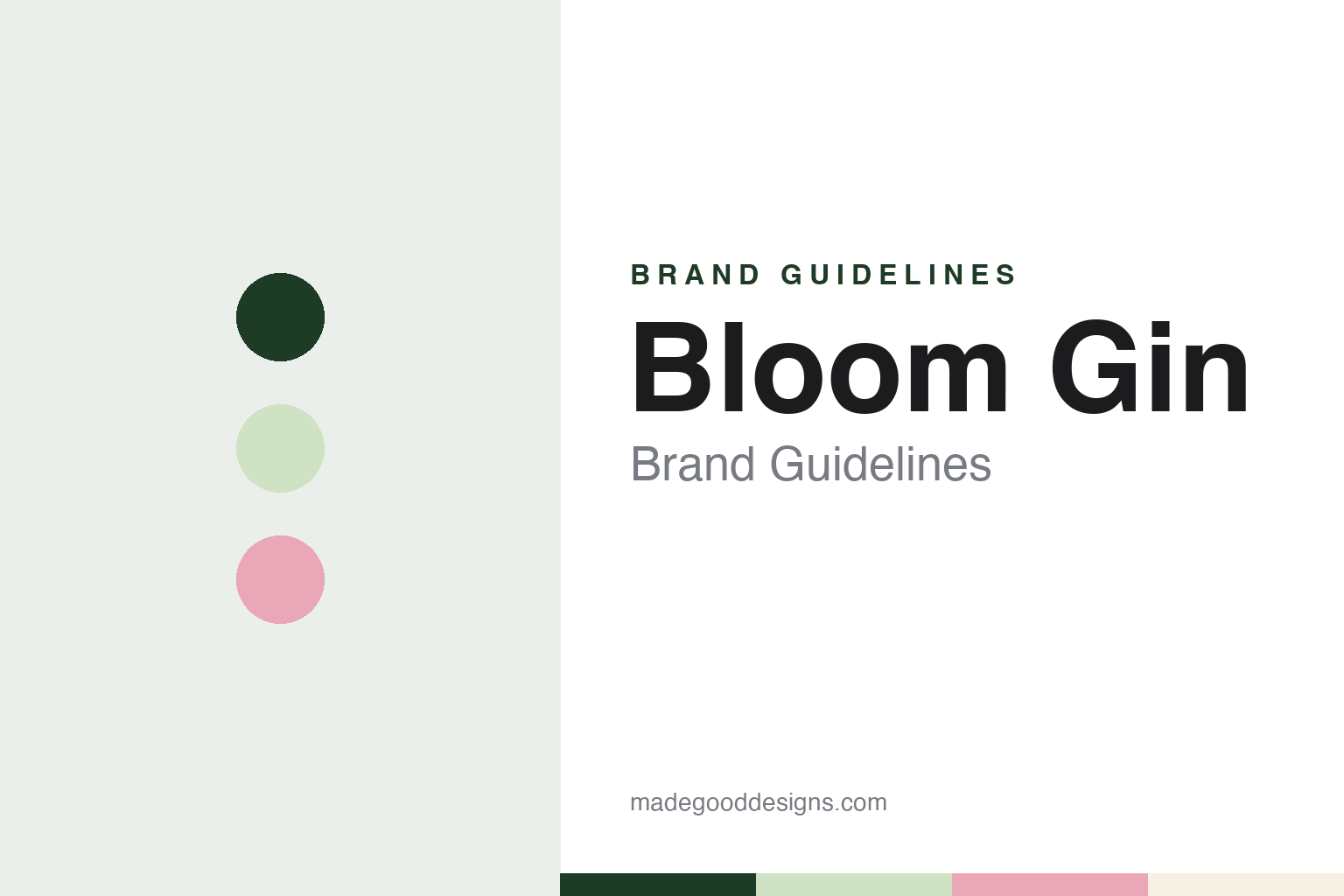
Bloom Gin Brand Guidelines
The floral London Dry gin from a walled-garden idea.
Aa
Two constants: a Bloom pale green and honeysuckle palette and a floral serif register. Abstract homage — not a Bloom product or mark; no bottle, logo or label is reproduced.
The secret garden
A biochemist’s light, floral gin.
Bloom is a London Dry Gin created by Joanne Moore, master distiller at G&J Distillers in Warrington, Cheshire. The Spirits Business reported in April 2014 that Moore, a biochemistry graduate, joined the company in 1996 and was appointed its first female master distiller in 2006. The Gin Guild describes her as the distillery’s seventh master distiller.
The distillery is older than the brand by two and a half centuries. English Wikipedia says Thomas Dakin built it on Bridge Street in Warrington in 1760 and made his first gin in 1761; the Dakin family ran it until 1860, when it was leased to Gilbert and John Greenall, whose name it carried as G&J Greenall. It moved to a larger neighbouring site in 1960 and, after a fire in 2005, to Birchwood in Warrington in 2008, Wikipedia says. The company’s present-day tagline is “Since 1761.”
Moore has explained the idea in her own words. She knew there was a gap for a light, floral gin, she told The Spirits Business, and imagined a secret garden with wild flower meadows and a wrought-iron gate; after testing camomile and many other flowers she settled on honeysuckle and pomelo, the “Chinese grapefruit.” The brand’s website ties the idea to her love of English walled gardens, which it says began when she read The Secret Garden as a child, and quotes her calling the gin “a very personal expression to me.” It names honeysuckle, red clover, chamomile stems and pomelo among the botanicals; the Gin Guild lists juniper, angelica root, coriander and cubeb among the rest, at 40% ABV.
Colour
Pale green glass and a garden gate.
Sources differ on the launch year. In June 2016 The Spirits Business and Glass Online both said the bottle’s coloured glass had been unchanged since the brand launched in 2008; some later accounts give 2009. The trade magazine Retail Packaging, in its July–August 2009 issue, reported that Allied Glass Containers was producing a proprietary bottle for G&J Greenall’s Bloom, describing an “ornate jewel cut” design with “flowering vines winding up its neck.”
The bottle’s details carry the story. Its embossing is inspired by the gate in Moore’s English country garden and includes the date 1761, when the distillery began, The Spirits Business reported. In 2016 the owner, Quintessential Brands, worked with the design agency Identica on new packaging: new front and back labels and images of the botanicals — honeysuckle, pomelo and chamomile — while the pale green glass and its embossing stayed the same. Packaging Insights reported in July 2016 that the update marked Moore’s ten years as master distiller. Kate Harrison, Quintessential’s international marketing manager for premium gins, described Bloom as “a light and floral gin marketed in a sophisticated and stylish way.” The new bottle reached UK supermarkets including Waitrose, Sainsbury’s, Tesco and Booths from mid-July 2016, and more than 25 markets from August.
Illustration has stayed part of the brand. In March 2022, ahead of International Women’s Day, Bloom issued limited-edition bottles of its original gin and its Passion Fruit & Vanilla Blossom gin with artwork by the illustrator Lainey Molnar, Asian Trader reported. Elaine Maher, Bloom’s brand director, said: “We’re an all-female team at Bloom Gin and it’s really important to us that we celebrate and support women.”
Typography
The English gin revival.
The seven brands in this group are all English gin names: Chase, Warner’s, Silent Pool, Bloom, Opihr, Portobello Road and Hayman’s. English gin brands sit at many different points in the trade, from family distillers and farm businesses that still carry a founder’s name to labels that now belong to much larger drinks groups, and a single gin can be sold everywhere from a supermarket shelf to a cocktail bar.
A gin brand’s identity is usually carried less by the spirit itself than by a bottle, a label and the place it names, because the company behind the name may have changed hands, moved its distillery or had its gin made under contract somewhere else. That makes the questions behind each name worth asking plainly: who started it, who owns it now, and where its gin is actually distilled and bottled.
Each guide separates what independent sources record from what the company says about itself — its founding story, its owners over time, where its gin is made and how its bottles and labels have changed — and marks plainly what rests only on the company’s own word.
Aa
A floral serif — the register of a garden gate and a botanical drawing. (Specimen set in Playfair Display, a serif STAND-IN; NOT the Bloom logo.)
Bloom Gin
A Quintessential Brands gin.
Bloom’s owner is the drinks group Quintessential Brands. English Wikipedia says the De Vere Group sold the Warrington distillery in a private-equity-backed management buyout in 2011. Quintessential Brands was launched in July 2013 by Enzo Visone, a former chief executive of the Campari Group, and the investment banker Warren Scott, and named G&J Greenall as its first acquisition, FoodIngredientsFirst reported on 3 July 2013. By 2016 the trade press was describing Quintessential as Bloom’s owner. In 2026 its website lists Bloom alongside Opihr, Greenall’s, Berkeley Square and Thomas Dakin gins, and its tagline “Since 1761.”
The range has grown from the original London Dry. The Gin Guild lists a Jasmine & Rose gin, the London Dry infused with Moroccan rose petals and East Asian jasmine flowers, also at 40%. In March 2020 Bloom added two Fruit and Floral Fusions — Passion Fruit & Vanilla Blossom, inspired by the Pornstar Martini, and Raspberry & Rose, inspired by the raspberry mojito — both at 40% and made without added sugar or sweeteners, FoodBev reported on 20 March 2020. A year later, in April 2021, FoodBev reported a ready-to-drink Bloom Passionfruit Soda for Sainsbury’s, which Maher, then global brand director, said was made by Moore.
For a design guide, Bloom shows how a gin can build its identity from one person’s image — a garden behind a wrought-iron gate — and keep the same glass through a redesign. Compare Opihr, another Joanne Moore gin from the same Warrington distillery, and Brockmans, an English gin built on berries rather than flowers. For this guide we use pale glass green, honeysuckle pink and a garden green with a serif, an unofficial interpretation; no product or logo is reproduced.
Explore & save
Keep Bloom Gin’s identity on hand — save it to a board in the Made Good inspiration library.
Bloom Gin identity set
Pin the Bloom pale green and honeysuckle palette and the floral serif register to your own board.


