Portobello Road Brand Guidelines
The Notting Hill gin born above a pub in 2011.
Aa
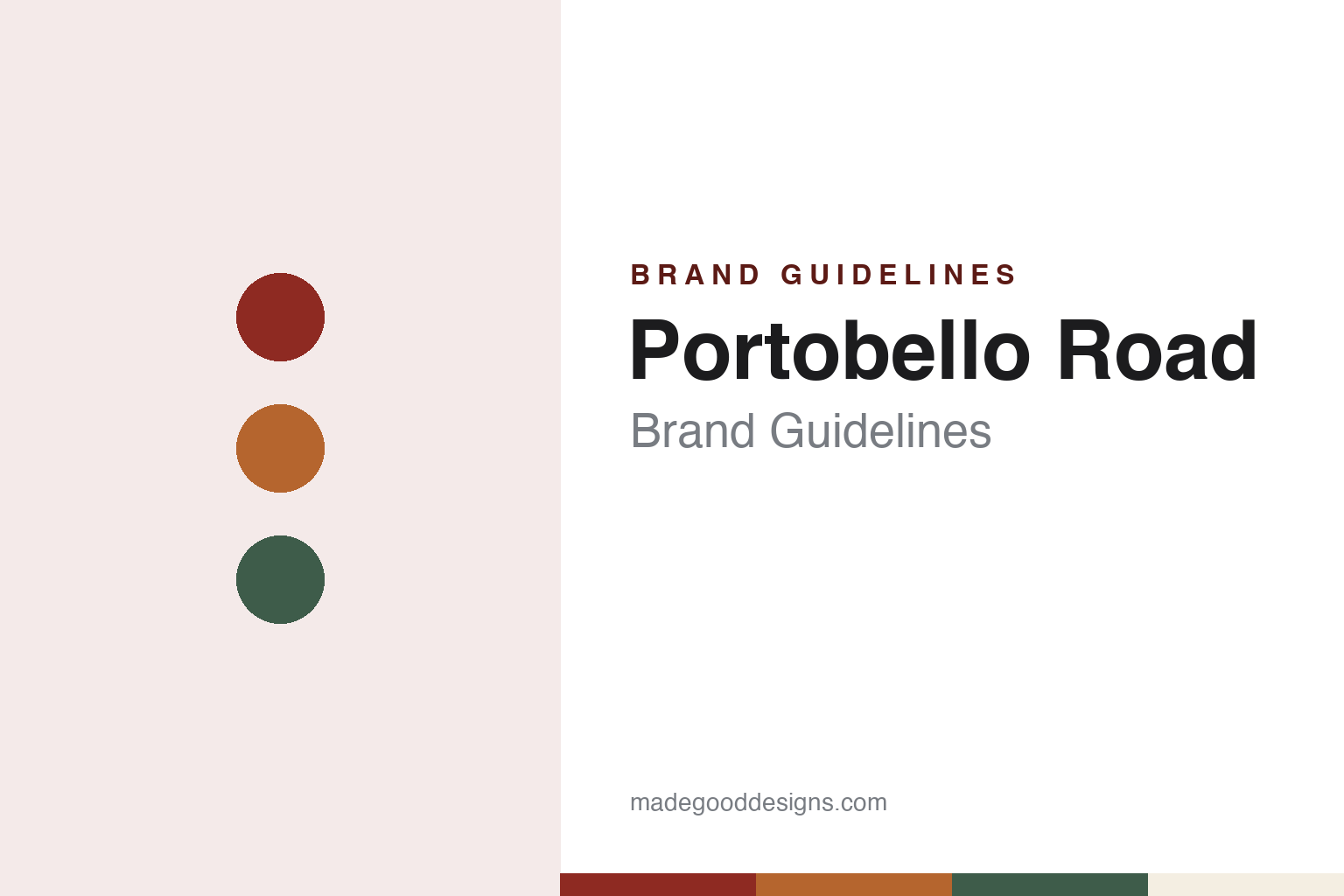
Two constants: a pub-front red, still copper and juniper green palette and a bookish transitional serif register. Abstract homage — not a Portobello Road product or mark; no label, logo or bottle is reproduced.
A gin museum above a pub
Three bar owners, a tiny still and a street name.
Portobello Road Gin was founded in 2011 above a nineteenth-century public house on London’s Portobello Road, The Spirits Business reported in April 2015. Its founders were three bar operators, Ged Feltham, Jake Burger and Paul Lane. In a 2016 interview with the trade title The Buyer, the brand said the three had run bars and restaurants in Leeds before opening their first London bar, The Portobello Star, at No. 171 on the street, in 2008.
The gin grew out of a museum. According to the brand’s account in The Buyer, the partners had collected gin artefacts and turned the flat above the Portobello Star into The Ginstitute, a small museum where visitors learn the history of gin and blend a recipe of their own. A gin that could call The Ginstitute home followed: Feltham and Burger spent nine months experimenting before Portobello Road No. 171, named after the pub’s address, was released in 2011. The company says it is a London dry gin bottled at 42 per cent, made with nine botanicals on a base spirit distilled from English-grown wheat.
Production moved quickly beyond the pub. The Spirits Business reported in May 2016 that the gin was first made in a tiny still at The Portobello Star, nicknamed Coppernicus, and then moved to Thames Distillers to increase capacity. The company, which places that distillery in south-west London, names the distiller there as Charles Maxwell, a former chairman of the Worshipful Company of Distillers whose family, it says, has distilled in London for generations.
Colour
An address as a brand, and a copa as a serve.
The brand’s central idea is its postcode. In April 2015 The Spirits Business reported a new marketing campaign under the line “Portobello Road Gin – the finest address in Gin,” built around the Portobello Road Copa, a gin and tonic served in a red-wine glass with garnishes. Feltham, then managing director, told the magazine that the provenance of the address mattered to drinkers abroad, particularly in the United States, where the gin was increasingly seen as a brand that communicated London’s drinking history.
Limited editions became its laboratory. The same report announced the Director’s Cut, made with botanicals foraged by the company’s directors and re-released as a different recipe each October; The Buyer reported in 2016 that the first, made with British asparagus, was created by Paul Lane. A second series, Local Heroes, pairs the distillers with people from the neighbourhood. The first was made with Brett Graham, chef and owner of The Ledbury restaurant, and in March 2019 The Spirits Business reported that Mark Knopfler of Dire Straits, a former Notting Hill local, had made Local Heroes No. 3 with Jake Burger, adding lime zest, cucumber peel and olive oil to the gin’s nine botanicals.
That release also gave the brand a documented piece of label design. According to The Spirits Business, each bottle of Local Heroes No. 3 carried a decorative label designed by Knopfler with the creative agency Analogue, inspired by his guitars. The distillery’s current shop continues the musical theme with a limited edition made with Brian May, named after his Red Special guitar.
Typography
Design and documentation.
The seven brands in this group are all English gin names: Chase, Warner’s, Silent Pool, Bloom, Opihr, Portobello Road and Hayman’s. English gin brands sit at many different points in the trade, from family distillers and farm businesses that still carry a founder’s name to labels that now belong to much larger drinks groups, and a single gin can be sold everywhere from a supermarket shelf to a cocktail bar.
A gin brand’s identity is usually carried less by the spirit itself than by a bottle, a label and the place it names, because the company behind the name may have changed hands, moved its distillery or had its gin made under contract somewhere else. That makes the questions behind each name worth asking plainly: who started it, who owns it now, and where its gin is actually distilled and bottled.
Each guide separates what independent sources record from what the company says about itself — its founding story, its owners over time, where its gin is made and how its bottles and labels have changed — and marks plainly what rests only on the company’s own word.
Aa
A bookish transitional serif for a gin that grew out of a museum. (Specimen set in Libre Baskerville, a serif STAND-IN; NOT the Portobello Road logo.)
Portobello Road
From a pub flat to a four-storey distillery.
In May 2016 The Spirits Business reported plans for a four-floor distillery on Portobello Road, with blending rooms, a Spanish-style gin and tonic bar and restaurant, shops and boutique guest rooms, and a new home for The Ginstitute. The Buyer quoted brand director Tom Coates the same year as saying the move would bring the gin’s production in house; Feltham was then also the founder of the restaurant group Leelex.
Ownership of the building followed. The Spirits Business reported on 13 September 2018 that the brand’s owner, Good Harbour Trading, had bought The Distillery at No. 186 Portobello Road from Leelex, in a deal completed two days earlier. The magazine described the building as the working production site of Portobello Road Gin and the home of The Ginstitute, a bottle shop, two bars, a private dining room and three guest rooms, and noted the launch earlier that year of a second core gin, a Navy Strength. In March 2018 the magazine had also reported Tonica By The Distillery, a bar at Exmouth Market with a small still in its basement, where master distiller Jake Burger made house spirits including a butter gin. In 2019 the magazine reported that Local Heroes No. 3 was distilled in a 400-litre copper still called King Henry.
The name needs a little care. Portobello is also a seaside district of Edinburgh; this gin belongs to Notting Hill, and the brand’s site is now portobelloroaddistillery.com.
For a design guide, Portobello Road shows how a street address, a pub museum and a run of collaborations can carry a London gin from one still above a bar to a distillery of its own. Compare Sipsmith, another London gin built around its own copper stills, and Tanqueray, the older London dry gin. For this guide we use pub-front red, still copper and juniper green with a serif, an unofficial interpretation; no product or logo is reproduced.
Explore & save
Keep Portobello Road’s identity on hand — save it to a board in the Made Good inspiration library.
Portobello Road identity set
Pin the Portobello Road pub-front red, still copper and juniper green palette and the bookish transitional serif register to your own board.