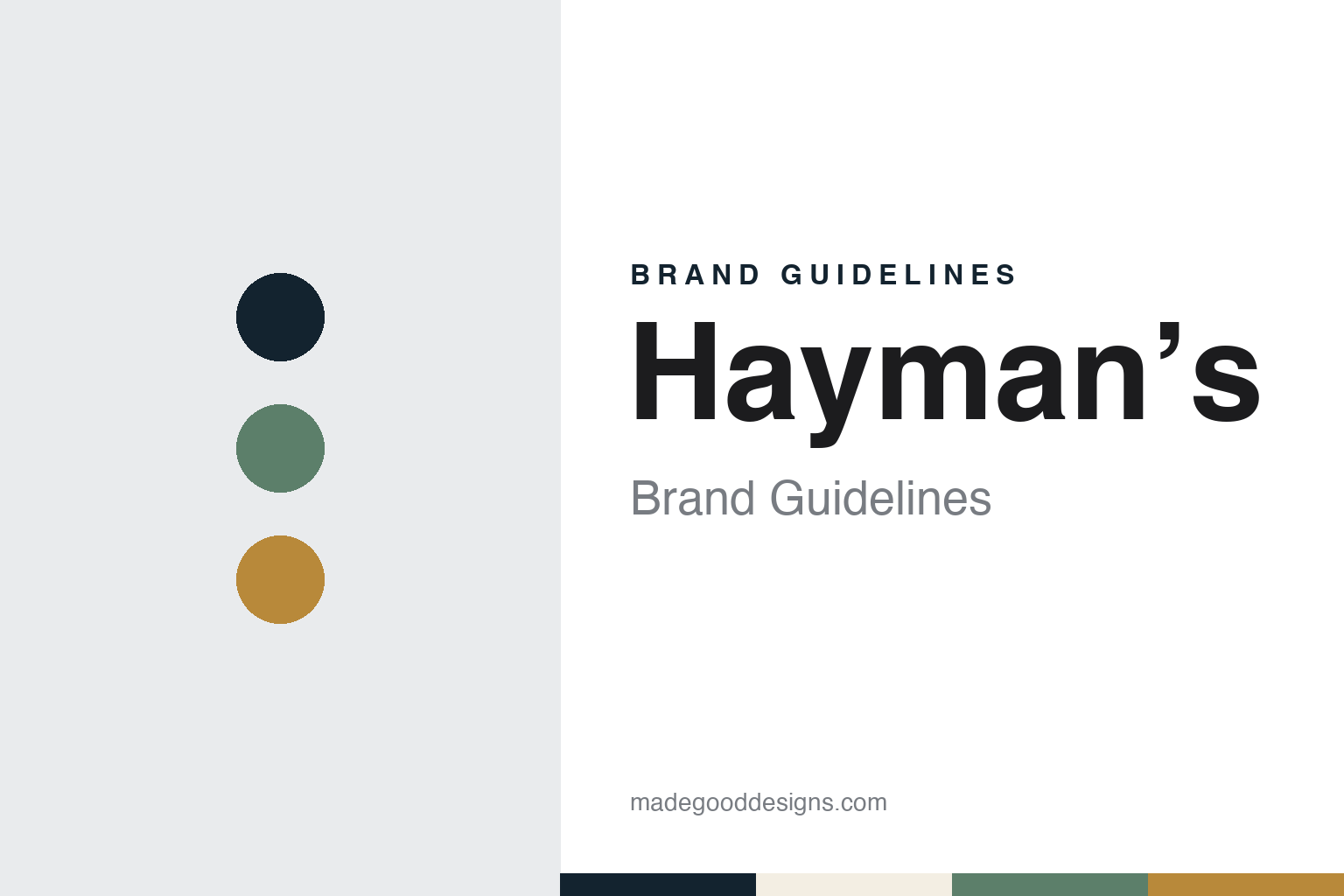
Hayman’s Brand Guidelines
A Victorian family recipe book, a Burrough great-grandson and a London distillery.
Aa
Two constants: a Chelsea navy, juniper green and lamp brass palette and a period English serif register. Abstract homage — not a Hayman’s product or mark; no bottle, label or logo is reproduced.
From Chelsea
A pharmacist’s distillery, a family sale and a division bought back.
Hayman’s gin is the newest chapter of a much older family business. Its story begins with James Burrough, a pharmacist who bought a small gin and liqueur distillery in Cale Street, Chelsea. The year is given two ways: The Spirits Business, in a 2016 brand history cited by English Wikipedia, dates the purchase to 1862, while the Hayman family and Difford’s Guide date it to 1863, the year the family uses as its founding date. Difford’s Guide says the firm he bought, John Taylor & Son, had been founded in 1820, and that by 1876 the company’s gins included James Burrough London Dry, Ye Old Chelsea and Beefeater. In 1906, it says, the business moved across the river to Hutton Road in Lambeth, naming its new site the Cale Distillery after the old Chelsea street.
James Burrough Ltd stayed in the family for more than a century. According to Difford’s Guide, its shares had spread across some 150 family members by the 1980s, and in October 1987, with Norman Burrough as chairman, the majority decided to sell to Whitbread; the Associated Press reported the brewer’s purchase of the Beefeater gin company on 14 September 1987. Difford’s Guide says the Hayman side of the family opposed the sale.
The man at the centre of the Hayman story is Christopher Hayman, son of Marjorie Burrough and Neville Hayman and a great-grandson of James Burrough. He joined the family company in 1969, and after the takeover, Difford’s Guide says, he became operations director of Whitbread’s spirits group, responsible for distilleries including Laphroaig and the Beefeater distillery in London, before deciding that he wanted to work in a family business again. Grace’s Guide, the British industrial history archive, records that in 1988 the Hayman family regained control of the Fine Alcohols division of James Burrough Ltd, which then traded under the new name Hayman Limited. Beefeater itself went with the sale and is now owned by Pernod Ricard, English Wikipedia says.
Colour
An Old Tom revival, a still called Marjorie and a move back to London.
For its first years Hayman made gins for other markets, Difford’s Guide says, including the United States and Japan. The Hayman’s name went on to bottles in September 2004, when Christopher, now joined by his son James and daughter Miranda, launched Hayman’s 1820 Gin Liqueur; the company dates James’s arrival to 2004 and Miranda’s to 2005. The family’s approach, Difford’s Guide says, was to recreate older styles from its recipe books rather than to invent new gins built around unusual botanicals.
The best-known of those revivals is Hayman’s Old Tom, the lightly sweetened style that came before London Dry. Harpers reported its launch on 18 January 2007, aimed at cocktail bars, and said it had been developed by Christopher Hayman; James Hayman, then marketing director, called Old Tom “the missing link” between genever and London dry gin. Harpers described the recipe as an 18th-century one, while Difford’s Guide calls it a recreation of a family recipe from the 1860s. Difford’s Guide dates Hayman’s London Dry Gin, made with ten botanicals, to 2008, and lists a sloe gin, a citrus gin first sold as Exotic Citrus and now called Vibrant Citrus, and Royal Dock, a navy-strength gin. The Gin Guild’s distillery listing says Royal Dock was first supplied to the Admiralty in the late 19th century.
Where the gin is made has moved twice. The Spirits Business reported on 9 September 2013, the company’s 150th anniversary year, that Hayman Distillers had installed a 450-litre copper pot still named Marjorie at its bottling and blending plant in Witham, Essex, moving distillation there from Thames Distillers in London; Christopher Hayman, as chairman, said all Hayman’s gins would now be distilled and bottled at Witham. The Gin Guild reported on 4 March 2017 that the family planned to move to a period brick warehouse in Balham, south-west London. The Drinks Business reported on 5 March 2018 that the distillery had officially opened there, about four miles from the original London site, with Marjorie joined by two new stills: Karin, named after Christopher Hayman’s wife, and Miranda, a small still that head distiller Sam Pembridge said would be used for limited editions.
Typography
Design and documentation.
The seven brands in this group are all English gin names: Chase, Warner’s, Silent Pool, Bloom, Opihr, Portobello Road and Hayman’s. English gin brands sit at many different points in the trade, from family distillers and farm businesses that still carry a founder’s name to labels that now belong to much larger drinks groups, and a single gin can be sold everywhere from a supermarket shelf to a cocktail bar.
A gin brand’s identity is usually carried less by the spirit itself than by a bottle, a label and the place it names, because the company behind the name may have changed hands, moved its distillery or had its gin made under contract somewhere else. That makes the questions behind each name worth asking plainly: who started it, who owns it now, and where its gin is actually distilled and bottled.
Each guide separates what independent sources record from what the company says about itself — its founding story, its owners over time, where its gin is made and how its bottles and labels have changed — and marks plainly what rests only on the company’s own word.
Est. 1863
A period English serif for a gin family that dates itself to Victorian Chelsea. (Specimen set in Libre Caslon Text, a serif STAND-IN; NOT the Hayman’s logo or label lettering.)
Hayman’s
Five generations, a Stranger and Stranger label and B Corp.
The current identity dates from the move to Balham. When the family announced the move in March 2017, The Gin Guild reported that the packaging specialists Stranger & Stranger had created a new look for the brand, with a contemporary colour palette and period English typography. The Drinks Business reported that the new packaging was unveiled at the Balham opening in 2018: the bottle shapes stayed the same, but the design was refreshed with lighter colours and a William Morris-style pattern on the caps. Miranda Hayman told the paper that the Victorian street lamps in the design on the London Dry caps were meant to reflect the family’s history of distilling. The family now describes the brand as “The Original Gin.”
Hayman Distillers remains an independent family business. The company says James and Miranda Hayman are the fifth generation and run it today, with Christopher Hayman still involved; it says he co-founded the WSET spirits certificates and The Gin Guild, and that the family marked 160 years as London gin distillers in 2023. The Gin Guild reported on 2 February 2024 that Hayman’s had achieved B Corp certification, quoting Miranda Hayman thanking the team that had worked towards it.
The range has grown well beyond the early liqueur. The Gin Guild’s listing names Gently Rested, a Rare Cut gin and a Connoisseur Dry Gin made for Singapore Airlines to mark 50 years of its London–Singapore flights, alongside the London Dry, Old Tom, Sloe and Royal Dock gins.
For a design guide, Hayman’s shows how a family that sold its most famous name can build a second brand from the same recipe books, leaning on Victorian dates, inherited stills and period lettering rather than on novelty. Compare Beefeater, the gin James Burrough created, and Sipsmith, another London copper-pot distillery. For this guide we use a Chelsea navy, a juniper green and a lamp brass with a period English serif, an unofficial interpretation; no product or logo is reproduced.
Explore & save
Keep Hayman’s’s identity on hand — save it to a board in the Made Good inspiration library.
Hayman’s identity set
Pin the Hayman’s Chelsea navy, juniper green and lamp brass palette and the period English serif register to your own board.