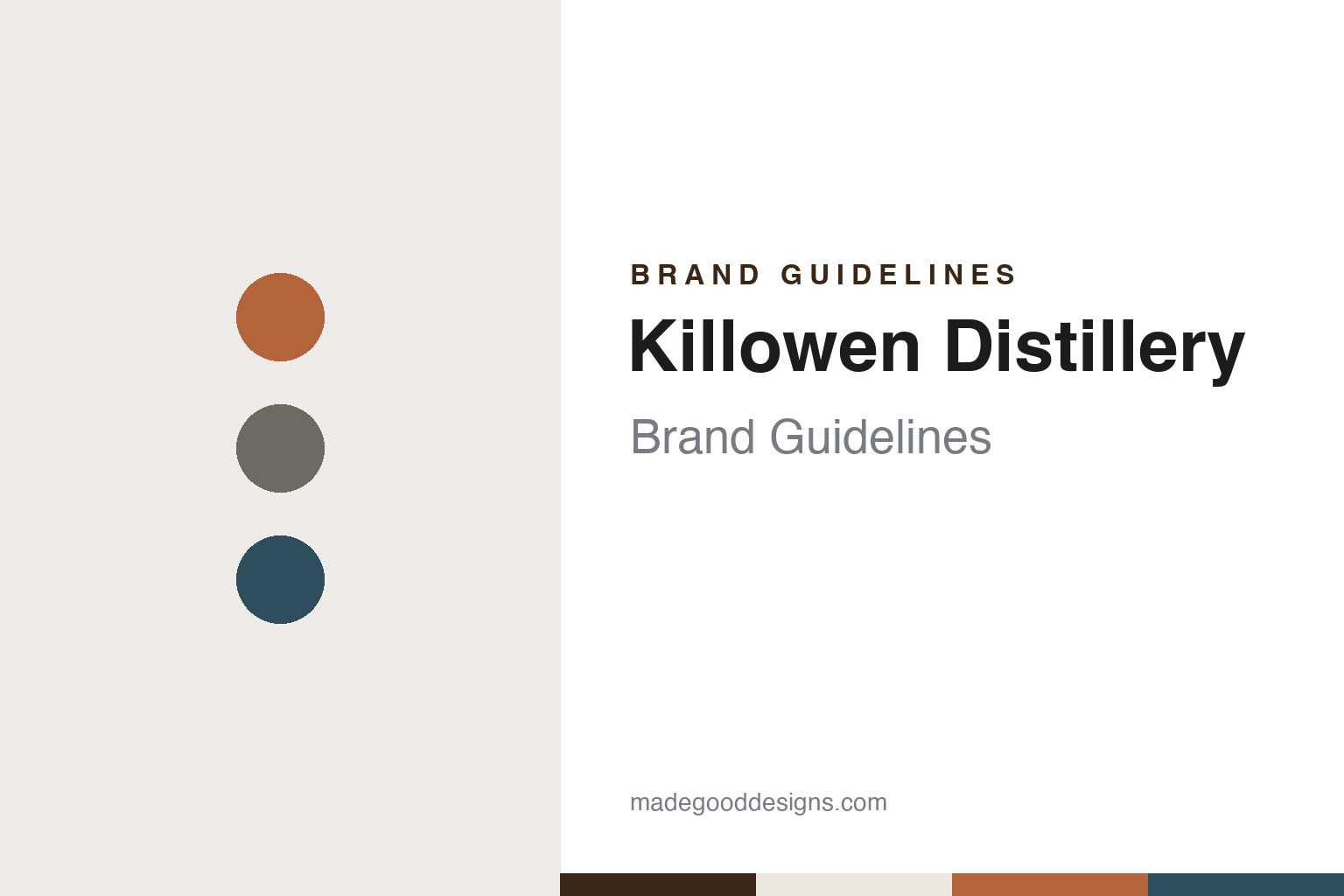
Killowen Distillery Brand Guidelines
Two flame-fed stills on a hillside above Carlingford Lough.
Aa
Two constants: a turf smoke, still copper and Mourne granite palette and an old-style book serif register. Abstract homage — not a Killowen Distillery product or mark; no label, logo or bottle is reproduced.
An architect’s distillery in the Mournes
Brendan Carty, two flame-fed stills and a hillside above Carlingford Lough.
Killowen Distillery sits on the slopes of the Mourne Mountains near Rostrevor in County Down, Northern Ireland, looking out over Carlingford Lough. It was founded in 2017 by Brendan Carty, an architect by profession from Warrenpoint who designed and largely built the distillery himself, Farming Life reported in April 2025; The Irish News gave the same founding year in December 2024. The narrow lanes that lead up to it climb towards the Kilfeaghan Dolmen, a megalithic tomb, and visitors are advised to ring ahead for directions; Carty told the paper the distillery is mindful of its remote setting and respectful for neighbouring farmers and for walkers in the mountains, Farming Life said.
The equipment is the centre of the story. The company says it runs two handmade pot stills, named Christoir (1,000 litres) and Broc (800 litres), both heated by flame, with worm tub condensers, and that it believes the still shape, size, flame heat and worm tubs together give “a traditional spirit with a contemporary twist.” Writing in March 2019, a few weeks after whiskey production had begun, Scotchwhisky.com described the stills as Portuguese and distinctively shaped, and reported mash bills taking in oats, wheat, malted and unmalted barley and some Maris Otter barley. Carty told the site that unmalted barley brought spice, that oats added oiliness and weight, and that the direct fire gave the spirit notes of caramelisation and smoke.
Carty has used the distillery to make an argument about what Irish whiskey is. In the same 2019 interview he said he wanted to challenge three common assumptions — that Irish whiskey is triple-distilled, smooth and unsmoked — and called for “positive reform” of the rules that define the category, while saying he respected the role of the Irish Whiskey Association. His first spirit, the site reported, was a pot still recipe made to fit the existing rules, with a mash bill carrying more non-barley grain planned in the hope that a revised definition would allow it. Farming Life reported in 2025 that Killowen double distils its whiskey and that some of its grain is smoked slowly in a chamber lined with turf. “My aim has been to create an Irish whiskey from traditional techniques over flame,” Carty told the paper.
Colour
Barántúil, poitín and labels that spell out their contents.
Killowen’s own-distilled whiskey is sold under the name Barántúil, Irish for “authentic,” The Irish News reported in December 2024. The paper described the Christmas ’24 Cask as the first five-year-old in the range: a single pot still that spent four years and a month in an ex-bourbon cask and a further 17 months in a Palo Cortado sherry cask, released in 227 bottles. Carty told the paper it would be the last Barántúil in the range’s 500ml bottle; a new 700ml bottle had already appeared on a limited edition for Dublin Airport. The next stage, he said, would be a series called Sagaland, created with historians and artists around stories from Irish myth and legend.
Alongside the whiskey runs a long line of other spirits. Food NI reported that Killowen had declared 2022 “The Year of the Poitín” and launched Stone Soup poitín, distilled from turf-smoked malted barley and oats with unmalted barley, malted wheat and malted rye, and named after an old folk tale about sharing food. Carty told Food NI that poitín should be seen not as a whiskey but as a small-batch premium spirit category. The distillery’s website now lists whiskey, poitín, a separate Pangur Irish poitín, gin, rum and liqueurs, among them a coffee liqueur called Gloria. In the United States its whiskeys were taken on by the Chicago importer High Road Spirits, Food NI reported.
The packaging carries the same argument as the stills. The company says each bottling in its Bonded Experimental Series is bottled at cask strength with no filtration, no added colouring and no added water, and that its labels set out the cask, the blended contents and where each component came from, so that drinkers can understand why they may taste certain flavours.
Typography
Design and documentation.
The seven brands in this group are all Irish distilleries: Killowen, Great Northern, Lough Gill, Clonakilty, Walsh Whiskey, Blackwater and Hinch. They are spread across the island rather than gathered in one district — Killowen in the Mourne Mountains and Hinch near Ballynahinch, both in County Down; Great Northern in Dundalk, County Louth, on the site of the former Harp brewery; Lough Gill in County Sligo; Clonakilty in west Cork; and Blackwater at Ballyduff in County Waterford.
Irish whiskey is a protected geographical indication. English Wikipedia notes that, under the rules set out in the 2014 technical file for Irish whiskey and checked by the Irish revenue authorities from January 2016, it must be matured for at least three years in wooden casks, and it recognises four styles: single pot still, single malt, single grain and blended. The word “single” may be used only when a whiskey is wholly distilled at one distillery.
The modern industry was rebuilt from very few distilleries. English Wikipedia records that Jameson, Powers and the Cork Distilleries Company merged as Irish Distillers in 1966, that Bushmills joined in 1972, and that Cooley Distillery was established by John Teeling in 1987; Great Northern, which Hospitality Ireland reported in August 2015 had begun distilling, was co-founded by him.
Ownership varies, and some of these names now sit inside larger drinks groups: BeverageDaily reported in November 2021 that Amber Beverage Group had acquired Walsh Whiskey, and in June 2022 that the Sazerac Company was buying Lough Gill Distillery, which Sazerac renamed Hawk’s Rock in 2025.
Each guide separates what independent sources record from what the company says about itself — who founded it, who owns it now, and where its whiskey is actually distilled, matured and bottled — and marks plainly what rests only on the company’s own word.
Aa
An old-style book serif for a distillery that leans on old methods. (Specimen set in Cormorant Garamond, a serif STAND-IN; NOT the Killowen Distillery logo.)
Killowen Distillery
An independent, founder-led distillery in County Down.
Killowen has remained in its founder’s hands. Farming Life described it in 2025 as an independent enterprise, and Food NI has described Carty as its founder and managing director. The Irish News reported in December 2024 that he ran the distillery with a team of six, and Carty told the paper that the five-year-old release had arrived during a challenging period for the spirits industry on the island. Its partners in the trade include Two Stacks of Newry, a business Carty works with, Farming Life said.
The name is a place name. The company gives its home as Killowen, on the County Down shore of Carlingford Lough near Rostrevor, and trades online at killowendistillery.com, where it describes itself as a craft Irish single pot still distillery.
For a design guide, Killowen Distillery shows how a small producer can make its process the brand — named stills, open flame, worm tubs and labels that spell out what is in the bottle. Compare Echlinville, the farm distillery on the Ards Peninsula elsewhere in County Down, and Hinch Distillery, another County Down whiskey maker. For this guide we use turf smoke, still copper and Mourne granite with an old-style serif, an unofficial interpretation; no product or logo is reproduced.
Explore & save
Keep Killowen Distillery’s identity on hand — save it to a board in the Made Good inspiration library.
Killowen Distillery identity set
Pin the Killowen Distillery turf smoke, still copper and Mourne granite palette and the old-style book serif register to your own board.


