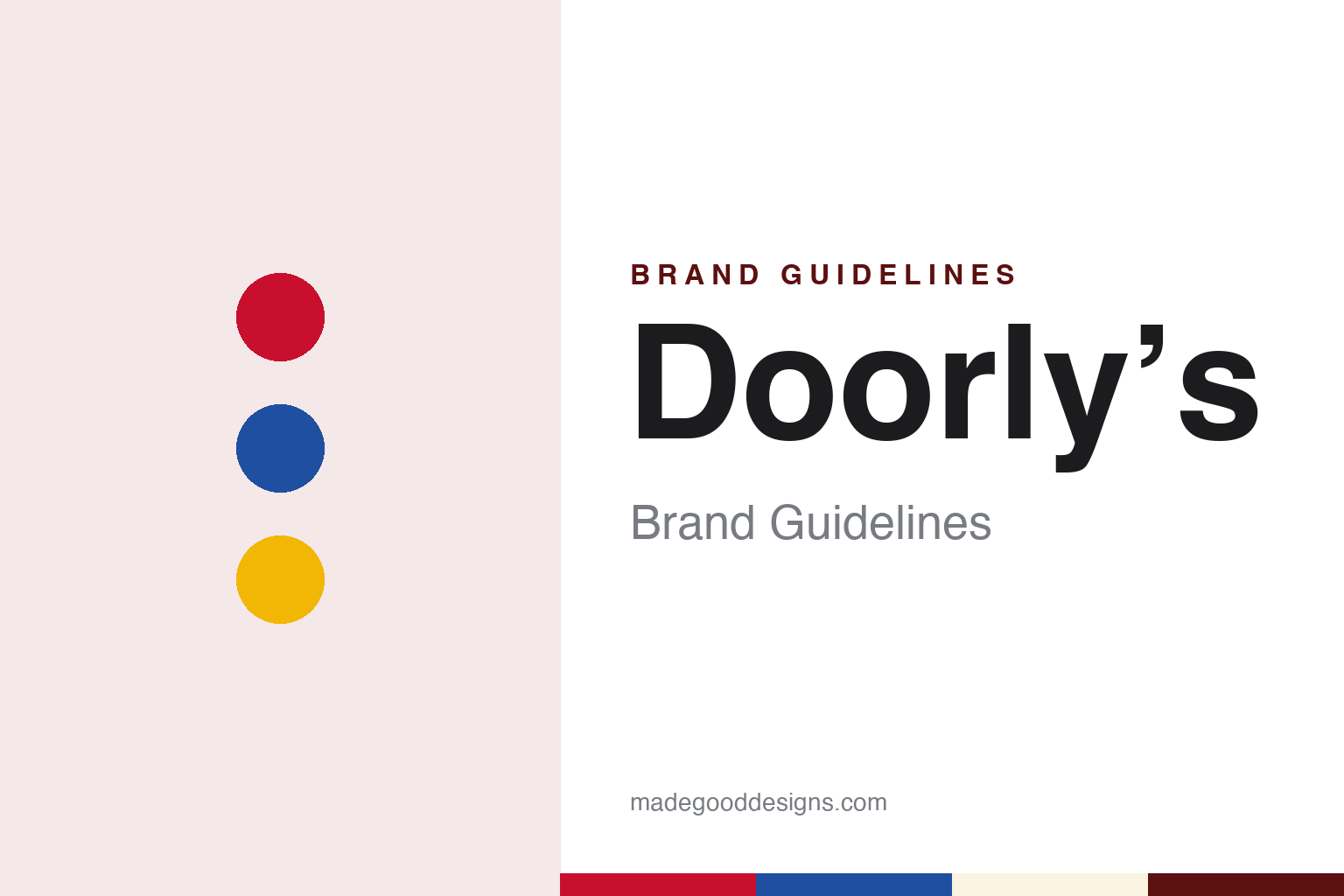
Doorly’s Brand Guidelines
The macaw-label Barbados rum made at Foursquare.
Aa
Two constants: a scarlet, hyacinth blue and macaw yellow palette and a transitional serif register. Abstract homage — not a Doorly’s product or mark; no label, logo or bottle is reproduced.
A Bridgetown bottler’s name
From a merchant’s macaw rum to a Seale family brand.
Doorly’s is a Barbados rum brand that belongs to R.L. Seale & Co, the Seale family company that owns the Foursquare distillery, and it is made at Foursquare in St Philip. The writer Matt Pietrek described Doorly’s in PUNCH in March 2018 as one of the cornerstone brands of the family’s rum business, and a 2025 product note from the UK retailer Drinkfinder states that Doorly’s rums are made at the Foursquare Distillery.
The name is older than the distillery. The brand began with Martin Doorly & Co, which product notes from the UK retailer Fareham Wine Cellar describe as one of the old Bridgetown rum-bottling companies, founded in the 1920s; the reviewer Nick Leghorn, writing on Thirty-One Whiskey in April 2022, also says Martin Doorly founded the company in the 1920s. The firm’s rum became known as Doorly’s Macaw Rum, a name it kept for decades.
Companies such as Martin Doorly & Co existed because of how the Barbados trade was organised. The rum reviewer behind The Fat Rum Pirate explains that a Rum Duty Act of 1906 limited licensed distillers to selling rum in bulk, which left bottling and branding to merchants, and that Martin Doorly & Co became one of those bottlers. Under that system a Barbados brand was a blender’s and a bottler’s name, not a distillery’s.
The Seale family, whose rum-making heritage Barbados Today traced back to 1820 in a 2024 report, worked the same way. PUNCH reported that from 1926 the Seales bought rum from Barbados distilleries and sold it under the R.L. Seale name, and that the family later acquired Doorly’s. Fareham Wine Cellar’s notes date the acquisition to 1993. Barbados Today reported in 2024 that the Seale family established the Foursquare Distillery in 1996, and Doorly’s is now made there.
Colour
One bird per age, and a name kept on the label.
The macaw is the constant. Thirty-One Whiskey wrote in 2022 that the bird on today’s label is a throwback to the decades when the brand traded as Doorly’s Macaw Rum, so the emblem carries the old name even though the name itself has been shortened.
The range turns the bird into a code. Drinkfinder reported in June 2025 that the younger 3 and 5 Year Old rums carry yellow and scarlet macaws, that the XO, a blend of rums aged six to twelve years, carries the Hyacinth Macaw, and that the 12 Year Old carries Spix’s Macaw, a bird the retailer described as feared extinct in the wild. Fareham Wine Cellar’s notes identify the Scarlet Macaw on the 5 Year Old. The species changes as the rum gets older.
The rum itself comes from the Foursquare stills. Pietrek reported in PUNCH that the Seale family’s rums are distilled in pot and traditional column stills without added sugar or sweet wines, and the Last Drop Distillers’ profile of Richard Seale describes the distillery’s double-retort pot still adapted to run under vacuum.
The XO has its own finish. Thirty-One Whiskey reported that it is aged in previously used American oak and then finished in Oloroso sherry casks, and that it carries no age statement, since “XO” has no legal definition for Barbados rum. Drinkfinder reported that the 12 Year Old was once sold in very limited quantities directly from the distillery before reaching the UK in 2025.
Doorly’s is therefore a brand whose name is older than its production site: the merchant’s surname and the macaw date from the Bridgetown bottling era, while the rum comes from a distillery the Seale family established in 1996.
Typography
Design and documentation.
The seven brands in this group are all rum names: Foursquare, Doorly’s, Chairman’s Reserve, Ron Matusalem, Pusser’s, Don Papa and Barbancourt. Their stories run through Barbados, Saint Lucia, Cuba, the Dominican Republic, Haiti and the Philippines, as well as the Royal Navy’s old rum ration, and at least one of them began in one country and is now made in another. Rum brands in general sit at many different points in the trade, from family distilleries that still carry a founder’s name to labels that now belong to much larger drinks groups.
A rum’s identity is usually carried less by a single bottle than by a label, a name and the place it promises, because the company behind the name may have changed hands, moved its distilling or grown far beyond the place where it started. Rum is made from sugar cane, either from molasses or from fresh cane juice, and the rules on what may be called rum, how long it is aged and what may be added differ from one country to the next. That makes the questions behind each name worth asking plainly: who started it, who owns it now, and where its rum is actually distilled, aged and bottled.
Each guide separates what independent sources record from what the company says about itself — its founding story, its owners over time, where its rum is made and how its labels have changed — and marks plainly what rests only on the company’s own word.
Aa
A transitional serif for a merchant’s name with a macaw beside it. (Specimen set in Libre Baskerville, a serif STAND-IN; NOT the Doorly’s logo.)
Doorly’s
A heritage label inside a distillery’s family of brands.
Doorly’s sits beside the distillery’s own name rather than under it. Foursquare’s Exceptional Cask Selection is sold under the distillery’s name and by vintage, while Doorly’s keeps a merchant’s surname and a bird, so the same still supplies two quite different brands. PUNCH noted in 2018 that the Seale family kept Doorly’s as a central brand after it began distilling, and English Wikipedia lists Doorly’s among R.L. Seale’s brands alongside Old Brigand and E.S.A. Field.
The range has also widened abroad. Drinkfinder described the XO in 2025 as a rum long sold in the UK as a sipping rum, and reported that the 12 Year Old, once available in very limited quantities from the distillery, had reached British shelves that year; The Fat Rum Pirate notes that R.L. Seale bought out the old bottling company and still makes the rum.
Spelling varies on shelves and online: the brand appears both as “Doorly’s” and as “Doorlys.”
For a design guide, Doorly’s shows how one emblem can be stretched into a system — a different species of the same bird for each age — so that a heritage name and its family of rums stay recognisable together. Compare Foursquare, the St Philip distillery that makes it, and Mount Gay, another Barbados rum name. For this guide we use scarlet, hyacinth blue and macaw yellow with a serif, an unofficial interpretation; no product or logo is reproduced.
Explore & save
Keep Doorly’s’s identity on hand — save it to a board in the Made Good inspiration library.
Doorly’s identity set
Pin the Doorly’s scarlet, hyacinth blue and macaw yellow palette and the transitional serif register to your own board.


