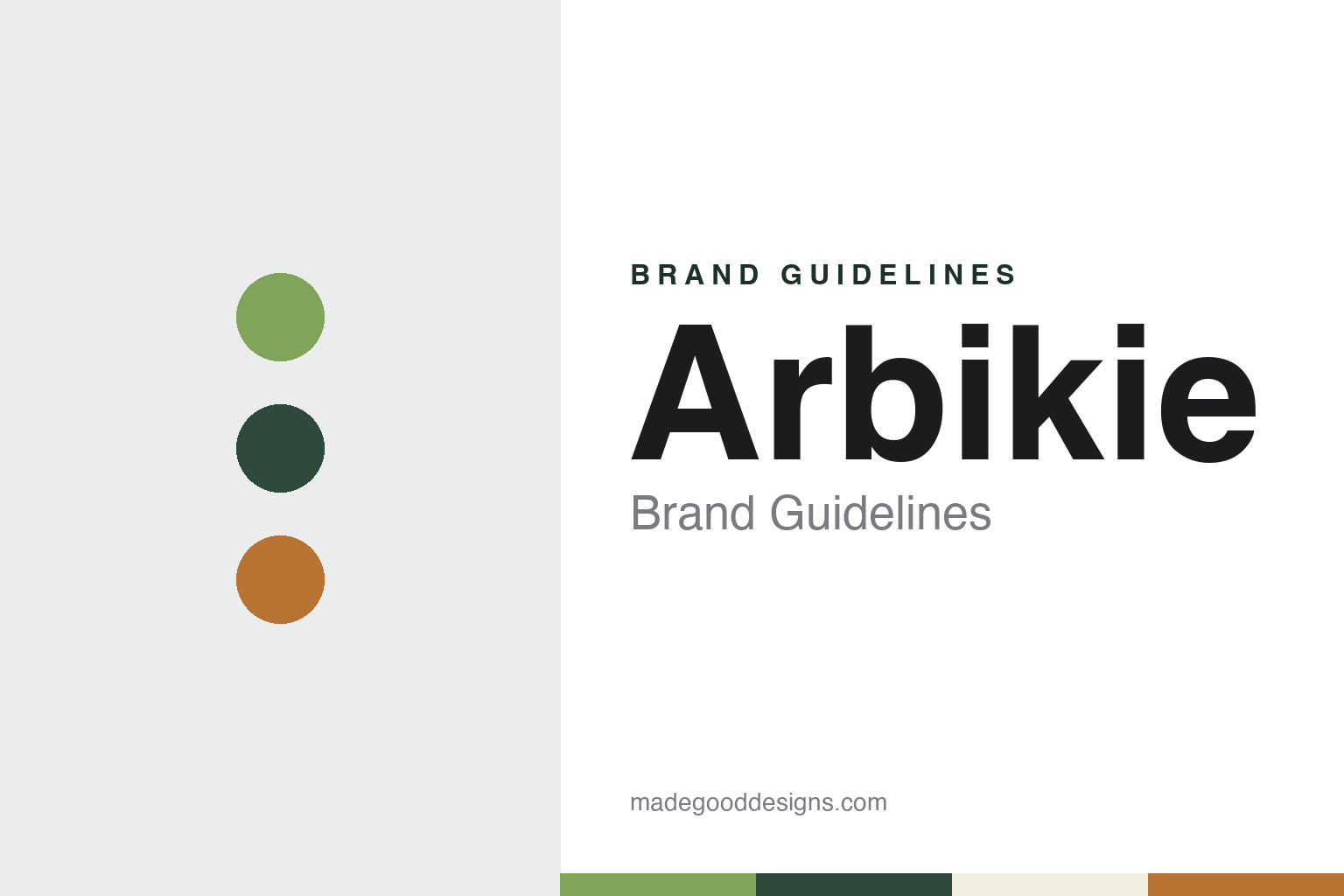
Arbikie Brand Guidelines
The Stirling brothers’ farm distillery above Lunan Bay, since 2013.
Aa
Two constants: a pea green, field green and still copper palette and a classic book serif register. Abstract homage — not an Arbikie product or mark; no label, logo or bottle is reproduced.
A farm that grew its own distillery
Three brothers, a family estate and a converted cattle shed.
Arbikie is a farm distillery on the Arbikie Highland Estate at Inverkeilor, near Arbroath on the Angus coast, on land that looks out over Lunan Bay. English Wikipedia describes the estate as a farm owned by the Stirling family for four generations, and the company’s own history traces the family’s farming much further back, to the west of Scotland, before a great-uncle moved to Lunan Bay in the 1920s. The distillery belongs to three brothers, John, Iain and David Stirling, who have owned and run it since they founded it.
The gazetteer on Scotchwhisky.com dates the start to 2013, when the brothers founded Arbikie Highland Estate and began an 18-month build of a small distillery inside an existing cattle shed. It says the stills were made by CARL in Germany and assembled with the help of the farm’s own mechanics and blacksmiths. The same source says the family believes there was a distillery in the area as early as 1720, and that the earliest record of one is a map from 1794; English Wikipedia also gives 1794 as the date of the estate’s earliest whisky records.
The first spirit off the stills was not whisky but vodka. The Morning Advertiser reported on 18 November 2014 that the new “farm to bottle” distillery had launched a vodka made from potatoes grown on the estate, and the Scottish trade paper SLTN reported later that month that it used a blend of Maris Piper, King Edward and Cultra potatoes. Iain Stirling, then the commercial director, told the Morning Advertiser that drinking should be no different from the way we eat, “goodness from the ground up.” Both papers said gin and whisky would follow in 2015. English Wikipedia describes the 2014 spirit as Scotland’s first commercial potato vodka.
Scotchwhisky.com says the gin followed in August 2015, and that by the end of that year the master distiller, Kirsty Black, was producing single malt spirit for long ageing.
Colour
Spirits sorted by the crop they come from.
The organising idea of the brand is that every spirit starts in a field on the estate. In SLTN in November 2014 the brothers described Arbikie as the first Scottish distillery to grow all its own ingredients and to ferment, distil, bottle, label and mature on site, a claim that rests on the company’s own word. The company’s website still presents the distillery as standing a stone’s throw from its fields and says it grows its own juniper and uses honey from bees kept on the farm.
The names on the bottles keep the farm and the family in view. The Scottish Gin Society wrote after a visit in March 2018 that the range included Tattie Bogle, a potato vodka, and Haar, a wheat vodka; that Kirsty’s Gin, made on a potato base, is named after Kirsty Black; and that AK’s Gin is made on a wheat base with honey from the estate’s bees. The same report said the copper pot stills are named Jan and AK after the brothers’ mother and father, and that the spirit also passes through a 40-plate column. Where possible, the society added, the botanicals come from the estate and the surrounding Angus countryside.
The best-documented product is Nàdar, whose name is the Gaelic word for “nature.” BeverageDaily reported on 20 February 2020 that Arbikie had launched it as a “climate positive” gin made from peas rather than grain. The gin came out of Kirsty Black’s PhD studentship between Abertay University and the James Hutton Institute, supervised by Graeme Walker, Abertay’s professor of zymology, and her pea-spirit research was published in the journal Environment International in 2019. Arbikie says each 700ml bottle has a footprint of minus 1.54kg of carbon dioxide equivalent; the argument it gives is that peas fix nitrogen from the air, so the crop needs no synthetic nitrogen fertiliser. The first edition used British peas, and its botanicals, lemongrass and citrus leaf, were grown on the estate.
Whisky came more slowly. English Wikipedia says Arbikie released a Highland rye whisky in 2020. In a post dated 5 May 2021, the company described its Highland Rye single grain Scotch as the first rye whisky distilled in Scotland in more than 100 years, laid down in 2015 from Arantes rye, Odyssey malted barley and Viscount wheat.
Typography
Design and documentation.
The seven brands in this group are all Scottish gins: Caorunn, Pickering’s, Rock Rose, Daffy’s, Eden Mill, Lussa and Arbikie. Scottish gins in general come from many different kinds of producer, from whisky distilleries that make a gin alongside their malt to small independent distilleries, family farms and island businesses, and a single bottle can be sold everywhere from a local shop to a bar list abroad.
A gin brand’s identity is usually carried less by the spirit itself than by a name, a bottle, a label and the place it promises, because gin needs no long ageing and can be distilled almost anywhere. The company behind a name may have changed hands, moved its stills or had its gin made under contract somewhere else. That makes the questions behind each name worth asking plainly: who started it, who owns it now, and where its gin is actually distilled and bottled.
Each guide separates what independent sources record from what the company says about itself — its founding story, its owners over time, where its gin is made, which botanicals it says come from its own surroundings and how its labels have changed — and marks plainly what rests only on the company’s own word.
Aa
A classic book serif for an estate name with a long farming story behind it. (Specimen set in Cormorant Garamond, a serif STAND-IN; NOT the Arbikie logo.)
Arbikie
A single malt still in the cask, and a farm turning to hydrogen.
The single malt was always the longest project. Scotchwhisky.com says the estate laid down its malt for a minimum of 14 years, with releases planned at 14, 18 and 21 years old and the first not likely before 2029. The company’s website now advertises its first 10-year-old single malt, so the timetable has moved earlier than that plan.
Energy has become part of the same story. On 24 November 2021 the UK government announced the projects funded in the second phase of its Green Distilleries Competition, among them a project by Locogen with Logan Energy and Arbikie Distilling to install a green hydrogen system at the distillery, with a wind turbine, an electrolyser, hydrogen storage and a hydrogen boiler, to replace the burning of oil to raise steam. English Wikipedia also records a distribution deal with the refill specialist ecoSPIRITS in August 2021 and the opening of a new visitor experience in May 2022. The company says it has been a certified B Corp since 2025.
The name is a place name, and the brand’s own site is arbikie.com; the estate and the distillery share the name.
For a design guide, Arbikie shows how a young distillery can build an identity from a single farm, naming its spirits after the crops, the people and the stills that make them, and leaning on one documented research story, a gin made from peas. Compare Kingsbarns, the Fife farm-steading distillery, Lindores Abbey in Fife, and Nc’nean, the organic whisky distillery at Drimnin. For this guide we use pea green, field green and still copper with a serif, an unofficial interpretation; no product or logo is reproduced.
Explore & save
Keep Arbikie’s identity on hand — save it to a board in the Made Good inspiration library.
Arbikie identity set
Pin the Arbikie pea green, field green and still copper palette and the classic book serif register to your own board.


