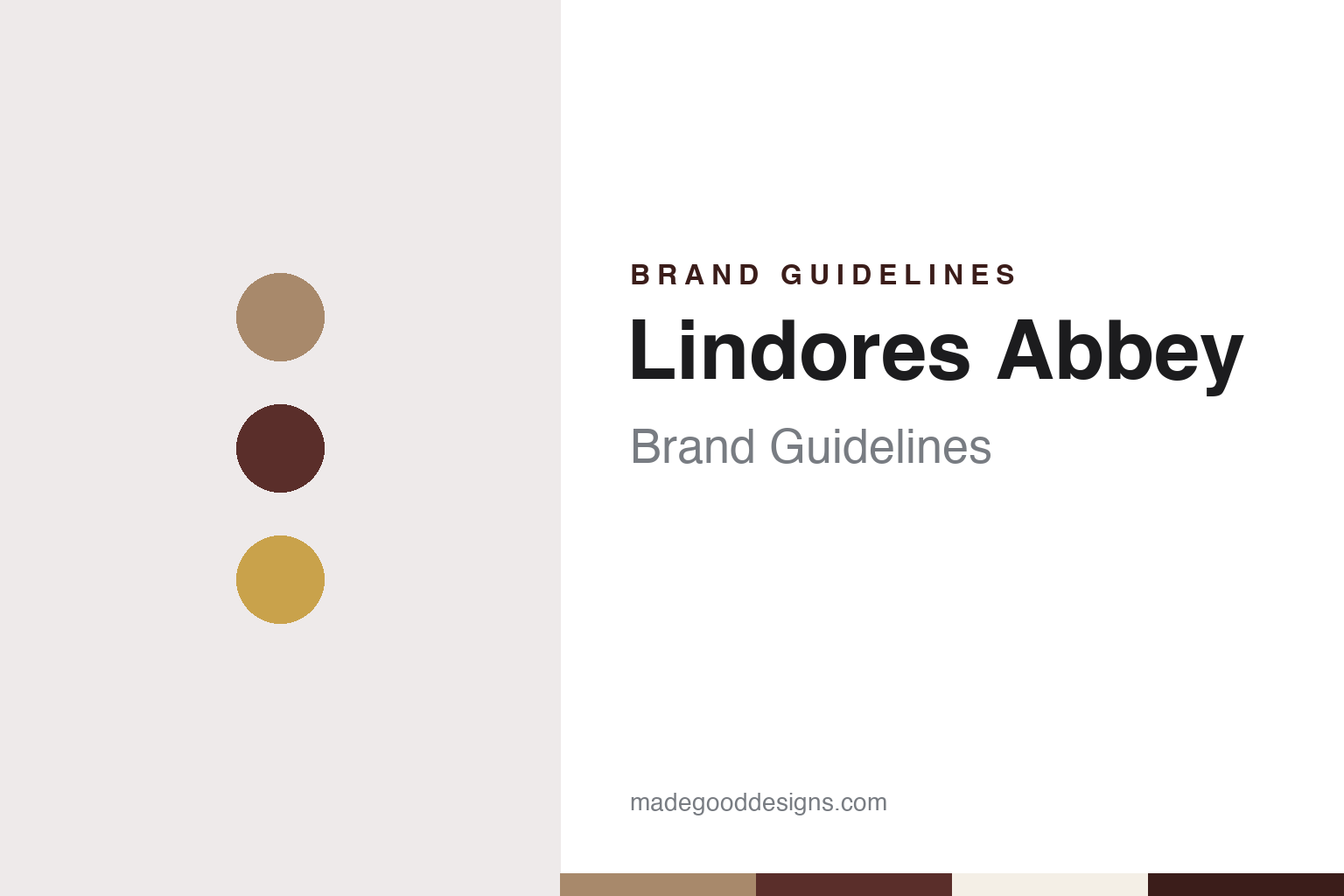
Lindores Abbey Brand Guidelines
A Fife distillery named for a 1494 record, distilling since 2017.
Aa
Two constants: an abbey sandstone, monastic claret and barley gold palette and an old-style roman serif register. Abstract homage — not a Lindores Abbey product or mark; no label, logo or bottle is reproduced.
Eight bolls of malt
An abbey, a friar, a king’s order and a family farm.
Lindores Abbey Distillery stands at Newburgh in Fife, across the road from the ruins of the abbey it is named after. The company says Lindores Abbey was founded in 1191 by David, Earl of Huntingdon, and settled by Tironensian monks from Kelso. The company’s history adds that the abbey received Robert the Bruce, David II and Edward I of England, and that William Wallace rested there; the visitor tours now include the abbey ruins and the wells that once fed it. Its claim on whisky history rests on one line in the Scottish Exchequer Rolls for 1494, which Whisky Advocate quoted in December 2017: “Eight bolls of malt to Friar John Cor wherewith to make aqua vitae,” an order made for King James IV. The distillery describes it as the earliest written reference to Scotch whisky, and uses the date, in Roman numerals, as a name.
The land came to the distillery through a family. English Wikipedia, citing The Guardian in 2016, says Lindores Abbey Farm, opposite the ruins, was bought by Drew McKenzie Smith’s grandfather in 1913. Drew and his wife Helen McKenzie Smith are the founders. SLTN reported in July 2016 that work was under way to convert and extend the old abbey steading into a distillery with three copper stills, one for wash and two for spirit, and quoted Drew McKenzie Smith saying that building on the site would “bring the spiritual home of Scotch whisky back to life.” Whisky Advocate, in a report by Gavin D. Smith, said the farmstead had been built with stone from the abbey.
The distillery opened on 30 August 2017 and ran its first spirit on 13 December 2017, Whisky Advocate reported. The company says spirit was flowing again on the site after a break of 523 years.
Colour
A date for a name and a spirit from the history books.
The identity is built on that date. Scotch has to mature for at least three years in oak, so before it had whisky to sell the distillery made an Aqua Vitae, a spirit that, Whisky Advocate wrote in 2017, was modelled on a fifteenth-century drink, with local honey, dried fruits and spices. The same report said most of the new make was being filled into first-fill bourbon casks from Old Forester and Woodford Reserve, for a single malt described as light and floral, in a Lowland style.
The first single malt took the year of the Exchequer Roll entry as its name: MCDXCIV, or 1494. Whisky Magazine reported on 17 June 2021 that the first general release would go on sale on 2 July 2021 in two forms with the same whisky inside, a Commemorative Release with a special label and a core bottling, after 1,494 bottles had gone to members of the distillery’s 1494 Society that spring. It quoted Drew McKenzie Smith, as founder and managing director, saying the aim was for the whisky to be “accessible and enjoyed rather than only collected.”
The rest of the range keeps to the abbey’s story. The company lists whiskies named Thiron and Friar John Cor Congregation, alongside Aqua Vitae and new make spirit, and offers private casks whose bottlings can be personalised. Its website quotes the whisky writer Michael Jackson: “For the whisky lover, it is a pilgrimage.” The company says its barley is the Laureate variety from farms around the distillery, on land that once belonged to the abbey, and that its wooden washbacks were supplied by Joseph Brown of Dufftown.
Typography
Design and documentation.
The seven brands in this group are all Scottish distilleries founded in the past decade and a half: Ardnamurchan, Lindores Abbey, Kingsbarns, Isle of Raasay, Isle of Harris, Wolfburn and Torabhaig. They are spread across the country, from the Fife coast to the islands of the west and the far north of the mainland, and they belong to owners of very different kinds, from family firms to companies that are part of larger drinks groups.
A new distillery has a particular design problem. In that time its identity is carried by other things: a building, a place-name, a founding story, a first release presented as an event, and sometimes a gin or another spirit sold while the casks mature.
That makes the questions behind each name worth asking plainly: who started it, who owns it now, and where its spirit is actually distilled, matured and bottled. Each guide separates what independent sources record from what the company says about itself — its founding story, its owners over time, its first releases and how its labels look — and marks plainly what rests only on the company’s own word.
Aa
An old-style roman serif for a brand built on a date in Roman numerals. (Specimen set in Cormorant Garamond, a serif STAND-IN; NOT the Lindores Abbey logo.)
Lindores Abbey
Investors, a pause and a restart.
The distillery’s funding has been reported in the press. Scottish Financial News reported on 11 March 2022, citing The Courier, that more than 75 per cent of the operating company, The Lindores Distilling Co Ltd, was owned by Spirex Ltd, a holding company controlled by Russian nationals; that after Russia’s invasion of Ukraine the company’s Russian directors had agreed to step down; and that the founders said they were negotiating for the McKenzie Smith family to acquire that shareholding. In a statement quoted in the same report, the founders said the investors were not oligarchs and were not on any sanctions list, and condemned the invasion.
The Scotsman reported on 26 February 2026 that Spirex Ltd held a 75 per cent stake. The Companies House register shows Spirex as the operating company’s only person with significant control; Spirex has itself been controlled since May 2025 by CD Lindores Ltd, a London holding company owned by the Irish-registered Conquer Dawn Limited. Drew McKenzie Smith ceased to be recorded as a person with significant control on 2 October 2026, though he remained a director. In the same report a spokesperson, speaking to The Courier, called rumours of closure inaccurate, said a non-core events business had been disbanded in summer 2025 and a small number of roles would go, and said that after a period of reduced production distillation resumed in September 2025 and the visitor centre remained open.
For a design guide, Lindores Abbey shows how a single archival line can carry a whole brand: a ruined abbey, a friar’s name and a year written as MCDXCIV give it a name, a range and a story in one. Compare Kingsbarns, another new Fife distillery, and Auchentoshan, the triple-distilled Lowland malt. For this guide we use abbey sandstone, monastic claret and barley gold with a serif, an unofficial interpretation; no product or logo is reproduced.
Explore & save
Keep Lindores Abbey’s identity on hand — save it to a board in the Made Good inspiration library.
Lindores Abbey identity set
Pin the Lindores Abbey sandstone, monastic claret and barley gold palette and the old-style roman serif register to your own board.