Glendalough Brand Guidelines
The St Kevin distillery from Wicklow, founded 2011.
Aa
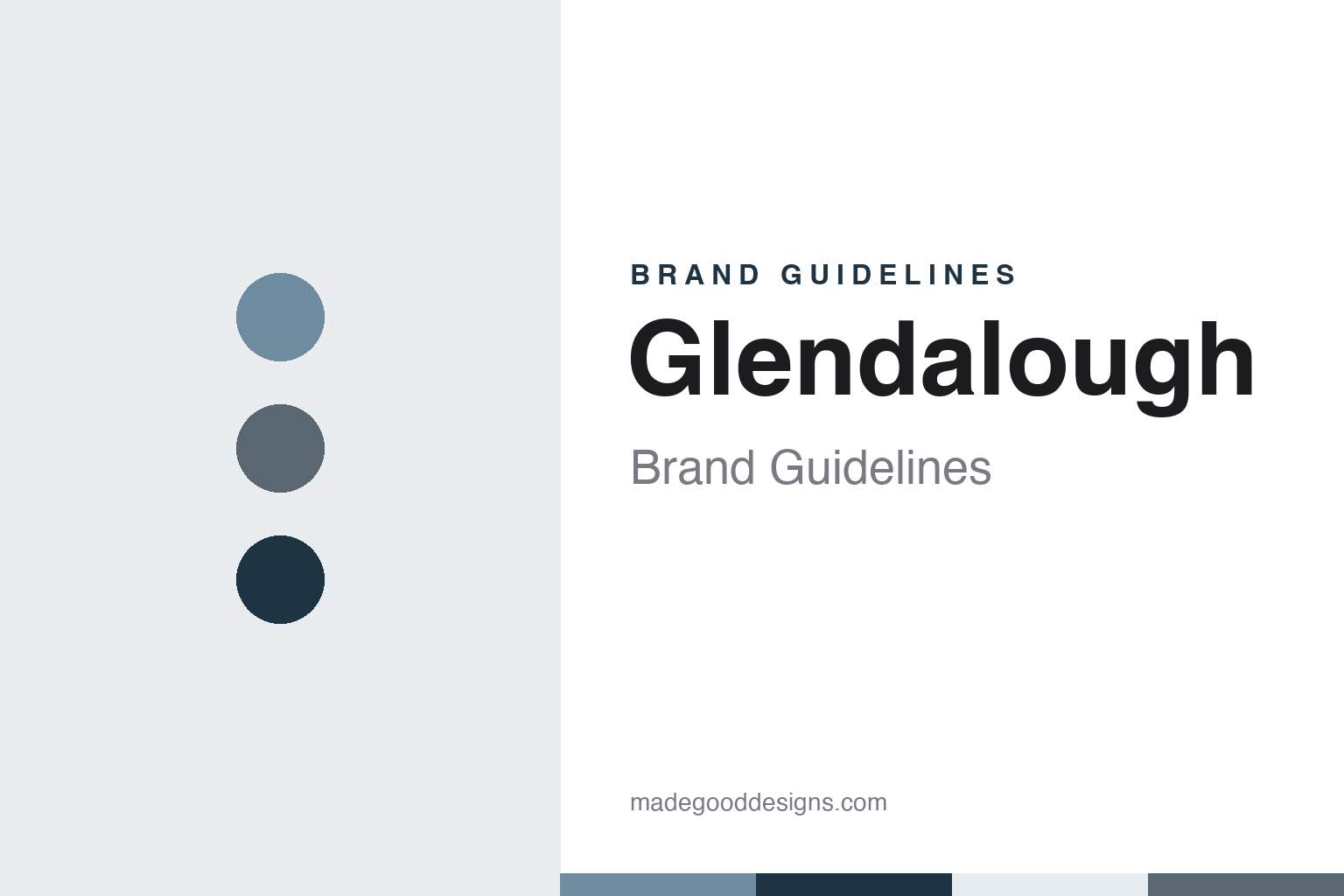
Two constants: a glacial blue, slate and granite grey palette and an old-style serif register. Abstract homage — not a Glendalough product or mark; no label, logo or bottle is reproduced.
Five friends and a Wicklow valley
From a single copper still to a Canadian-owned craft distiller.
Glendalough Distillery makes Irish whiskey, gin and poitín in County Wicklow, and takes its name from the valley in the Wicklow Mountains where, as Hospitality Ireland put it in 2018, St Kevin, a sixth-century monk, founded the Glendalough settlement. Its owner, Mark Anthony Brands International, says the company was founded in 2011 and names Barry Gallagher and Brian Fagan as its founders. The Irish food and drink site TheTaste described the founding group in 2016 as five friends from Dublin and Wicklow, and Hospitality Ireland quoted Kevin Keenan in 2018 as the distillery’s founder and creative director.
The first bottle on the market was not a whiskey. Mark Anthony’s 2019 announcement says the distillery first sold poitín, and TheTaste noted that Glendalough’s poitín is made from barley rather than potatoes. Gin followed, in a series of seasonal releases that TheTaste said had made the brand’s name by 2016.
That year the same writer visited the distillery in an industrial estate on the edge of Newtownmountkennedy, Co Wicklow, and described a modest operation: a single 500-litre Arnold Holstein still in burnished copper, botanicals added by hand and cut points judged largely by taste. Drinks Industry Ireland still gave Newtownmountkennedy as the company’s base in December 2019.
Ownership came in two steps. In August 2016 Mark Anthony Brands International, the Dublin-based arm of the Vancouver-headquartered Mark Anthony Group, took a 40 per cent stake, The Spirits Business reported. On 12 December 2019 Mark Anthony announced it had bought the remaining shares, giving it complete ownership; the group, led by its founder Anthony von Mandl, is also the company behind White Claw hard seltzer. The announcement said Glendalough would carry on as a separate company under its existing management, led by Gallagher and Fagan, and that Coca-Cola HBC Ireland had recently taken on distribution of the range in Ireland. Mark Anthony has owned Glendalough outright since December 2019.
Colour
A monk at the centre of every bottle.
The constant in Glendalough’s identity is a figure rather than a letterform. TheTaste called St Kevin the distillery’s mascot in 2016, chosen to stand for the area’s history and for patience, perseverance and commitment to an ideal, and he appears on the bottle in both of the redesigns that followed.
The first of those came in 2018. Just Drinks reported in February 2018 that Glendalough was launching a new whiskey range alongside a new bottle design across its whole portfolio, and Hospitality Ireland described the change on 22 February 2018: taller, slimmer 70cl bottles with contemporary labels in muted blues and greys that refer to the brand’s birthplace, a glacial valley in County Wicklow, and St Kevin as the centrepiece of each bottle. The whiskeys launched with the new look were a double barrel blend finished in Oloroso casks, a seven-year-old single malt finished in Dublin craft porter barrels and a thirteen-year-old single malt aged in Japanese Mizunara oak. The Wild Botanical gin and the Mountain Strength poitín moved into the same packaging. Keenan told the magazine that the new look and bespoke bottle brought the range together “as a family.”
The gin was redrawn again in 2023. Drinks Industry Ireland reported on 28 April 2023 that a new bottle for Glendalough Irish Gin had been created by the agency Here Design in collaboration with the distillery. A woven pattern at the base refers to the handwoven basket used for foraging; wild botanicals including sorrel, elderflower and fir are embossed around the glass, rising from the foot; and the Monastery Archway, the Seven Churches and the Deer Stone of the Glendalough site are worked into the design, with St Kevin shown standing as a strong but gentle guardian. Enda O’Sullivan, vice president of spirits at Mark Anthony Brands International, said the bottle tells the story of the gin and the Irish landscape it comes from.
Typography
Design and documentation.
The seven brands in this group are all names from the newer generation of distilleries on the island of Ireland: Dingle, Waterford, Glendalough, West Cork, Pearse Lyons, Boann and Echlinville. Distillery brands in general sit at many different points in the trade, from family-run sites that still carry a founder’s name or a farm’s fields to labels that belong to larger drinks groups, and a single name can cover a whiskey, a gin, a vodka or a poitín.
A young distillery’s identity is often carried less by its own aged spirit than by a place, a story and a label, because whiskey takes years in the cask before it can be sold as whiskey, and some distilleries sell gin, bought-in whiskey or spirit they have finished themselves while their own stock matures. That makes the questions behind each name worth asking plainly: who started it, who owns it now, and where its spirit is actually distilled, matured and bottled.
Each guide separates what independent sources record from what the company says about itself — its founding story, its owners over time, where its spirit is made and how its labels have changed — and marks plainly what rests only on the company’s own word.
Aa
An old-style serif for a monastic, hand-made register. (Specimen set in Cormorant Garamond, a serif STAND-IN; NOT the Glendalough logo.)
Glendalough
Foraged botanicals and numbered Irish oak.
Much of the brand’s story is told through where its ingredients come from. TheTaste reported in 2016 that the distillery’s forager, Geraldine Kavanagh, gathered the gins’ local botanicals in Wicklow each season, and that these were macerated for two weeks with six core ingredients: juniper, coriander, angelica root, orange peel, bitter almond and orris root. By 2023 Drinks Industry Ireland was describing Kavanagh as the distillery’s full-time forager, and the basket on the new gin bottle is a nod to her.
The whiskey side took the same idea into wood. The Whiskey Wash reported on 6 February 2020, as three Glendalough whiskeys reached the United States, that the distillery’s Irish oak casks were made from trees Glendalough had felled itself in the mountains around the distillery. Each bottle was numbered so that it could be traced to its batch, cask and tree, and a neck tag sent buyers to a website where they could enter those numbers and watch a short film of the tree being felled and the cask being coopered. The same report covered a seventeen-year-old finished in Mizunara oak and a twenty-five-year-old finished in Irish oak.
The name needs a little care online. Glendalough is also the name of the monastic site and valley in the Wicklow Mountains; the drinks company trades as Glendalough Distillery.
For a design guide, Glendalough shows how a single figure from a valley’s history, a muted landscape palette and embossed glass can tie whiskey, gin and poitín into one family. Compare Teeling, the Dublin whiskey house in the Liberties, and White Claw, the hard seltzer from the same parent group. For this guide we use glacial blue, lake slate and granite grey with an old-style serif, an unofficial interpretation; no product or logo is reproduced.
Explore & save
Keep Glendalough’s identity on hand — save it to a board in the Made Good inspiration library.
Glendalough identity set
Pin the Glendalough glacial blue, lake slate and granite grey palette and the old-style serif register to your own board.