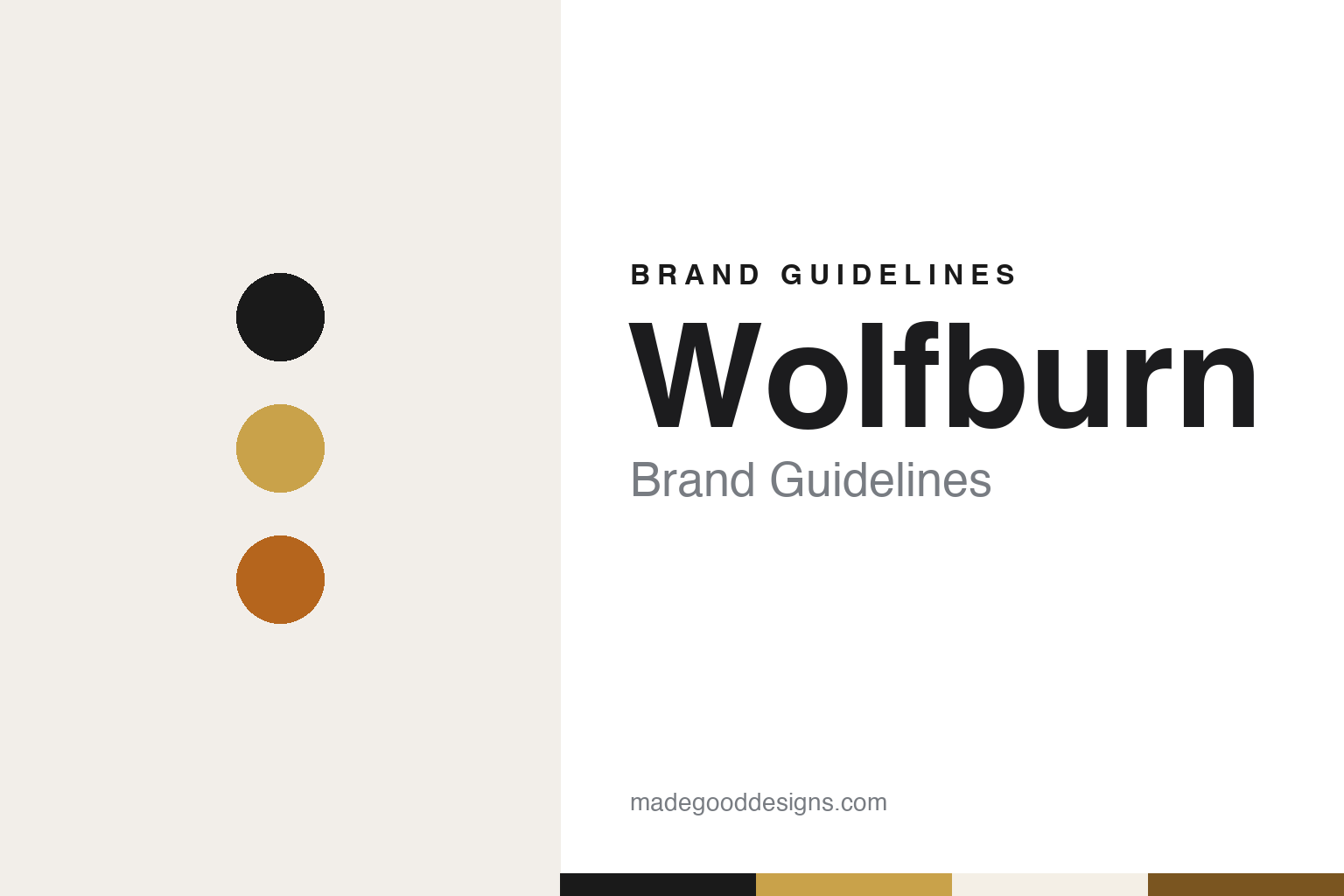
Wolfburn Brand Guidelines
A Thurso name back on spirit after a century and a half.
Aa
Two constants: a carton black, foil gold and whisky amber palette and an engraved capital serif register. Abstract homage — not a Wolfburn product or mark; no label, logo or bottle is reproduced.
A lost Caithness distillery
An 1821 name, revived a short walk down the burn.
The first Wolfburn was founded in 1821 by William Smith on the outskirts of Thurso, in Caithness, and named after the stream that supplied its water, the Wolf Burn, English Wikipedia and the company both say. It stayed with the Smith family for decades, but the date it stopped distilling is uncertain: ScotchWhisky.com’s Whiskypedia notes claims that it worked intermittently into the 1860s, and English Wikipedia says the first Ordnance Survey map of 1872 shows the site as a ruin. Little of it survives.
The modern distillery is a new building, not a restoration. Whisky Magazine reported in February 2013 that private investors had formed a company, Aurora Brewing, to build and run it, and Whiskypedia says this Caithness consortium received planning permission in 2012 and broke ground that August. English Wikipedia places the new plant at Henderson Park, about 350 metres from the old ruins, drawing on the same burn.
Production began on 25 January 2013, Whiskypedia says; Harpers later reported that the first spirit was laid down on Burns Night 2013. Whisky Magazine reported that the plant had been custom-built and designed by Forsyths of Rothes, that the distillery started with three staff under Shane Fraser, formerly manager at Glenfarclas, and that it was then the most northerly distillery on the Scottish mainland. Whiskypedia lists one wash still and one spirit still and maturation mainly in ex-bourbon casks, with some ex-sherry, in dunnage warehouses on site.
English Wikipedia says on-site bottling began in February 2016 and the first whisky was launched in March 2016. Harpers reported on 4 March 2016, under the headline “Wolfburn distillery returns to life after 150 years,” that the single malt would reach the UK the following month through Amathus Drinks, alongside a numbered, engraved Inaugural Special Edition of 875 bottles in a hand-made oak box.
Colour
A wolf that walks on water.
The emblem is older than the distillery by several centuries. Harpers reported in 2016 that the Wolfburn logo is based on a 16th-century drawing by the Swiss naturalist Conrad Gessner, thought to show a sea wolf, a creature believed to walk on water whose sighting was considered lucky. The company says the logo was designed in 2011 and pairs it with the line “Fortune Favours the Brave.” The packaging maker Progress Packaging, in an article published around 2017, quoted managing director Daniel Smith as saying that some people love the wolf logo and others hate it, and said his wife had found the illustration while researching Gessner.
The packaging is mostly black. The Dieline reported in April 2016 that Progress Packaging had developed the new packaging for the brand, describing it as largely black with gloss and the colour of the whisky picked up in some of the text. Progress said its cartons wrap the wolf around the box, flood-printed and foil-blocked in gold, while the labels are digitally printed on Fedrigoni Tintoretto paper and also blocked in gold; the rigid special-edition boxes use silver foil.
Names carry the northern theme. The first core bottling was Northland, followed by Aurora, a reference to the northern lights, the lightly peated Morven and the stronger Langskip; The Whiskey Wash listed those four in January 2023 when it reported that ImpEx Beverages of California had become the brand’s exclusive US importer, quoting the co-founder Harry Tayler.
Typography
Design and documentation.
The seven brands in this group are all Scottish distilleries founded in the past decade and a half: Ardnamurchan, Lindores Abbey, Kingsbarns, Isle of Raasay, Isle of Harris, Wolfburn and Torabhaig. They are spread across the country, from the Fife coast to the islands of the west and the far north of the mainland, and they belong to owners of very different kinds, from family firms to companies that are part of larger drinks groups.
A new distillery has a particular design problem. In that time its identity is carried by other things: a building, a place-name, a founding story, a first release presented as an event, and sometimes a gin or another spirit sold while the casks mature.
That makes the questions behind each name worth asking plainly: who started it, who owns it now, and where its spirit is actually distilled, matured and bottled. Each guide separates what independent sources record from what the company says about itself — its founding story, its owners over time, its first releases and how its labels look — and marks plainly what rests only on the company’s own word.
Aa
An engraved capital serif for an old name revived. (Specimen set in Cinzel, a serif STAND-IN; NOT the Wolfburn logo.)
Wolfburn
Age statements, special labels and a far-north address.
As the stock has aged, the range has moved to age statements. English Wikipedia says a 10 Year Old followed in 2023 and that in 2025 the distillery added two 8 Year Olds and a 12 Year Old as its flagship. The company lists the 12, 10 and 8 Year Old Northland among its core whiskies today, along with Aurora, Morven and Langskip, and a whisky liqueur called Pentland. It marked the 200th anniversary of the original distillery in 2021 with a limited release.
Special labels have become a regular outlet for the brand. Packaging Scotland reported in November 2025 that a special edition of the 10 Year Old had been dressed for The Last Keeper, a documentary by the film-maker Tom Opre about land use in Scotland, with a label and presentation tube produced by The Label Makers; it quoted Paul Collins, Wolfburn’s head of brand. Scotland’s Charity Air Ambulance has announced a five-year partnership under which Wolfburn sells a 12 Year Old with a specially commissioned charity label, starting with a numbered run of 145 bottles.
Both Whiskypedia and English Wikipedia name Aurora Brewing as the owner, and the company still describes its whisky as made in Thurso, Caithness.
For a design guide, Wolfburn shows how a revived distillery can borrow authority from an old name and an older picture, letting a Renaissance sea wolf and gold foil on black do the work of a heritage it had to rebuild from a ruin. Compare Old Pulteney, the maritime malt from Wick down the Caithness coast, and Highland Park, across the Pentland Firth in Orkney. For this guide we use carton black, foil gold and whisky amber with a serif, an unofficial interpretation; no product or logo is reproduced.
Explore & save
Keep Wolfburn’s identity on hand — save it to a board in the Made Good inspiration library.
Wolfburn identity set
Pin the Wolfburn carton black, foil gold and whisky amber palette and the engraved capital serif register to your own board.