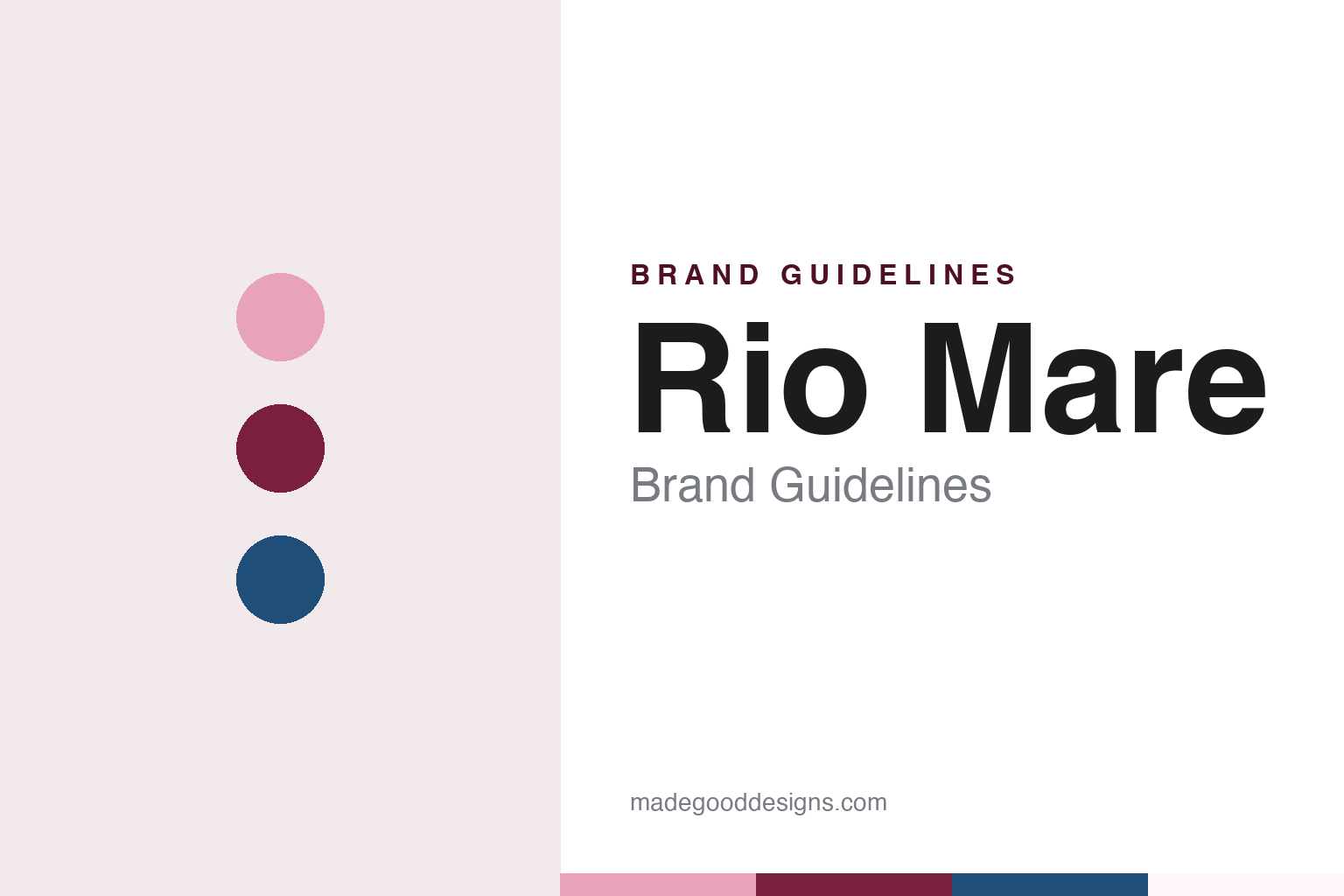
Rio Mare Brand Guidelines
Bolton’s pink-can tuna from Cermenate, registered 1965.
Aa
Two constants: a tin pink, deep berry and sea blue palette and a friendly grotesque sans register. Abstract homage — not a Rio Mare product or mark; no can, label or logo is reproduced.
Trinity Alimentari
A tuna brand from a canned-meat company.
Rio Mare is the tuna brand of the Milan-based Bolton Group, and it began inside a canned-meat business. Bolton traces its origins to Exportex, a Milan distributor of consumer goods founded in 1949 by Joseph Nissim, according to English and Italian Wikipedia. In 1960, Italian Wikipedia says, Nissim acquired ICIS, a canned-meat maker at Cermenate, in the province of Como, whose brand was Manzotin. In 1965 the company was renamed Trinity Alimentari, and it began canning tuna under the Rio Mare name, which became its flagship.
Bolton says the trademark was registered in Milan on 12 November 1965, and credits Nissim with the idea behind it: selling tuna in single portions rather than in large cans. Rio Mare’s Italian website dates both Trinity Alimentari and the building of the Cermenate tuna plant to 1965. Sources differ on the launch itself: Bolton’s brand page says Rio Mare was launched in 1965 but also carries the line “Revolutionary since 1967,” and the Milan daily Il Giorno gave 1967 as the launch year in January 2025.
The group’s structure changed around the brand. Italian Wikipedia records that Bolton Group B.V. was formed in Amsterdam in 1978 and took control of Exportex and Trinity in 1981, that the registered office moved to Milan in 2012, and that since a 2017 reorganisation Bolton Group S.r.l. has been controlled by Factor Holding, the Nissim family’s holding company. Trinity Alimentari was renamed Bolton Alimentari in 2003; the brand now belongs to Bolton Food, the group’s food division, and Italian Wikipedia lists Marina Nissim as the group’s chair.
Colour
The pink can and the breadstick.
Rio Mare’s best-known asset is a colour. Its Italian website calls the pink can (“lattina rosa”) the one that would become Italians’ favourite over the years, and Bolton writes that “the famous pink packaging quickly won over Italian families.” The same website gives the line that went with it: tuna “così tenero che si taglia con un grissino” — so tender it can be cut with a breadstick. Italian Wikipedia says the brand became known early through advertisements on Carosello, the evening advertising programme of the Italian state broadcaster RAI.
The company’s timeline lists the campaigns that followed: the first advertising for Insalatissime, its ready-made tuna salads, in 1986; a 1987 campaign for tuna in olive oil, “Mari Aperti” (“open seas”), which it calls its most remembered and most broadcast; and, around 2000, the line “Voulez-vous Paté avec moi?” for Rio Mare Paté, a fish spread in a tube that began in 1996 as Rio Mare Snack. Later the brand turned to actors. Its website welcomes Kevin Costner as a Rio Mare testimonial, and says that from 2016 Alessandro Gassmann fronted spots directed by Luca Miniero, the director of the comedy Benvenuti al Sud, set against towns of the Amalfi Coast.
The range widened in the same way. By the company’s account, Rio Mare added tuna in natural juice and in extra virgin olive oil in the 1980s, salmon fillets in 1992, mackerel fillets in the 1990s, a pressure-cooked tuna “trancio” in 2000 and hand-prepared tuna fillets in the 2000s; Rio Mare Leggero and grilled mackerel fillets followed in 2015. It first went abroad in 1978, to Greece, according to both the company and Italian Wikipedia. A Gambero Rosso profile of the brand describes the pink tin as an icon of tuna in oil.
Typography
Design and documentation.
The seven brands in this group are all tinned-fish names, from brands based in Spain, Italy and the United States: Matiz, Palacio de Oriente, Albo, Rio Mare, Mare Aperto, AsdoMAR and Wild Planet. Tinned-fish brands sit at many different points in the trade, from family canneries that still carry a founder’s name to labels that belong to much larger food groups, and the same name can appear on a delicatessen shelf and in a supermarket aisle. Two of the seven share an owner: Italy’s Bolton Group, based in Milan, lists both Rio Mare and Wild Planet among its food brands, having announced its acquisition of Wild Planet in August 2021.
A tinned-fish brand’s identity is carried less by the fish than by the tin: its label, its colours, its name and the place it promises. The company behind a name may have changed hands, moved its canning or bought its fish from far away, which makes the plain questions worth asking: who started the brand, who owns it now, and where its fish is caught, packed and canned.
Each guide separates what independent sources record from what the company says about itself — its founding story, its owners over time, where its fish is processed and how its tins and labels have changed — and marks plainly what rests only on the company’s own word.
Aa
A friendly grotesque sans for a brand built on one pink can. (Specimen set in Archivo, a sans-serif STAND-IN; NOT the Rio Mare logo.)
Rio Mare
Made in Cermenate, and elsewhere.
Bolton built a group around Rio Mare. Italian Wikipedia records its purchase of the French brand Saupiquet in 1999, of the Spanish canner Garavilla, the owner of Isabel, in two steps in 2015 and 2016, and of the American tuna company Tri Marine in 2019. English Wikipedia adds a 40 per cent stake in Spain’s Grupo Calvo in 2012 and the American canned-fish brand Wild Planet in August 2021, and calls Rio Mare the group’s flagship tuna brand.
Where the cans are filled is only partly documented. Bolton’s 2017 sustainability report, as cited by Italian Wikipedia, listed plants at Cermenate and at Quimper in France, with Rio Mare production concentrated at Cermenate. In January 2025 Il Giorno reported a 2025–2027 plan to add jobs and a night shift at Cermenate for Rio Mare and Insalatissime, even though Bolton also has factories in Spain and Morocco and production sites in South America and Oceania. Not every Rio Mare product is made in Italy: in March 2013 Bolton’s press office told the food website Il Fatto Alimentare that Rio Mare tuna fillets were processed entirely in Thailand, and the label of the pack in question gave Thailand as the origin.
Bolton also presents the brand through sourcing. Italian Wikipedia says Bolton was a founding member of the International Seafood Sustainability Foundation in 2009, launched its “Qualità Responsabile” programme in 2011 and signed an agreement with WWF in 2016; Bolton says it aims for all Rio Mare tuna to come from MSC-certified fisheries by 2030.
For a design guide, Rio Mare shows how one colour on one can can carry a brand for six decades. Compare Saupiquet and Isabel, two canned-fish brands Bolton later brought into the same group. For this guide we use a tin pink, a deep berry and a sea blue with a sans, an unofficial interpretation; no product or logo is reproduced.
Explore & save
Keep Rio Mare’s identity on hand — save it to a board in the Made Good inspiration library.
Rio Mare identity set
Pin the Rio Mare tin pink, deep berry and sea blue palette and the friendly grotesque sans register to your own board.


