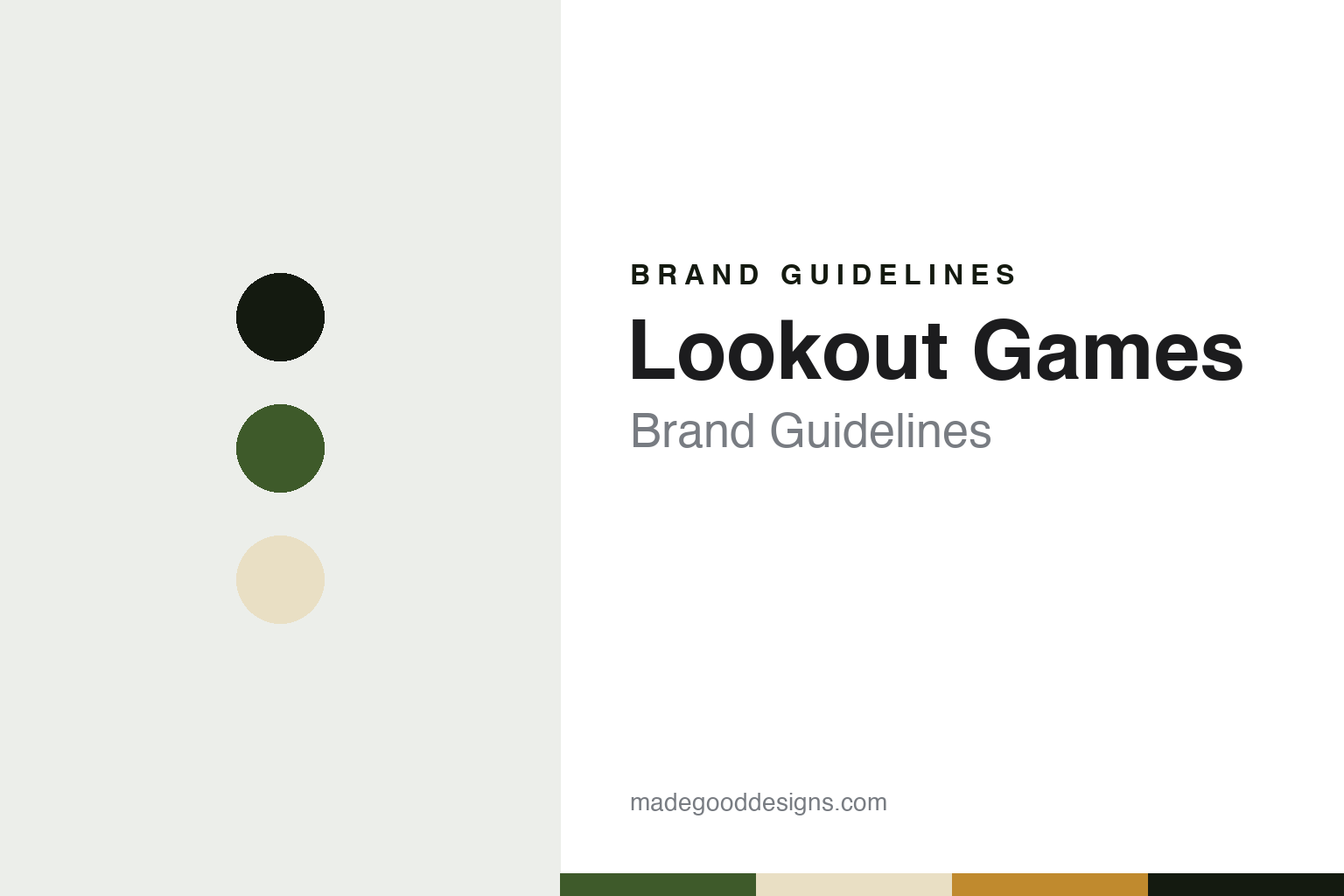
Lookout Games Brand Guidelines
The Schwabenheim publisher of Agricola, Asmodee-owned since 2018.
Aa
Two constants: a Lookout field green and wheat palette and a Farmhouse serif register. Abstract homage — not a Lookout product or mark; no game, box, logo or artwork is reproduced.
Lookout Spiele
A small publisher in Rhenish Hesse.
Lookout Games — Lookout Spiele in German — was founded in 2000. German Wikipedia names its founders as Hanno Girke and Uwe Rosenberg; English Wikipedia adds the designer Marcel-André Casasola Merkle, so we give both accounts. The company is a GmbH based in Schwabenheim an der Selz, a municipality in Rhenish Hesse, near Mainz, and its website’s legal notice, read in October 2026, still gives that address and names Hanno Girke as the person who represents the company.
Its original purpose, German Wikipedia says, was to market the founders’ own game ideas and special editions. One of those was Bohnanza, the bean-trading card game Rosenberg had first published with Amigo in 1998: around the Essen game fair each year, Lookout released a limited run of 2,500 copies, according to German Wikipedia.
Its first game of its own was Attribut, a small card game by Casasola Merkle that, English Wikipedia says, was first played online at Brettspielwelt before it appeared in print. The Spiel des Jahres jury put Attribut on its recommendation list in 2003, its own website shows. From 2005, English Wikipedia says, Lookout also published titles from the American company Z-Man Games in Germany, a link that ran the other way when Agricola was translated.
Colour
Agricola and the farming games.
The game that made Lookout’s name was Agricola, designed by Uwe Rosenberg and released at the Spiel fair in Essen in 2007. In 2008 the Spiel des Jahres jury gave it a special prize as a “Komplexes Spiel” — a complex game — noting that “because of its wealth of material and its detailed rules, the game makes high demands on players,” in our translation of the jury’s statement. The English edition was published by Z-Man Games in July 2008, English Wikipedia says, and a second edition by Mayfair Games in May 2016.
Rosenberg followed it with Le Havre in 2008, a game set in the French port in which players collect goods such as fish and wood to feed their community and build ships, English Wikipedia says; Hanno Girke edited it, and Lookout released the English edition itself, alongside the German one. Then came Caverna in 2013 — sold in English as Caverna: The Cave Farmers, the title ICv2 used in 2018. Lookout also published two-player spin-offs and Patchwork, Rosenberg’s game of 2014; and in 2020, Hallertau, English Wikipedia says.
Not every hit was Rosenberg’s. Isle of Skye, by Alexander Pfister and Andreas Pelikan, was published by Lookout in 2015 and won the Kennerspiel des Jahres, the jury’s prize for connoisseurs’ games, in 2016, according to the Spiel des Jahres website and German Wikipedia’s list of winners. More recently Mischwald, by the designer known as Kosch — the word means “mixed forest”, was published in 2023 and placed on the Kennerspiel recommendation list in 2024, the jury’s website shows. In English the game is sold as Forest Shuffle.
The catalogue is now large. In October 2026 Lookout’s games page listed 143 titles in 22 families — among them Agricola, Patchwork, Isle of Skye and Forest Shuffle, Nusfjord, the Grand Austria Hotel games, and a family of 18XX railway games headed by 1830 – Railways & Robber Barons, alongside Camel Up and a run of “paper point and click” books.
Typography
Board-game publishing.
The seven brands in this group are all board-game publishers: Lookout Games, Gamewright, Thunderworks Games, North Star Games, Devir, Horrible Guild and Bézier Games. Board-game publishers sit at many different points in the hobby, from small studios built around the work of one or two designers to companies that now belong to much larger games groups, and a single title can be sold everywhere from a specialist game shop to a toy aisle.
A publisher’s identity is usually carried less by a single box than by a name, a logo on the box and the games it becomes known for, because the company behind the name may have changed hands, moved, or licensed its games to other publishers in other countries. That makes the questions behind each name worth asking plainly: who started it, who owns it now, and which games and designers made its reputation.
Each guide separates what independent sources record from what the company says about itself — its founding story, its owners over time, its best-known games and any honours from named awarding bodies — and marks plainly what rests only on the company’s own word.
Aa
A farmhouse serif — the publisher of Agricola. (Specimen set in Fraunces, a serif STAND-IN; NOT the Lookout logo.)
Lookout Games
From Mayfair to Asmodee.
Lookout did not stay independent. Mayfair Games, the American publisher, “acquired a controlling interest in Lookout in 2013,” the trade site ICv2 reported. On 9 February 2018 ICv2 reported that the Asmodee group had announced the acquisition of Lookout GmbH as Mayfair withdrew from game publishing, and that “Lookout will remain an independent studio,” with ASS Altenburger continuing to distribute its games in German and Asmodee North America taking over distribution in North America. German Wikipedia dates the change to January 2018 and describes Lookout as an independent studio within the Asmodée group; English Wikipedia gives February. Asmodee has owned Lookout since 2018.
The company also takes public positions. Its website carries a page for #spielendfuertoleranz — “gaming for tolerance” — an initiative against social exclusion, antisemitism and xenophobia founded by the reviewers Udo Bartsch, Harald Schrapers and Martin Klein. Lookout says that, as a company of many people, it holds as many opinions on the subject as it has employees, and it publishes statements from individual staff; the page was last changed in March 2022.
We found no published brand guidelines and no statement of where Lookout’s games are printed in the sources we checked. Its identity lives mainly in its game titles, several of which — Agricola, Le Havre, Hallertau, Mischwald — are named after farming, a port, a hop region and a forest.
For a design guide, Lookout Games shows how a small publisher can build an identity around one designer’s farming games and keep its name inside a much larger group. Compare Asmodee, the group that has owned it since 2018, and Kosmos, another German games publisher. For this guide we use a field green, a wheat and a harvest gold with a serif, an unofficial interpretation; no product or logo is reproduced.
Explore & save
Keep Lookout Games’s identity on hand — save it to a board in the Made Good inspiration library.
Lookout Games identity set
Pin the Lookout field green and wheat palette and the Farmhouse serif register to your own board.