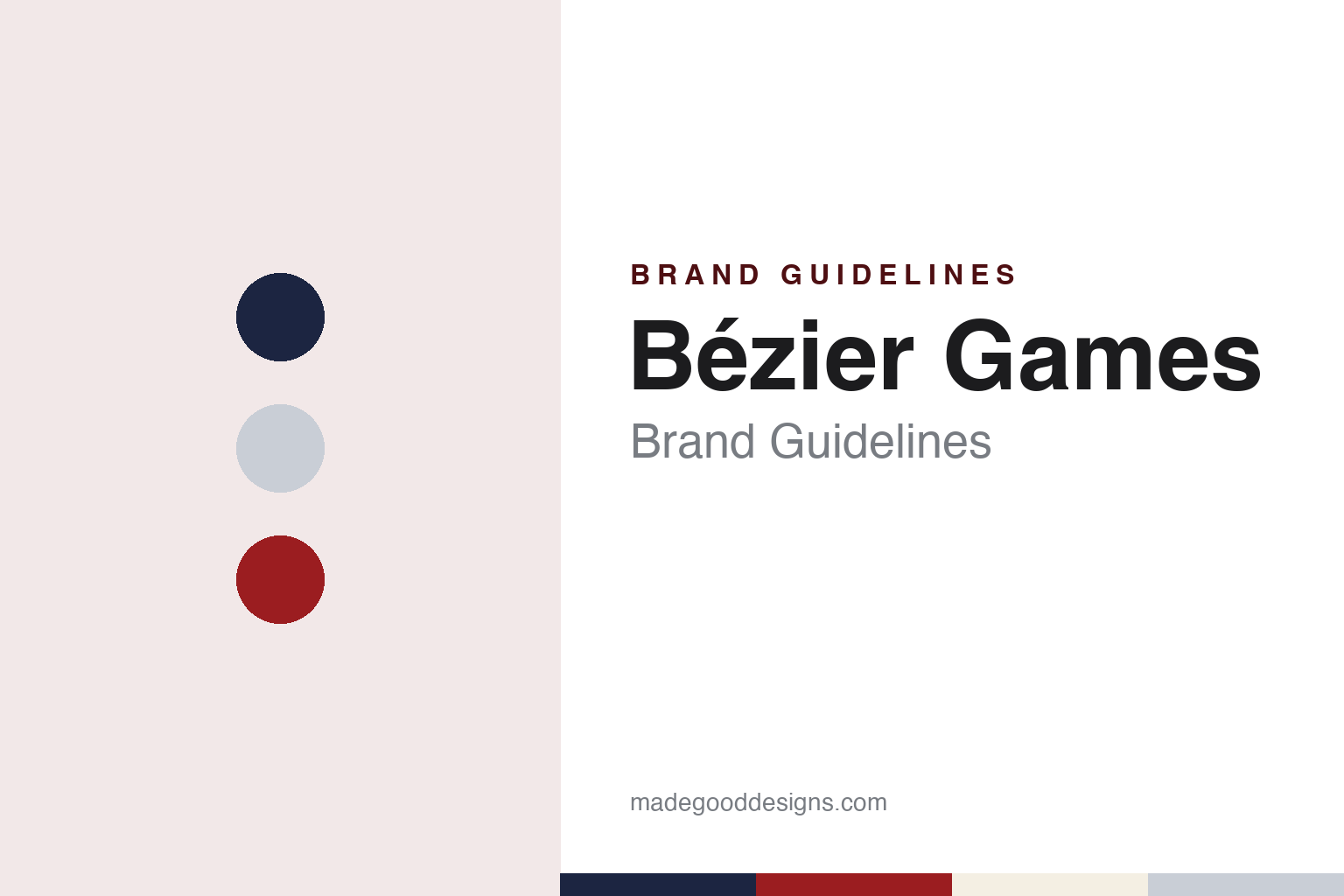
Bézier Games Brand Guidelines
Ted Alspach’s werewolf publisher, founded 2006.
Aa
Two constants: a midnight navy, werewolf red and moon silver palette and a soft display serif register. Abstract homage — not a Bézier Games product or mark; no box, card, logo or artwork is reproduced.
From Illustrator to werewolves
A software product manager’s game company, started with one small card game.
Bézier Games is an American publisher of board and card games founded by the game designer Ted Alspach. English Wikipedia says Alspach started the company in 2006 in San Jose, California, with the publication of Start Player, a small card game of his own design that W. Eric Martin wrote about on FunandBoardgames.com in October 2006. The same article says the business took the name Bézier Games, Inc. when it incorporated in 2013, and that it moved to Louisville, Tennessee, in 2016, run by Ted and Toni Alspach. The company describes itself on its website as a maker of “richly themed board games for friends and families to play together.”
Alspach came to games from software and publishing. English Wikipedia’s article on him says he was group product manager for Illustrator and the Creative Suite at Adobe from 1999 to 2006, and that he wrote more than 30 books on graphics and desktop publishing, among them titles in the Illustrator For Dummies series. His first book, The Macworld Illustrator Bible (1995), carried a foreword by Pierre Bézier, the French engineer after whom Bézier curves are named, the same article says. It also credits Alspach with two typefaces, RansomNote and LeftyCasual.
The early catalogue mixed Alspach’s own designs with add-ons for other designers’ games: English Wikipedia lists a run of expansions for the railway game Age of Steam released by the company between 2006 and 2011. Over time the list widened to games by other designers, and the article on Alspach names Tom Lehmann, Friedemann Friese, Scott Caputo and Rob Daviau among those the company has published.
The title that came to define the company was Ultimate Werewolf. English Wikipedia’s article on the game says Bézier published it in 2008, and traces it to Werewolf, Andrew Plotkin’s reworking of Mafia, the party game Dimitry Davidoff created in 1987. In Ultimate Werewolf a village of players tries to find the werewolves hidden among them, and one player normally acts as moderator, reading the script that runs each night. In October 2014 the fantasy and gaming site Black Gate described the game as designed by Ted Alspach and published by Bézier Games, with expansions and a deluxe edition from the same company.
Colour
One night, one vote and an app as narrator.
Bézier’s best-known design compressed that game into a single round. One Night Ultimate Werewolf, credited to Akihisa Okui and Ted Alspach, was reviewed by the blog Theology of Games in March 2014 as a game for three to ten players lasting five to ten minutes. English Wikipedia describes it as playing out over one “night,” with only one round of discussion, voting and elimination. A free companion app for iPhone and Android narrated the night phase, the 2014 review noted, taking over the moderator’s job. In October 2014 Black Gate reported that Bézier was taking a follow-up, One Night Ultimate Werewolf Daybreak, to Kickstarter, and English Wikipedia lists later spin-offs including One Night Ultimate Vampire, One Night Ultimate Alien and One Night Ultimate Super Villains.
The strategy side of the catalogue began with Suburbia, a tile-laying city-building game Alspach designed, published in 2012. American Mensa named Suburbia one of its five Mensa Select winners at its Mind Games event in April 2013, and Castles of Mad King Ludwig, another Alspach design, received the same seal in 2015, according to American Mensa’s press releases for those years. Both lists also included a game from Gamewright: Forbidden Desert in 2013 and Dragonwood in 2015. The trade site ICv2 reported the 2015 honour in May of that year.
The word game Werewords, which English Wikipedia dates to 2017, carried the werewolf idea into guessing words. Its German edition, Werwörter, was published by Ravensburger.
Card games kept the werewolf thread running. ICv2 reported in May 2019 that Bézier would launch Silver, an Alspach card game for two to four players in which each player leads a village of five character cards, at Gen Con that August, followed in October by a stand-alone expansion, Silver Bullet. The same report said the company was releasing a revamped edition of Suburbia that autumn.
Typography
Design and documentation.
The seven brands in this group are all board-game publishers: Lookout Games, Gamewright, Thunderworks Games, North Star Games, Devir, Horrible Guild and Bézier Games. Board-game publishers sit at many different points in the hobby, from small studios built around the work of one or two designers to companies that now belong to much larger games groups, and a single title can be sold everywhere from a specialist game shop to a toy aisle.
A publisher’s identity is usually carried less by a single box than by a name, a logo on the box and the games it becomes known for, because the company behind the name may have changed hands, moved, or licensed its games to other publishers in other countries. That makes the questions behind each name worth asking plainly: who started it, who owns it now, and which games and designers made its reputation.
Each guide separates what independent sources record from what the company says about itself — its founding story, its owners over time, its best-known games and any honours from named awarding bodies — and marks plainly what rests only on the company’s own word.
Aa
A soft display serif for a storybook, night-time register. (Specimen set in Fraunces, a serif STAND-IN; NOT the Bézier Games logo.)
Bézier Games
A designer-led publisher, and a name with two spellings.
The catalogue has kept growing around the same designer. English Wikipedia’s list of the company’s games runs to about 150 titles and includes the train game Maglev Metro (2021 onward) and Xylotar (2024), alongside a second edition of the card game CABO (2019). In October 2026 the company’s own website was promoting The Game Makers, a game in which, the company says, players are board-game manufacturers racing to build a collection of classic modern games.
The name appears in two forms. English Wikipedia titles the company Bézier Games, with the accent, while American Mensa’s press releases and ICv2’s reports write it as Bezier Games, and the company’s web address, beziergames.com, carries no accent. The name also needs a little care online: Creative Bloq has covered a browser exercise called “The Bézier Game” that teaches the pen tool in drawing software, which has nothing to do with the board-game publisher.
For a design guide, Bézier Games shows how a small, designer-led publisher can build a recognisable family of products from one idea — the hidden werewolf — and a handful of repeated title words, then stretch the same name across city-builders, castle-builders and word games. Compare Czech Games Edition, the Czech publisher of the word game Codenames, and Stonemaier Games, the American publisher of Wingspan and Scythe. For this guide we use midnight navy, werewolf red and moon silver with a serif, an unofficial interpretation; no product or logo is reproduced.
Explore & save
Keep Bézier Games’s identity on hand — save it to a board in the Made Good inspiration library.
Bézier Games identity set
Pin the Bézier Games midnight navy, werewolf red and moon silver palette and the soft display serif register to your own board.


