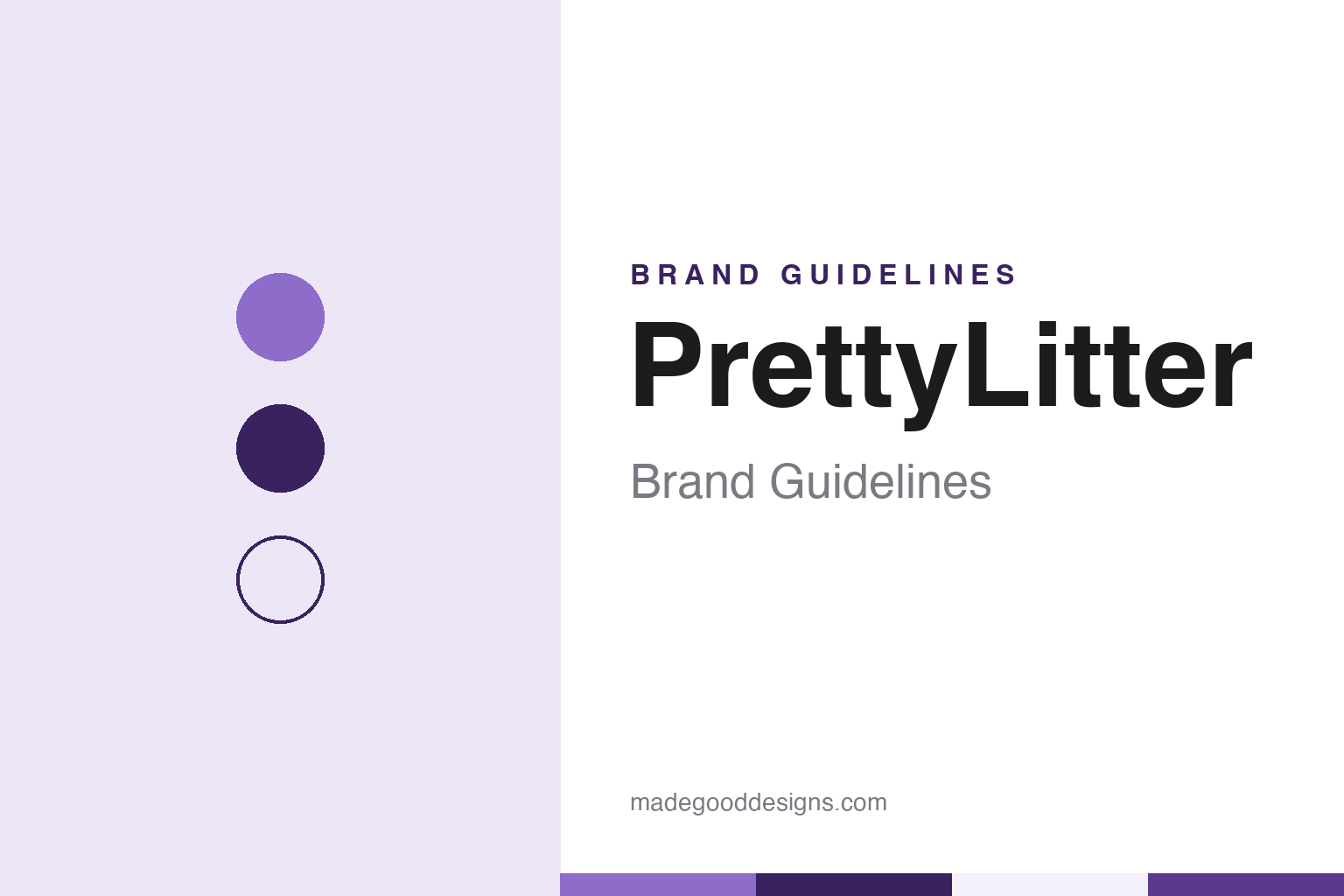
PrettyLitter Brand Guidelines
Daniel Rotman’s 2015 crystal litter, owned by Mars since 2021.
Aa
Two constants: a crystal violet, plum and lilac palette and a geometric sans register. Abstract homage — not a PrettyLitter product or mark; no bag, logo or litter is reproduced.
A litter born on reality television
A Silicon Valley show, a pitch and a founder from outside the pet trade.
PrettyLitter is a cat litter made of silica-gel crystals, sold largely by subscription and delivered by mail. It was founded in 2015 by Daniel Rotman, who is still listed on the company’s website as founder and chief executive, and it is based in Los Angeles. Since 2021 it has belonged to Mars Petcare, the pet-care division of the American food company Mars. The company writes its name as a single word with two capitals, and its website is prettylitter.com.
The brand began on television. In June 2015 Variety reported the cast of Startup U, an ABC Family docu-series set in Silicon Valley in which the participants went through a seven-week program at Draper University, the school led by the venture capitalist Tim Draper, before pitching their ideas to investors. Variety said the series followed ten participants and came from Ugly Brother Studios, with Draper among its executive producers. The show premiered on 18 August 2015.
Forbes reported in May 2019 that the litter idea was pitched on the show by a contestant, the pet blogger Carly Martinetti, with Rotman helping to build the concept off-screen while the series was filming. PrettyLitter won the show’s consumer-product category, the magazine reported, and when Martinetti decided not to develop the idea further, Rotman took ownership of the business.
Rotman came to cat litter from outside the pet trade. According to Forbes, he studied at the University of California, Berkeley, took a master’s degree at Harvard, where he was a Gleitsman Fellow, worked for the chair of the House Foreign Affairs Committee in the US Congress, and then founded a funding organisation for nonprofits before turning to the litter.
Colour
An apartment start-up, shaped by its customers.
The company was a one-person operation at first. Rotman officially started it later in 2015 and ran it out of his apartment, packing and shipping orders himself, Forbes reported; the first bags reached customers in early 2016. By 2019, the magazine said, the company was based in Los Angeles and had staff around the country. Rotman told Forbes that the litter took about seven months to bring to market, helped by the contacts that came with the Startup U win.
The product kept changing after launch. Rotman told the magazine that most changes came once the litter was already on sale and grew out of customer feedback: crystals made softer on cats’ paws, materials changed to be less dusty, and larger bags after customers said a single bag did not last long enough.
The material is the centre of the brand. The company says the litter is made from non-toxic amorphous silica gel and contains no crystalline silica. Its site sets out the difference between amorphous silica, or silica gel, which it says is also used in food additives, toothpaste and cosmetics, and crystalline silica such as quartz. The company presents the product as a colour-changing crystal litter; English Wikipedia describes it as a lightweight, crystal-based litter. The company says it works with outside suppliers for its materials, and its website names Jennifer Cookson as its director of research and development innovation, the person who signs its statement on product standards.
Selling direct also shaped the identity. The website is built around a subscription, with deliveries at a frequency the customer chooses. The company says it ships to the United States, Canada and Mexico, and that single bags are also sold at Target, Walmart and Chewy.
Typography
Design and documentation.
The seven brands in this group are all cat-litter names: World’s Best Cat Litter, Tidy Cats, Fresh Step, Cat’s Best, Catit, PrettyLitter and Dr. Elsey’s. Cat-litter brands in general sit at many different points in the pet trade, from names that still carry a founder’s story to labels that now belong to much larger consumer-goods or pet-care groups, and a single brand can be sold everywhere from a supermarket aisle to a pet shop or an online subscription.
A litter brand’s identity is usually carried less by the product itself than by a bag or box, a name and the material it promises, because the company behind the name may have changed hands, moved its production or grown far beyond the place where it started. That makes the questions behind each name worth asking plainly: who started it, who owns it now, and where its litter is actually made.
Each guide separates what independent sources record from what the company says about itself — its founding story, its owners over time, where its litter is made and how its packaging has changed — and marks plainly what rests only on the company’s own word.
Aa
A clean geometric sans for a direct-to-consumer register. (Specimen set in Poppins, a geometric sans-serif STAND-IN; NOT the PrettyLitter logo.)
PrettyLitter
From a subscription start-up to a brand inside Mars Petcare.
The start-up did not stay independent for long. Bloomberg reporters Crystal Tse and Kiel Porter, citing people with knowledge of the matter, reported on 7 September 2021 that Mars had agreed to acquire PrettyLitter, and a representative told the news agency that Mars’ pet-care division had agreed to buy the company in May of that year. In a statement the representative described Mars Petcare’s scientific expertise and long experience as a complement to PrettyLitter’s technology. The German trade publisher Dähne’s petworldwide reported the purchase on 21 September 2021, noting that the brand had until then sold its products direct.
Under Mars, the name and the direct model have been kept, and English Wikipedia lists Mars as the parent company and Los Angeles as the headquarters. In October 2026 the PrettyLitter website still gives the company as PrettyLitter, Inc. in its footer, lists Rotman as founder and chief executive, and its email sign-up refers to “other Mars Petcare Brands.” That places PrettyLitter in the same group as the cat food Whiskas and the pet-food maker Royal Canin.
For a design guide, PrettyLitter shows how a litter that started as a reality-television pitch and an apartment mail-order business built a brand around a single material and a subscription before joining Mars Petcare. Compare Whiskas, Mars’s purple cat food, and Royal Canin, the pet food from the Gard owned by Mars since 2002. For this guide we use crystal violet, plum and lilac with a geometric sans, an unofficial interpretation; no product or logo is reproduced.
Explore & save
Keep PrettyLitter’s identity on hand — save it to a board in the Made Good inspiration library.
PrettyLitter identity set
Pin the PrettyLitter crystal violet, plum and lilac palette and the geometric sans register to your own board.