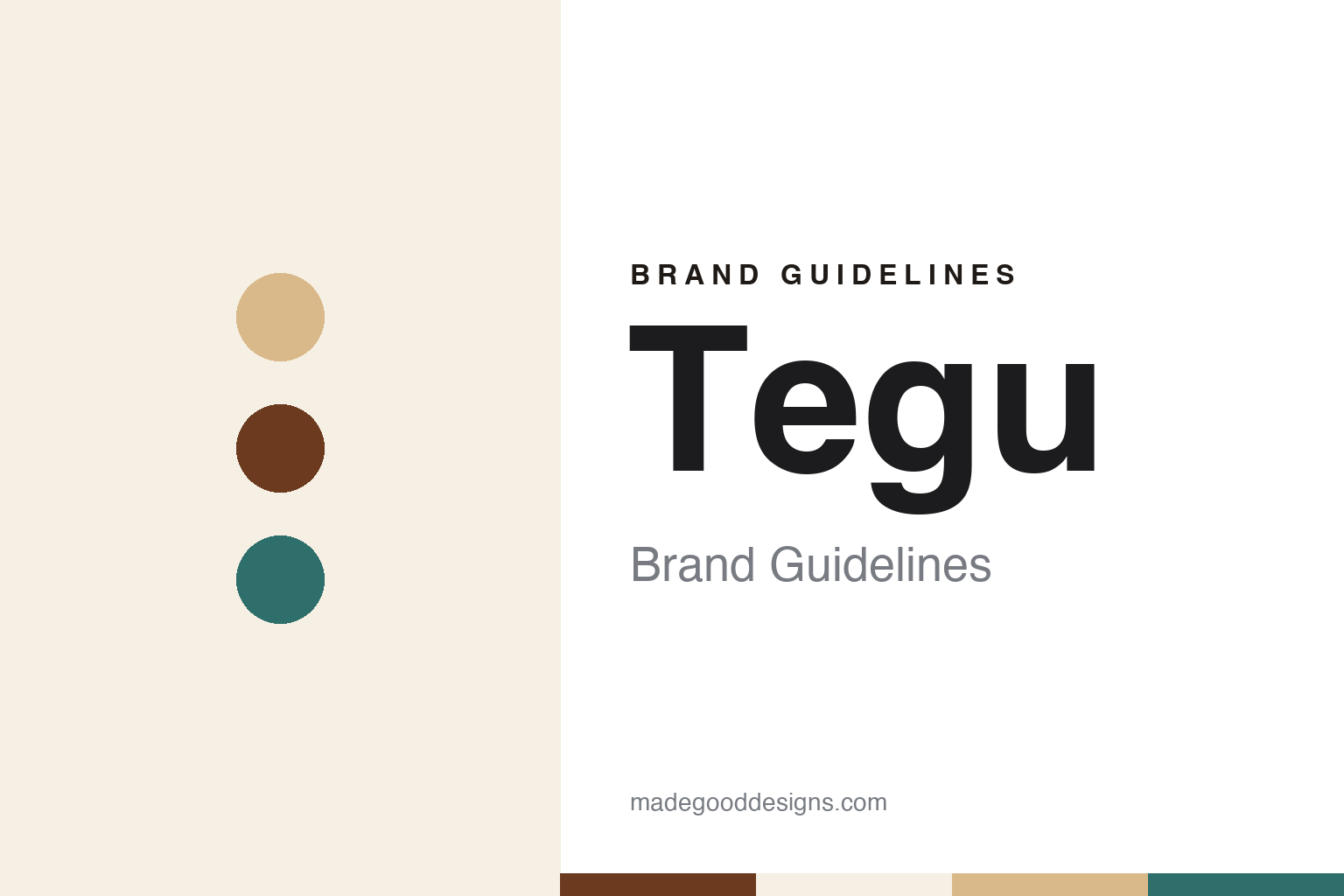
Tegu Brand Guidelines
Magnetic wooden blocks made in Honduras.
Aa
Two constants: a mahogany, blond hardwood and forest teal palette and a geometric sans register. Abstract homage — not a Tegu product or mark; no block, box or logo is reproduced.
Named after a capital
Two brothers, a business plan and Tegucigalpa.
Tegu was started by two brothers, Chris and Will Haughey. The Victoria and Albert Museum, which holds a Tegu set in its collection, says the company was founded in 2006 and launched its range of magnetic wooden construction blocks in 2009. English Wikipedia gives the same founding year in its summary, while its history section says Chris left the Boston Consulting Group to found Tegu in March 2007; we give both dates.
The name is a place. The V&A says the company is named after Tegucigalpa, the capital of Honduras, and that is where the business was built. Christianity Today, profiling the brothers in its July/August 2016 issue, described them as having backgrounds in mission work and finance, and degrees in business and engineering, and said they set out to start a business in Honduras that would use the country’s hardwoods. Chris moved to Tegucigalpa to open the manufacturing plant, the magazine reported, and Honduran employees had been making the company’s blocks since 2010.
The company tells the same story in its own words. Its website says the founders asked whether they could “create a for-profit company based in Honduras,” and says: “We’re in Honduras by choice and we’re here to stay.”
The brothers split the work between them. The San Francisco Chronicle, in a March 2016 profile, said they were raised in St. Louis; that Chris, who studied mechanical engineering at Stanford, handled design and engineering; and that Will, who had worked at Goldman Sachs, handled financing and marketing. Both left full-time jobs within eighteen months of starting the company, the paper reported.
The product took shape in California before it moved to Honduras. The Chronicle reported that a prototype existed by 2007, that the first models with rounded wooden edges were made at Philip Roberts Models in Palo Alto, and that Chris drew on model-makers and classmates from Stanford’s design school. The paper said the manufacturing method was covered by a patent.
Colour
A cube, hidden magnets and two kinds of wood.
Tegu’s product is a wooden block with magnets inside. The V&A’s catalogue entry, for a set dated 2012 with a cardboard box, lists its materials as wood, card and magnets and gives its place of origin as Honduras for manufacture and the United States for design. The museum describes the blocks as proportionally scaled, with the cube as the foundation piece, and says the magnets are hidden inside and oriented in a deliberately random way.
The company’s own account matches the museum’s. Its website says every block is designed to work with the others around a core cubic module, and that “the cube was the first piece we made.” The point of the design is that the pieces join without pegs, studs or glue; the magnet does the work, and the wood stays plain on the outside.
The V&A says the blocks are made from sustainably harvested wood sourced from Honduras and Guatemala. English Wikipedia names the woods as huesito, mahogany, beech and primavera, though that section of the article is not footnoted, so we give it as Wikipedia’s description rather than the company’s.
The museum entry also notes Tegu’s link between sales and tree planting in Honduras, which the company presents as part of its purpose; we leave the figures to the company.
The range grew out of the cube. The Chronicle listed the shapes in 2016 as cubes, planks, angles, columns and wheels, sold in sets in either neutral or rainbow colours, with every piece compatible with every other. It said the finishes were water-based. Instead of step-by-step instructions, the paper reported, Tegu packed its sets with booklets of ideas, and Will Haughey described the approach as “boundless play.”
Typography
Wooden toys and design.
The seven brands in this group are all toy names: Djeco, Janod, Tegu, Kapla, SmartGames, goki and Le Toy Van. Toy brands in general sit at many different points in the trade, from family firms that still carry a founder’s idea to labels that now belong to larger groups, and a single brand can be sold everywhere from a small independent shop to a department store.
A toy brand’s identity is usually carried less by a single object than by a box, a name, a colour and a way of drawing, because the company behind the name may have changed hands, moved its production or grown far beyond the place where it started. That makes the questions behind each name worth asking plainly: who started it, who owns it now, and where its toys are actually designed and made.
Each guide separates what independent sources record from what the company says about itself — its founding story, its owners over time, where its toys are made and how its boxes and logos have changed — and marks plainly what rests only on the company’s own word.
Aa
A geometric sans — clean, modular and plain. (Specimen set in Outfit, a sans STAND-IN; NOT the Tegu logo.)
Tegu
Designed in the US, made in Honduras.
Where Tegu makes its blocks is documented rather than only claimed. The V&A records Honduras as the place of manufacture, Christianity Today reported in 2016 that the plant was in Tegucigalpa and that Honduran staff had made the blocks since 2010, and the company says it established its “fully independent toy factory outside Tegucigalpa.” The Chronicle added in 2016 that the company had built the plant there from scratch and that every Tegu block was made in Honduras.
The commercial side sits in the United States. English Wikipedia gives the company’s headquarters as Rowayton, Connecticut, as well as Tegucigalpa, and describes it as a private company. The V&A’s record keeps the two halves of that arrangement apart, listing Honduras for manufacture and the United States for design; the V&A, Christianity Today and the company itself all present Tegu as the Haughey brothers’ business.
The supply side was part of the 2016 story too. The Chronicle compared the way every Tegu piece fits every other to LEGO bricks, and reported that the company’s Honduran wood came from cooperatives overseen by local non-governmental organisations, and that Tegu was working with the Rainforest Alliance towards certification of its own.
For a design guide, Tegu shows how a brand can let a material and a place carry the story. Compare Melissa & Doug, another American wooden-toy name, and Hape, another wooden-toy brand. For this guide we use mahogany, blond hardwood and a forest teal with a sans, an unofficial interpretation; no product or logo is reproduced.
Explore & save
Keep Tegu’s identity on hand — save it to a board in the Made Good inspiration library.
Tegu identity set
Pin the Tegu mahogany, blond hardwood & forest teal palette and the geometric sans register to your own board.


