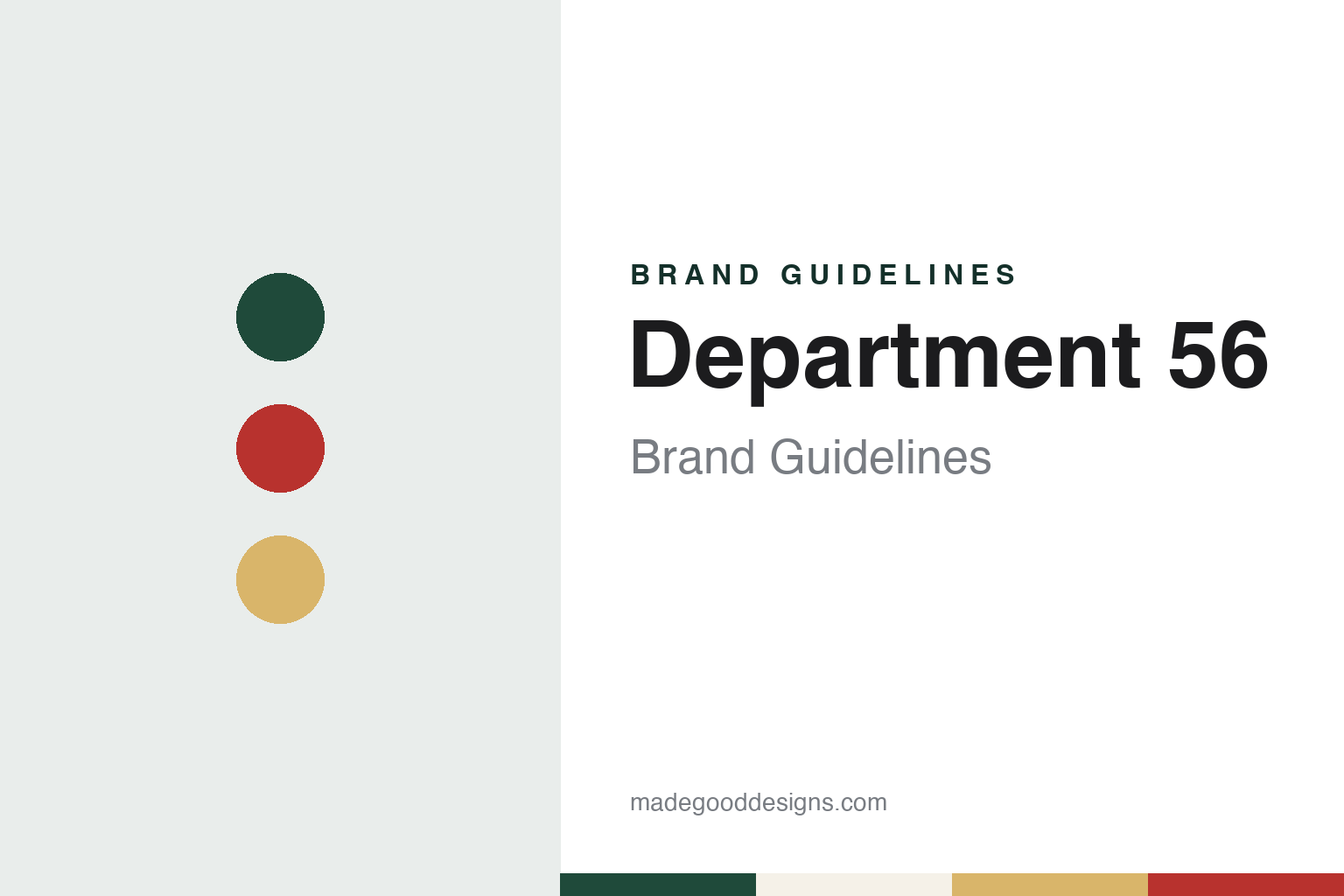
Department 56 Brand Guidelines
A village of lit houses, built one piece a year.
Aa
Two constants: a fir green, holly red and lamplight gold palette and a village serif register. Abstract homage — not a Department 56 product or mark; no house, figurine or logo is reproduced.
A department number in Minneapolis
The name came from a florist’s numbering system.
Department 56 takes its name from an internal label. English Wikipedia says the company was founded in 1976 as part of Bachman’s, a retail florist based in Minneapolis, Minnesota. Bachman’s identified each of its departments by number, and the number assigned to its wholesale gift imports division was 56. The name stuck when the division became a business of its own.
Wikipedia credits Edward Rudy Bazinet, a Bachman’s employee, with founding the company by persuading the Bachman family to back the new division in 1976. It says he became its first president when Department 56 was spun off as a subsidiary in 1984, that he sold the company in 1992, and that he stayed in leadership roles until he retired in 1997.
The first products set the pattern for everything that followed. Wikipedia says the brand began with the Original Snow Village, a collection of six ceramic houses issued in 1976: the Mountain Lodge, the Gabled Cottage, the Inn, the Country Church, the Steepled Church and the Small Chalet. Each Department 56 item carries its name on the bottom, and Wikipedia notes that the buildings are dated with the year of copyright rather than the year of issue, a detail collectors use when identifying pieces.
Colour
One village became many.
The single snowy town grew into a family of villages, each with its own setting. Wikipedia says the Heritage Village collection began with the porcelain Dickens’ Village in 1984, its houses depicting the England of Charles Dickens and the stories he wrote, with pieces such as The Cottage of Bob Cratchit & Tiny Tim and The Old Curiosity Shop, and buildings named for Nicholas Nickleby, David Copperfield and Oliver Twist. The New England Village and the Alpine Village followed in 1986, the first with churches, lighthouses and farm buildings, the second with pieces such as a farmhouse, a bierkeller and a grist mill.
Wikipedia says Christmas in the City, set in the 1930s and 1940s, started in 1987 with pieces such as the Palace Theatre and the Ritz Hotel, and that the Little Town of Bethlehem was issued the same year as a set of twelve pieces. The North Pole Series began in 1990 with Santa’s Workshop, the Elf Bunkhouse and the Reindeer Barn; Wikipedia says its fifteenth anniversary in 2005 was marked by five special-edition buildings that spell out “SANTA” when placed together.
The Snow Village line kept growing too. Wikipedia describes a sub-series called Christmas Lane, made up of heavily decorated suburban homes, and says that in 2011 a pair of twin brothers won a national contest to have their own decorated house turned into a Christmas Lane piece. It dates Snow Village Halloween to 1998, launched with a Haunted Mansion, and says two new villages, First Frost and Holiday In The Woods, arrived in May 2016. Licensed subjects sit alongside the original towns: Wikipedia says that as of June 2023 the company listed licences including Harry Potter, The Nightmare Before Christmas, Disney, Peanuts, The Grinch and A Christmas Story.
Typography
Design and documentation.
Christmas decor and ornament brands occupy an unusual corner of the home trade. Their products are bought for a few weeks of the year but kept for many more, unpacked from the same boxes each December and often handed down within a family, so a name in this field is asked to stand for continuity as much as for novelty.
Much of the category leans on borrowed tradition: mouth-blown glass, carved figures, village scenes and old-fashioned lettering that point back to older European workshop traditions. Behind that look, the companies themselves may be family firms, importers, designers who work with makers elsewhere, or businesses that have changed owners several times, and the place a brand calls home is not always the place its pieces are made.
Each guide separates what independent sources record from what a company says about itself — who founded it and where, who owns it now, where its pieces are produced and how its packaging and marks have looked over time — and marks plainly what rests only on the company’s own word.
Aa
A bookish Georgian-style serif. (Specimen set in Libre Baskerville, a serif STAND-IN; NOT the Department 56 logo.)
Department 56
From a florist’s division to an Enesco brand.
The company’s corporate life took several turns after Bachman’s. English Wikipedia says Department 56 was listed on the New York Stock Exchange in 1993. In 2005, after buying the tableware maker Lenox from Brown-Forman, the company renamed itself Lenox Group Inc. Wikipedia says Lenox filed for bankruptcy in 2009, and that the same year the giftware company Enesco acquired Department 56 from Lenox.
Enesco has owned Department 56 since 2009. Wikipedia’s article on Enesco says that company began in 1958 as the import division of the N. Shure Company, taking its name from the initials “N S Co”, and that its other brands include Heartwood Creek, the line it has made with the artist Jim Shore since 2002. Wikipedia says the holding company Ad Populum acquired Enesco in January 2023. Department 56 itself has been headquartered in Eden Prairie, Minnesota, since June 1991, according to Wikipedia, which also names the Snowbabies figurines among the brand’s known collections.
Collectors built their own structure around the villages. Wikipedia says the National Council of Fifty Six Clubs was founded in 1992 as an umbrella organisation for Department 56 collector clubs in the United States and Canada, and that it helps sponsor gatherings with seminars, display contests and fundraising for local charities. The council’s structure, like the villages themselves, is organised by place: Wikipedia says its member clubs are grouped into regions across the two countries.
The licensed side of the catalogue widens the cast without changing the format. Wikipedia’s June 2023 list also includes National Lampoon’s Christmas Vacation, Game of Thrones and Ghostbusters, each translated into the same lit-building and figurine language as the original Snow Village.
For a design guide, Department 56 shows how a brand can be built from a world rather than a mascot: a town, a period and a season, extended one building at a time, with the name printed on the base of every piece. Compare a family-run American decorations importer in our Kurt Adler brand guidelines and a glass-ornament house in our Christopher Radko brand guidelines. For this guide we use fir green, holly red and lamplight gold with a serif, an unofficial interpretation; no product or logo is reproduced.
Explore & save
Keep Department 56’s identity on hand — save it to a board in the Made Good inspiration library.
Department 56 identity set
Pin the Department 56 fir green, holly red and lamplight gold palette and the village serif register to your own board.


