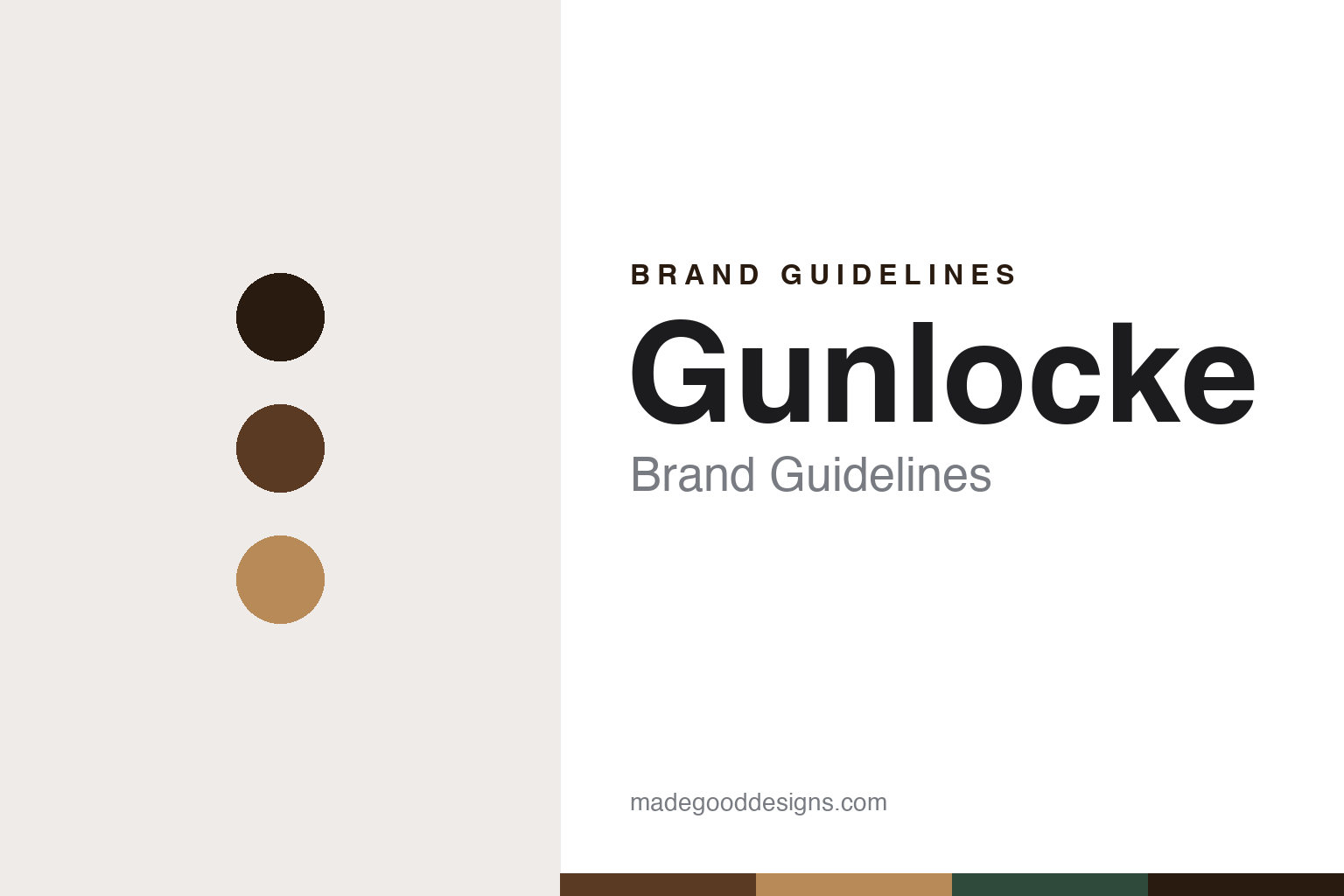
Gunlocke Brand Guidelines
A chair arm bent in steam, a village in western New York, and a name carried into the boardroom.
Aa
Two constants: a walnut, steam-bent oak and Wayland green palette and a Bookish transitional serif register. Abstract homage — not a Gunlocke product or mark; no chair, catalogue or logo is reproduced.
Wayland, 1902
A wood finisher from Binghamton and a chair works in a small village.
Gunlocke is an American maker of wood office furniture, and its name comes from the man who started it, William Henry Gunlocke. The company’s early history is set out in the International Directory of Company Histories (volume 23, St. James Press, 1998), which says Gunlocke entered the chair business in Binghamton, New York, in 1888, starting as a wood finisher and rising to become factory superintendent there. In 1902, the directory says, he and four other men moved to Wayland, a village in western New York, and founded the W.H. Gunlocke Chair Co., which it lists as incorporated in that year.
The first products were not office chairs at all. The directory says the young company made seating for the home, among them bedroom, library and lounge chairs and rocking chairs. It records that Gunlocke began to specialise in office furniture in 1911, and that in 1912 a whole department of the Wayland works was given over to steambending, the process of softening timber with steam so that it can be shaped into curved arms, rails and backs. The directory describes steambending as central to the company’s reputation for quality and craftsmanship, and it notes that the wood was air-dried before it went into the shop.
Office work brought larger customers. The directory says Gunlocke received a national corporate contract from Western Electric in the 1920s, and it states that Woodrow Wilson began a long line of United States presidents who used Gunlocke chairs. The family ran the business into the next generation: after William Gunlocke’s death in 1937, the directory says, his son Howard W. Gunlocke became president, and by then the company was also operating a second factory in Cortland, New York.
Colour
Steambending, a Chicago showroom and a chair in metal and wood.
Gunlocke’s design story is told mostly through its products and the ways it showed them. The company changed its own name in 1969: the International Directory of Company Histories says that after a change of owner that year it became The Gunlocke Company, Inc., dropping the older “Chair Co.” as its range grew beyond seating. The directory credits an armchair of around 1970 to Jens Thuesen, a designer on the company’s own staff, and it records that in 1971 Gunlocke opened a showroom in Chicago’s Merchandise Mart.
The range kept widening. In 1972, according to the directory, Gunlocke bought Sjostrom U.S.A., which added library furniture to its line. In 1987 it introduced the Exel 3 seating line and a production method the directory calls the SteamFold process. In 1996, the directory says, Gunlocke introduced the Serra chair, which combined metal and wood. By 1997 the directory lists case goods, stacking chairs, side chairs and swivel chairs, with model names such as Tremont, Medley, Chorus and Contura.
For a visual identity, that history leaves a consistent set of cues rather than a single famous mark. The name itself is a family surname, carried first as the W.H. Gunlocke Chair Co. and then as The Gunlocke Company. The material is wood, and the defining craft is the bending of that wood with steam into curved arms and backs. The setting is the executive office and the boardroom rather than the open-plan floor, and the trade showroom in Chicago has been part of how the company presented itself since the early 1970s. Our palette follows those cues: a dark walnut and a boardroom brown for text and structure, a lighter steam-bent oak for warmth, and a muted green taken from the landscape around Wayland rather than from any Gunlocke material.
Typography
Design and documentation.
The brands in this group all make furniture for workplaces: office chairs, desks, storage, panel systems and the tables and seating that fill meeting rooms, reception areas and, for some of them, hospitals and schools. Contract office-furniture makers come from very different starting points, from family workshops that once made chairs for the home to metal-goods firms and companies founded around a single product, and over the decades many of them have changed owners, joined larger groups or moved where their furniture is built.
In this trade a brand’s identity is carried less by a logo on a box than by a catalogue, a showroom, a named chair or system and the designers credited with it, because the furniture is usually chosen by architects, designers and facilities buyers rather than picked off a shelf. That makes the plain questions behind each name worth asking: who started it, who owns it now, and where its furniture is actually made.
Each guide separates what independent sources record from what the company says about itself, and marks plainly what rests only on the company’s own word.
Aa
A bookish transitional serif — formal and warm, like a carved name on a wood desk. (Specimen set in Libre Baskerville, a transitional serif STAND-IN; NOT the Gunlocke logo.)
Gunlocke
From the family to S&H, its own officers, Chicago Pacific and HON.
Gunlocke changed hands several times in the second half of the twentieth century. The International Directory of Company Histories says Sperry and Hutchinson (S&H) bought Gunlocke in 1969 and made it part of its interior-furnishings group, folding it into a furnishings division in 1974. When S&H sold off its units in 1981, the directory says, Gunlocke’s own officers bought the company. In 1987 it was bought by Chicago Pacific Corp.; in January 1989 Chicago Pacific merged into Maytag, which sold the furniture division to LADD Furniture, and LADD in turn sold Gunlocke to HON INDUSTRIES of Muscatine, Iowa, in 1989.
Gunlocke has been part of that group ever since. English Wikipedia lists Gunlocke among the office-furniture brands of HNI Corporation, the Muscatine group founded in 1944, alongside HON and Allsteel; the same article says HNI acquired Kimball International in March 2023 and Steelcase in August 2025. In a release issued through Business Wire on 8 January 2026, HNI said it “will exit its Wayland, New York, manufacturing facility in 2027” and consolidate that production into its other North American facilities. The company said all products made at Wayland would move to existing plants in its network, and that “the Gunlocke brand, its products, and its standards of quality, craftsmanship, and service will continue” as part of its portfolio. So the brand that began in Wayland in 1902 is set to be made elsewhere from 2027, while keeping its name.
For a design guide, Gunlocke shows how a furniture brand can rest on a surname, a material and a craft process rather than on a single logo, and how that identity can survive a long chain of owners. Compare it with Allsteel and HON, its sister brands under HNI. For this guide we use walnut, steam-bent oak and Wayland green with a transitional serif, an unofficial interpretation; no product or logo is reproduced.
Explore & save
Keep Gunlocke’s identity on hand — save it to a board in the Made Good inspiration library.
Gunlocke identity set
Pin the Gunlocke walnut, steam-bent oak and Wayland green palette and the Bookish transitional serif register to your own board.


