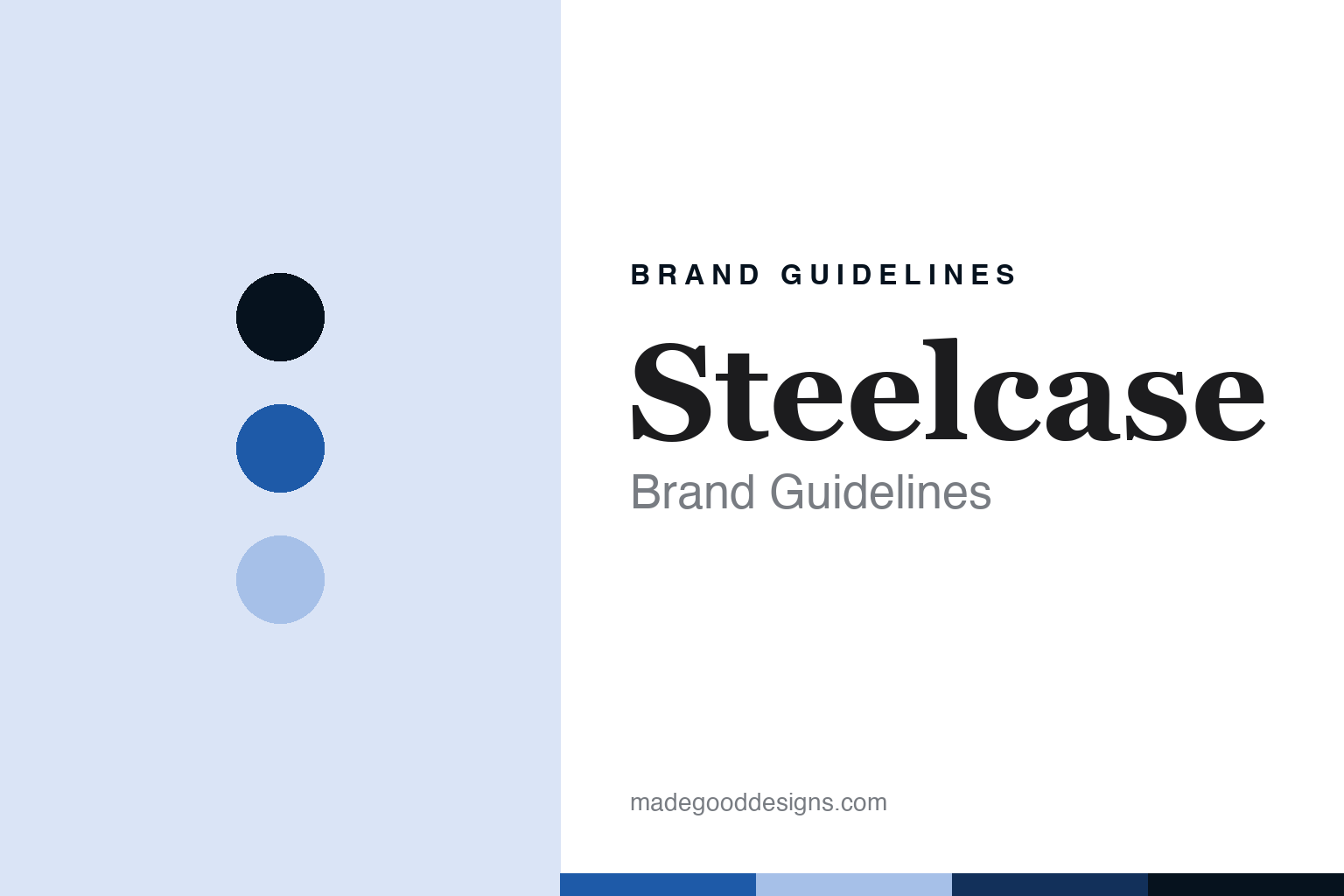
Steelcase Brand Guidelines
The contract-furniture giant, now under HNI.
Aa
Two constants: a Steelcase-blue palette and a giant-serif register. Abstract homage — not a Steelcase product or mark; no chair, seat or logo is reproduced.
The contract-furniture giant, now under HNI
Steelcase is a 113-year-old Grand Rapids maker (the Leap and Gesture chairs), long the world’s largest office-furniture company — acquired by HNI in December 2025.
Steelcase opens the office-chair round as its giant node — the century-old American maker long called the world’s largest office-furniture company, whose independence ended in a 2025 acquisition. Its answer to a round about who owns the chair world is the just-acquired one: the giant, freshly under HNI.
Its identity is the contract-furniture giant, now under HNI. The 1912 founding, the HNI ownership and the Leap and Gesture chairs are the story here. The biggest, newly bought. The contract-furniture giant, now under HNI.
(Honest notes, so the founding, the ownership change, the recalls and a naming detail are framed accurately. Steelcase sells office furniture as its heroes — the Leap, Gesture and Series 1 chairs; we report its language as the brand’s own. On founding: Steelcase was incorporated in 1912 in Grand Rapids, Michigan, as the Metal Office Furniture Company, its founder Peter Martin Wege, and it took the Steelcase name in 1954. On ownership, the key change and dated: after going public in 1998, Steelcase was acquired by HNI Corporation in a deal completed in December 2025, delisting its shares and making it a subsidiary of HNI, an Iowa company that also owns HON and Allsteel, so we write its ownership in past tense. On the recalls, dated: Steelcase issued voluntary recalls of Cachet chairs in 2011, Amia chairs in 2012 and certain swivel chairs in 2016, all fall hazards. On a naming detail: it was founded as the Metal Office Furniture Company, not as Steelcase. Its designs and the Steelcase name are IP we describe but do not reproduce; there is no official brand hex; these tones are an unofficial interpretation.)
Colour
Steelcase lives in a Steelcase blue. Click a swatch to copy the hex.
Steelcase’s identity is giant, HNI-owned and blue — a Steelcase blue, an ink, a pale blue, a deep navy, and a paper. The palette leans Steelcase blue and deep navy: a corporate, contract register that nods to the industry giant rather than a loud logo colour. It signals the contract-furniture giant, now under HNI — giant, HNI-owned and blue. The honest caveat: with no official brand hex, these values are a corporate, unofficial interpretation, not first-party colours.
The lesson is a Steelcase blue signals a giant, contract identity. Steelcase’s world is the corporate floor plate. For designers, it is a reminder that a corporate blue and a deep navy can carry a giant, contract brand — a contract tone held as an accent, not a product shot. Because a mid hue can fail as small text, keep type dark and let the colour live in the accents, palette and band. The takeaways: date the founding to 1912 and the Metal Office Furniture Company name; record the HNI acquisition in December 2025; date the recalls; and keep the world’s-largest claim attributed.
Typography
The register is a giant serif — giant, HNI-owned, blue.
Steelcase’s identity carries a giant, HNI-owned spirit — the biggest maker of its category. A giant serif captures the mood: classic, authoritative and established, the register of an industry leader. Set in a Steelcase-blue palette, the giant serif feels solid and trusted — exactly the personality Steelcase carries. It behaves like a made, working thing rather than a loud logo, mirroring a tilt-ring and a lumbar-line. (Steelcase’s real products and the name are things we describe but do not reproduce, and the exact typeface is not ours to use.) Because it is not ours to use, the honest description is “a giant-serif brand,” shown here in a stand-in. The type behaves like the brand: giant, HNI-owned and blue.
Aa
A giant-serif brand — solid and trusted. (Specimen set in Fraunces, a giant-serif STAND-IN; NOT the Steelcase logo or products.)
The chair node
Steelcase stands for the contract-furniture giant, now under HNI.
Steelcase opens the round as its giant node. A Steelcase-blue palette, a giant serif and a 1912 founding make one thing — the contract-furniture giant, now under HNI — the whole identity: giant, HNI-owned and blue. The 1912 founding is the pitch, the HNI acquisition is the change, and the Leap and Gesture chairs are the icons. The point is the biggest maker freshly bought, the anchor of the round about who owns the chair world.
Put to work, the identity is the brand told straight, the acquisition recorded and the recalls dated. A brand in this spirit would date the founding to 1912 and the Metal Office Furniture Company name, record the HNI acquisition in December 2025, date the recalls, and keep the world’s-largest claim attributed. A reader in this spirit would keep the facts right: Steelcase sells the Leap and Gesture; it was founded in 1912 in Grand Rapids as the Metal Office Furniture Company; it was acquired by HNI in December 2025; and it issued fall-hazard recalls in 2011, 2012 and 2016. Steelcase opens the round, before Haworth. The honest editorial moves are to date the founding, to record the acquisition, to date the recalls, and to attribute the claim.
For designers and brand-builders, Steelcase opens the chair node: write a giant in transition tense — and correct its founding name. The lessons: a brand can be the biggest maker of its category, here Steelcase and its contract chairs; a founding is dated to 1912 in Grand Rapids, Michigan, as the Metal Office Furniture Company under Peter Martin Wege, taking the Steelcase name in 1954; an ownership is recorded in transition tense, public on the New York exchange from 1998 and then acquired by HNI Corporation in a deal completed in December 2025 that delisted its shares and made it a subsidiary of HNI, which also owns HON and Allsteel; recalls are dated, the voluntary fall-hazard recalls of Cachet chairs in 2011, Amia chairs in 2012 and certain swivel chairs in 2016; and a claim is attributed, the description of Steelcase as the world’s largest office-furniture maker, now reinforced by the larger HNI combination. It is also a reminder to stay precise: Steelcase is the HNI-owned contract-furniture giant of the chair aisle — with the palette here an unofficial interpretation. The hook is that scale and change: Steelcase is the contract-furniture giant now under HNI, a 113-year-old Grand Rapids maker of the Leap and Gesture chairs, long the world’s largest office-furniture company, acquired by HNI in December 2025. Read that way, Steelcase is less a single chair than the contract-furniture giant, now under HNI: giant, HNI-owned, blue. The lesson for a brand is that writing a giant in transition tense and correcting its founding name reinforce the honesty, and dating the acquisition keeps it earned. Steelcase made the-contract-furniture-giant the identity — proof that a just-acquired giant can open a round.
Explore & save
Keep Steelcase’s identity on hand — save it to a board in the Made Good inspiration library.