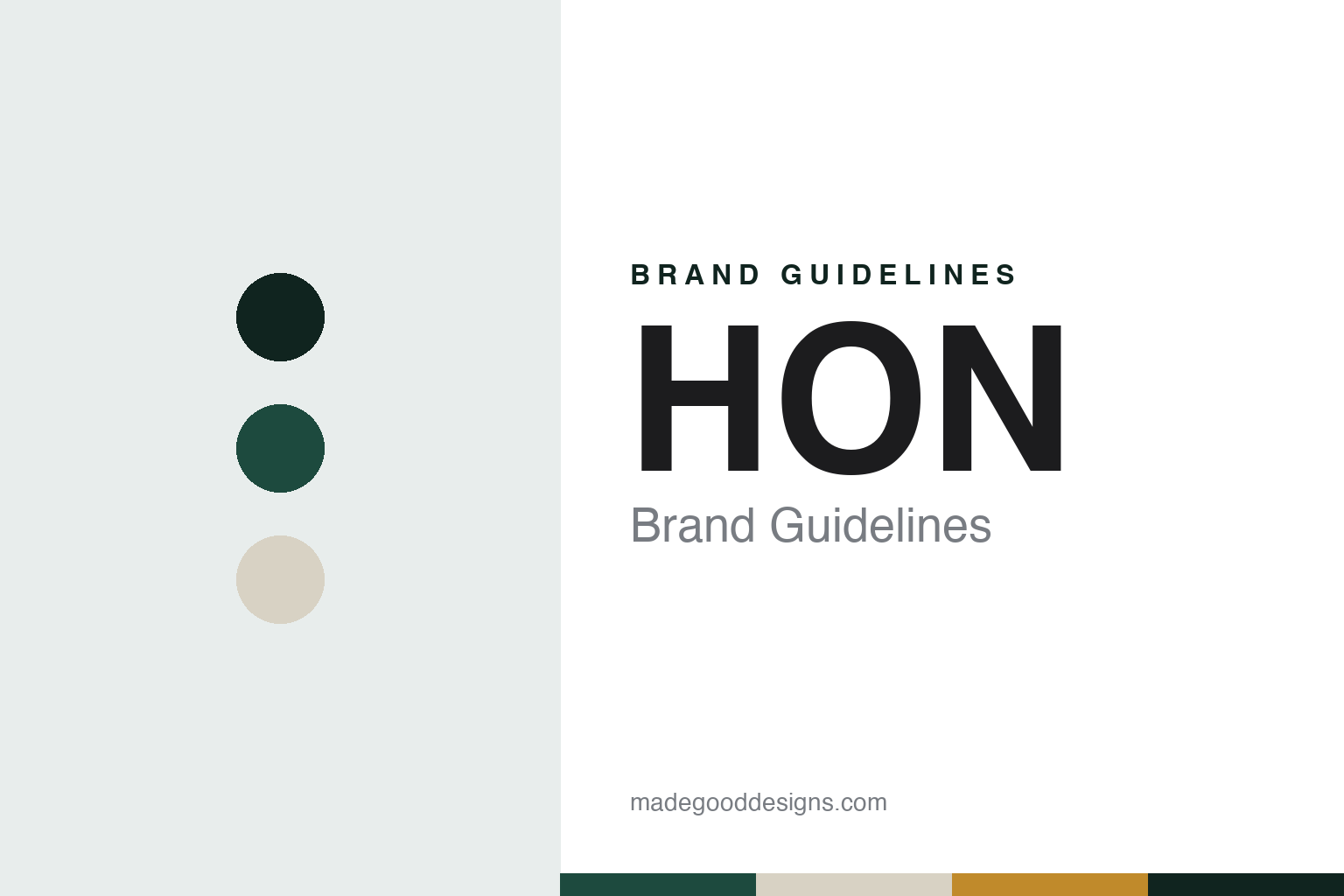
HON Brand Guidelines
A recipe-card box made from scrap aluminium, and three letters lifted from a longer name.
Aa
Two constants: a river green, recipe card and corn gold palette and a Plain workhorse sans register. Abstract homage — not a HON product or mark; no chair, desk or logo is reproduced.
Muscatine, 1944
Three men, a wartime idea and a kitchen cabinet.
HON is an office-furniture company based in Muscatine, Iowa, a river town on the Mississippi, and it is the brand that gave its name to its parent, HNI Corporation. English Wikipedia says the business was incorporated as The Home-O-Nize Company on 6 January 1944 by the brothers-in-law C. Maxwell Stanley and Clement T. Hanson, together with H. Wood Miller. Wikipedia’s article on HNI describes the three as an engineer, an advertising executive and an industrial designer respectively.
Both Wikipedia articles consulted for this guide name the third founder H. Wood Miller. Wikipedia’s biography of Stanley places the co-founding in 1943, a year earlier than the incorporation date; the incorporation date of January 1944 is the one used in this guide.
Stanley was already running a business in the same town. English Wikipedia says he had founded the engineering firm Stanley Consultants in 1939 with his younger brother Art, and that he and his wife Elizabeth later created the Stanley Foundation in 1956, now the Stanley Center for Peace and Security. All three organisations, Wikipedia notes, are headquartered in Muscatine.
The purpose of the new company was practical. According to English Wikipedia, Home-O-Nize was founded with the intent of providing work for people returning from service in the Second World War. Its name pointed at the home rather than the office: the company first made kitchen cabinets, initially in Davenport, Iowa, and then in the old US Button Company factory in downtown Muscatine.
A full history of those years exists in print. The HON Story: A History of HON Industries, 1944–1985, by James H. Soltow and C. Maxwell Stanley, was published by Iowa State University Press in 1991.
Colour
Scrap aluminium, recipe boxes and three letters.
Kitchen cabinets did not last. English Wikipedia says the company soon turned to contract work, making aluminium hoods for gas bottles for a firm called Stampings, Inc. The scrap left over from those hoods was turned into small products of its own: flower-identification labels, beverage coasters and recipe-card file boxes.
For a while the factory took whatever work came. Wikipedia lists pick-up attachments for John Deere combines, corn pickers for Associated Manufacturers Inc., and contract jobs for local firms including Red Jacket, Carver Pump and Collins Radio. In the end, Wikipedia says, it was the recipe-file boxes that led the company into the office furniture and supply business. A small steel box for index cards is a short step from a box for office records.
The brand name grew out of that shift. English Wikipedia says that in the early 1950s the office-products division of Home-O-Nize became The H-O-N Division, and that in 1967 it officially became The HON Company. The parent company changed its own name to HON INDUSTRIES Inc. in 1968, and to HNI in 2004. So the three letters began as initials of a longer, homely name, H-O-N for Home-O-Nize, before standing alone.
That compression is the core of the HON identity. The wordmark is three capitals, short enough to read on a drawer front, a chair back or a catalogue spine, and its origin in “Home-O-Nize” is a reminder that the company did not begin in the office at all.
The company also has a long-standing address of its own. English Wikipedia says that in 1980 The HON Company moved out of the HON INDUSTRIES headquarters at 414 East Third Street in Muscatine and into 200 Oak Street, the former home of the Huttig Manufacturing Company. That building was renovated in 2009.
Typography
Design and documentation.
The brands in this group all make furniture for workplaces: office chairs, desks, storage, panel systems and the tables and seating that fill meeting rooms, reception areas and, for some of them, hospitals and schools. Contract office-furniture makers come from very different starting points, from family workshops that once made chairs for the home to metal-goods firms and companies founded around a single product, and over the decades many of them have changed owners, joined larger groups or moved where their furniture is built.
In this trade a brand’s identity is carried less by a logo on a box than by a catalogue, a showroom, a named chair or system and the designers credited with it, because the furniture is usually chosen by architects, designers and facilities buyers rather than picked off a shelf. That makes the plain questions behind each name worth asking: who started it, who owns it now, and where its furniture is actually made.
Each guide separates what independent sources record from what the company says about itself, and marks plainly what rests only on the company’s own word.
Aa
A plain workhorse sans — wide, even and unfussy, like stencilled letters on a shipping carton. (Specimen set in Work Sans, a grotesque sans STAND-IN; NOT the HON logo.)
HON
Muscatine factories, dealers and a growing parent.
Today HON makes the core pieces of an office. English Wikipedia describes its range as workstations, desks, chairs, tables and storage, along with education furniture, aimed at small and medium-sized businesses, universities, large corporations, schools and government offices. It sells through a nationwide network of dealers and retailers.
Manufacturing is spread across more than one country. According to English Wikipedia, HON has factories in Muscatine and in Cedartown, Georgia, distribution centres in Muscatine and Lithia Springs, Georgia, and manufacturing facilities in the United States and China. Wikipedia lists showrooms in Muscatine, New York City, Chicago and Washington, D.C.
The parent has grown well beyond HON. English Wikipedia’s article on HNI lists its office-furniture brands as The HON Company, Allsteel, Gunlocke, Maxon, HBF, OFM and Lamex, and says HNI also makes fireplaces and stoves through Hearth & Home Technologies, under names including Heatilator, Heat & Glo and Vermont Castings. Wikipedia’s article on Kimball International says HNI agreed to buy that company on 8 March 2023 and completed the purchase the same year, and its article on Steelcase says HNI announced in 2025 that it would acquire Steelcase.
Through all of that, the oldest brand keeps the company’s first initials. HNI itself is a compression of HON INDUSTRIES, which was in turn named after the HON division, so the three letters chosen for a recipe-box business in the early 1950s still sit at the root of the group’s name.
For a design guide, HON shows how a short set of initials, taken from a longer and more domestic name, can become a durable office-furniture mark and then lend its letters to a whole corporate group. Compare Allsteel, its sister brand under HNI, and Kimball, the furniture group HNI agreed to buy in 2023. For this guide we use river green, recipe card and corn gold with a sans, an unofficial interpretation; no product or logo is reproduced.
Explore & save
Keep HON’s identity on hand — save it to a board in the Made Good inspiration library.
HON identity set
Pin the HON river green, recipe card and corn gold palette and the Plain workhorse sans register to your own board.


