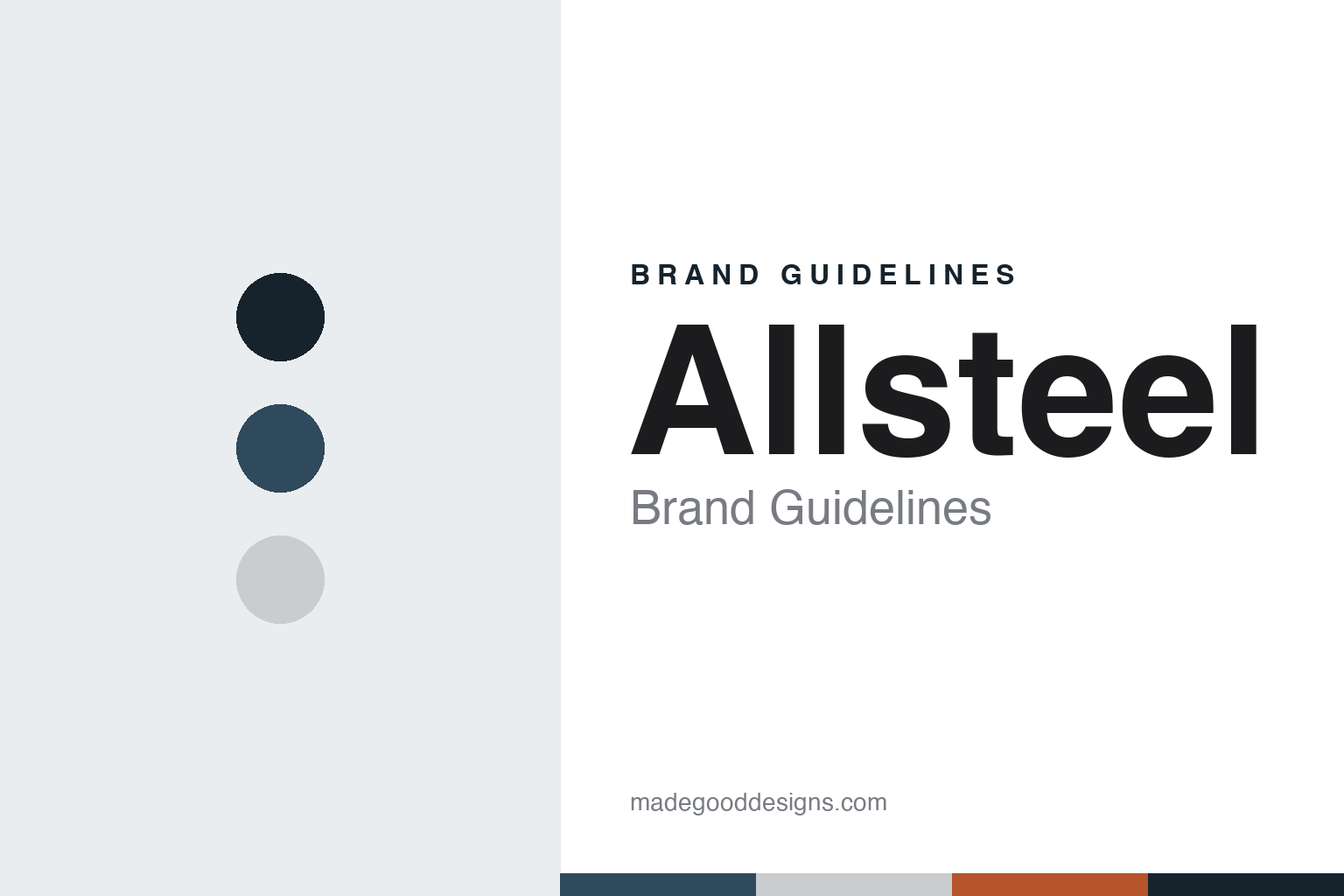
Allsteel Brand Guidelines
A filing cabinet in a frame building in Aurora, and a name that says what the furniture is made of.
Aa
Two constants: a cabinet blue-grey, brushed steel and rust signal palette and a Sturdy grotesque sans register. Abstract homage — not an Allsteel product or mark; no chair, cabinet or logo is reproduced.
Aurora, 1912
Ten people, a frame building and a lot of sheet metal.
Allsteel is an office-furniture brand that belongs to HNI Corporation of Muscatine, Iowa. Its roots lie a few hours to the east, in Illinois. A short company history that Allsteel published on its website, archived by the Wayback Machine in October 2010, says the business started “modestly in a small frame building” in Aurora, Illinois, in 1912, under the name Allsteelequip Company. The same history says its first workforce of ten made electrical cutout boxes, shop tote boxes and other made-to-order metal items.
The company’s account names two early leaders, John Knell as president and Charles H. Lembcke as general manager, and says that for nearly two decades they drew modest salaries, took no dividends and put the profits back into the business. That is the company’s own telling, and it is the only source read here for those names.
The name changed in 1929 to All-Steel-Equip Company, a date that both the company history and English Wikipedia give. For a long time the firm was mainly a supplier of electrical equipment and sheet-metal goods. The company history lists water-cooler cabinets, boiler jackets, kitchen cabinets, refrigerated food lockers and custom sheet-metal work among its products in those years.
Office furniture arrived by a side door. According to the company history, customers who bought All-Steel-Equip cabinets and lockers for their offices began asking for filing cabinets, so the company first bought them in from a supplier in Aurora. As the orders grew it bought that supplier, the Aurora Metal Cabinet Company, and reworked its manufacturing to its own standards; by 1936, the history says, it was “a serious competitor in filing cabinets.” English Wikipedia gives the same 1936 date for the purchase.
The brand’s name has always described a material rather than a person or a place. “All steel” was a plain promise for a maker of metal boxes and cabinets, and the name was later shortened to a single word.
Colour
Desks, chairs, a film set and the lateral file.
The Second World War delayed the next step. The company history says All-Steel-Equip moved into desks in 1947, with a “knock-down” desk line built from interchangeable components, and followed it with bookcases, telephone stands and credenzas. The same document says the company’s Los Angeles showroom was used as a set during the filming of the 1947 film Miracle on 34th Street; English Wikipedia repeats the story, citing the company.
Chairs were the missing piece. The company history says that in 1953 All-Steel-Equip bought the Shepherd Chair Co. of Melrose Park, Illinois, revised its designs and manufacturing, and introduced a new line of office chairs a few months later. According to that account, a full range of desks, storage and seating set the stage for nationwide sales and for a move into the architectural and design market, the world of specifiers and interior designers that contract furniture still serves.
The product the company itself singles out is the lateral file, the wide filing cabinet whose drawers run side to side rather than front to back. The company history describes it as one of Allsteel’s signature innovations and says it was developed in 1967 and went into production in 1969. English Wikipedia gives the same two years. For a brand born making filing cabinets, it is a fitting product to be known for.
By the 2000s the range had grown into whole offices. The archived history ends with a list of product names from that period: the #19 and Sum chairs, the Terrace and Concensys workstations, Get Set training furniture and the Reach storage system. Those names show how the brand was naming things at the time: short, single words, sometimes just a number.
English Wikipedia also notes that Allsteel’s company archives are held by Past Present Future, a furniture restoration business in Minneapolis, and that many older All-Steel pieces have been restored by antique-furniture dealers.
Typography
Design and documentation.
The brands in this group all make furniture for workplaces: office chairs, desks, storage, panel systems and the tables and seating that fill meeting rooms, reception areas and, for some of them, hospitals and schools. Contract office-furniture makers come from very different starting points, from family workshops that once made chairs for the home to metal-goods firms and companies founded around a single product, and over the decades many of them have changed owners, joined larger groups or moved where their furniture is built.
In this trade a brand’s identity is carried less by a logo on a box than by a catalogue, a showroom, a named chair or system and the designers credited with it, because the furniture is usually chosen by architects, designers and facilities buyers rather than picked off a shelf. That makes the plain questions behind each name worth asking: who started it, who owns it now, and where its furniture is actually made.
Each guide separates what independent sources record from what the company says about itself, and marks plainly what rests only on the company’s own word.
Aa
A sturdy grotesque sans — square-shouldered and plain, like a stamped steel drawer front. (Specimen set in Archivo, a grotesque sans STAND-IN; NOT the Allsteel logo.)
Allsteel
From C.I.T. and B.K. Johl to HNI.
The family of owners began to change in the 1960s. The company history says C.I.T. Financial Corp. bought All-Steel-Equip in 1966, and that another C.I.T. business, B.K. Johl Inc. of Montreal, a Canadian office-furniture maker, became part of the company at the same time. In 1967 the business was reorganised into three divisions: office furniture, electrical products and B.K. Johl.
The name then shortened in two steps. Six years after that restructuring, in 1973, the furniture divisions were renamed All-Steel Inc. and All-Steel Canada Ltd., and in 1986 both were simplified to Allsteel. The company history and English Wikipedia agree on those dates. The company history adds that Allsteel “had several corporate parents, including RCA,” before its current owner bought it.
That owner is HNI Corporation, then called HON INDUSTRIES Inc. The two sources disagree on the year: the archived company history says HNI acquired Allsteel in 1997, while English Wikipedia says Allsteel merged into HNI in 1998. English Wikipedia lists Allsteel among HNI’s office-furniture brands alongside HON, Gunlocke, HBF, OFM and Lamex, with the group headquartered in Muscatine, Iowa.
For a design guide, Allsteel shows how a plain, material name chosen by a sheet-metal shop can carry a furniture brand from filing cabinets to whole offices, with a lateral file and a run of short product names doing much of the work. Compare HON, its sister brand in Muscatine, and Gunlocke, another HNI furniture maker. For this guide we use cabinet blue-grey, brushed steel and rust signal with a sans, an unofficial interpretation; no product or logo is reproduced.
Explore & save
Keep Allsteel’s identity on hand — save it to a board in the Made Good inspiration library.
Allsteel identity set
Pin the Allsteel cabinet blue-grey, brushed steel and rust signal palette and the Sturdy grotesque sans register to your own board.