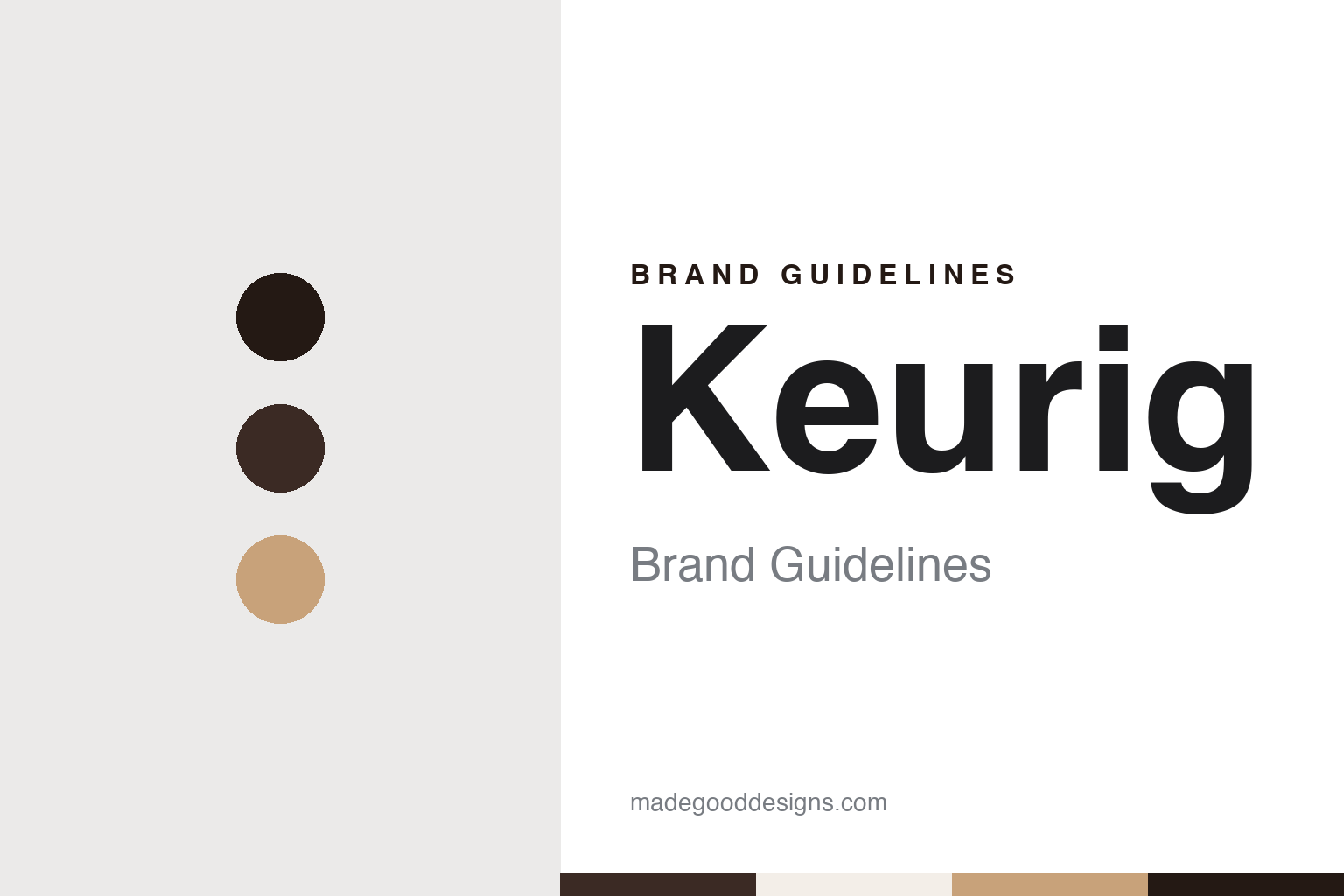
Keurig Brand Guidelines
The Massachusetts pod brewer named for a Dutch word.
Aa
Two constants: a roast brown, crema tan and foil white palette and a clean geometric sans register. Abstract homage — not a Keurig product or mark; no brewer, pod or logo is reproduced.
Keurig, Inc.
Two college roommates, a pod and a brewer.
Keurig began as a problem one tinkerer wanted to solve. English Wikipedia says John Sylvan, who had quit a technology job in Massachusetts in the early 1990s, wanted to avoid brewed coffee turning bitter and stale as it sat, and set out to make a single-serving pod of grounds and a machine to brew it. Working in Greater Boston, he went through a long run of trial and error on both the pod and the brewer. In 1992 he brought in Peter Dragone, his roommate at Colby College in Maine in the late 1970s and then a finance director at Chiquita, to help write a business plan, and the two founded Keurig, Inc. in Massachusetts that year.
The name is a borrowed word. Wikipedia quotes Sylvan as saying that he “looked up the word excellence in Dutch” and took Keurig from the result.
The early prototypes were unreliable and the company needed money to develop them. Wikipedia says it approached Green Mountain Coffee Roasters, the specialty roaster from Vermont, which invested in Keurig at that stage, and that the partners later raised venture funding from a Minneapolis investor, Food Fund, in 1994 and from the Cambridge fund MDT Advisers, whose principal Larry Kernan became chairman in 1995 and held the post through 2002. Sylvan left the company in 1997, and Dragone left a few months later while keeping his stake.
The product reached the market in two steps. In 1997, Wikipedia says, Green Mountain began offering its coffee in the Keurig K-Cup pod for the newly finished Keurig Single-Cup Brewing System, and in 1998 Keurig delivered its first brewer, the B2000, designed for offices. Distribution began in New York and New England. The office machines were large units connected to a building’s water supply; Keurig sold them to local coffee distributors, who placed them in offices and earned their return on the pods. Regional roasters including Tully’s Coffee, Timothy’s World Coffee, Diedrich Coffee and Van Houtte took K-Cup licences, and in 2000 the pods widened to hot chocolate and teas.
Colour
Green Mountain, JAB, Dr Pepper and JDE Peet’s.
The move into homes took until 2004, when Keurig had a counter-sized prototype ready and sent representatives into stores to demonstrate its B100 home brewer, Wikipedia says. Green Mountain Coffee Roasters, which had increased its stake in Keurig in 1993, 1996 and 2003, completed its full acquisition of the company in 2006, and then bought the four other main K-Cup licensees in 2009 and 2010. By 2008, Wikipedia says, K-Cup pods were on sale in supermarkets across the United States, and in 2010 licensed brewers from Breville, Cuisinart and Mr. Coffee joined Keurig’s own machines.
The key original patent on the K-Cup expired in September 2012. Around it, the company widened the system: the Vue brewer and pod arrived in February 2012, the Rivo espresso machine, co-developed with Lavazza, in November 2012, and the full-pot Bolt for offices in 2013. Partner deals in 2011 brought Dunkin’ Donuts and Starbucks coffee into K-Cup pods. In March 2014 shareholders renamed the parent Keurig Green Mountain, and Keurig stopped being a separate subsidiary and became the group’s main brand. Later that year the Keurig 2.0 brewer was introduced with technology designed to stop old or unlicensed pods from being used in it; in June 2014 the resulting U.S. antitrust suits were consolidated in the Southern District of New York. The Keurig Kold cold-drinks machine followed in September 2015.
Ownership then changed again. An investor group led by JAB Holding Company agreed to buy Keurig Green Mountain in December 2015 and completed the purchase in March 2016. On 9 July 2018 Keurig Green Mountain combined with Dr Pepper Snapple Group, which was renamed Keurig Dr Pepper, with headquarters in Burlington, Massachusetts, and Frisco, Texas; the brand has sat inside that company, alongside Dr Pepper, since then. A Drinkworks home cocktail machine developed with AB InBev launched in 2019 and was discontinued in December 2021.
The next change is still in progress. The Associated Press reported on 25 August 2025 that Keurig Dr Pepper would buy JDE Peet’s, the Amsterdam-based owner of Peet’s, Jacobs, L’OR and Douwe Egberts, and then split into a coffee company and a beverage company. Keurig Dr Pepper and JDE Peet’s announced on 1 April 2026 that the acquisition had been completed. On 1 October 2026 Keurig Dr Pepper named Russ Torres, joining from Kimberly-Clark on 3 November 2026, as chief executive of the future Global Coffee Co., which the company says will include Keurig, and said the separation is targeted for early 2027.
Typography
Design and documentation.
Small kitchen appliances and tableware reach people through a few repeated surfaces. An appliance is usually first met as a printed box on a shop shelf, with a photograph of the product, a name in large type and a short line about what it does. Once the box is opened, the name moves to a smaller badge: a moulded or printed mark on a lid, a hinge, a front panel or a control dial, sitting beside the switches and settings the owner will use every day.
Tableware works differently. Cutlery and flatware are often sold in a fitted box or a presentation case, with a pattern name printed on the lid or a card, while the maker’s mark is stamped small on the back of a handle. Plates and glasses may carry a backstamp or an etched mark that most people never look at.
Because of that, a name in this trade can travel a long way from the company that first used it. Each guide here sets out what can be checked about who started a brand, who owns it now and where its products are made, and marks clearly what rests only on the company’s own word.
Aa
A clean geometric sans — the register of a brewer badge and a pod lid. (Specimen set in Montserrat, a sans-serif STAND-IN; NOT the Keurig logo.)
Keurig
A borrowed word, a pod name and a family of machines.
The Keurig identity works on two levels at once. One is the company word itself, a Dutch term that Sylvan chose in 1992 and that has stayed on the brewers through each later owner. The other is the vocabulary of the system: K-Cup for the pod, and then a run of K-prefixed and short product names, from K-Carafe and K-Mug pods to the K200 brewer that Wikipedia says came in various colours in 2015. Wikipedia describes the K-Cup itself as a plastic cup with a foil lid and a paper filter inside, which the machine pierces at the top and bottom to brew.
The pod also carries other companies’ names. From the start, Wikipedia says, Keurig enlisted regional roasters so that drinkers could keep the coffee they already liked, and Keurig Dr Pepper today makes K-Cup pods for partner brands including Starbucks, Dunkin’, Folgers, Peet’s and Swiss Miss as well as for its own Green Mountain Coffee Roasters, The Original Donut Shop and McCafé lines.
The machine is where Keurig’s own design shows. Wikipedia records a Keurig retail store that opened inside the Burlington Mall in Burlington, Massachusetts, in November 2013, selling the full line of machines and letting shoppers build their own boxes of K-Cup pods. Keurig also licenses its brewing system for use in other appliances, and General Electric announced a refrigerator with a Keurig brewer built into the door in 2015.
For a design guide, Keurig shows how a coined product name and a single small object, a pod with a foil lid, can become the visual anchor for a system that carries dozens of other brands, while the company name rides on the hardware. Compare it with Dr Pepper, its stablemate since 2018, and Folgers, one of the coffees sold in K-Cup pods. For this guide we use roast brown, crema tan and foil white with a sans, an unofficial interpretation; no product or logo is reproduced.
Explore & save
Keep Keurig’s identity on hand — save it to a board in the Made Good inspiration library.
Keurig identity set
Pin the Keurig roast brown, crema tan and foil white palette and the clean geometric sans register to your own board.

