British Museum Brand Guidelines
An Act of 1753, a portico of columns and a courtyard under glass.
Aa
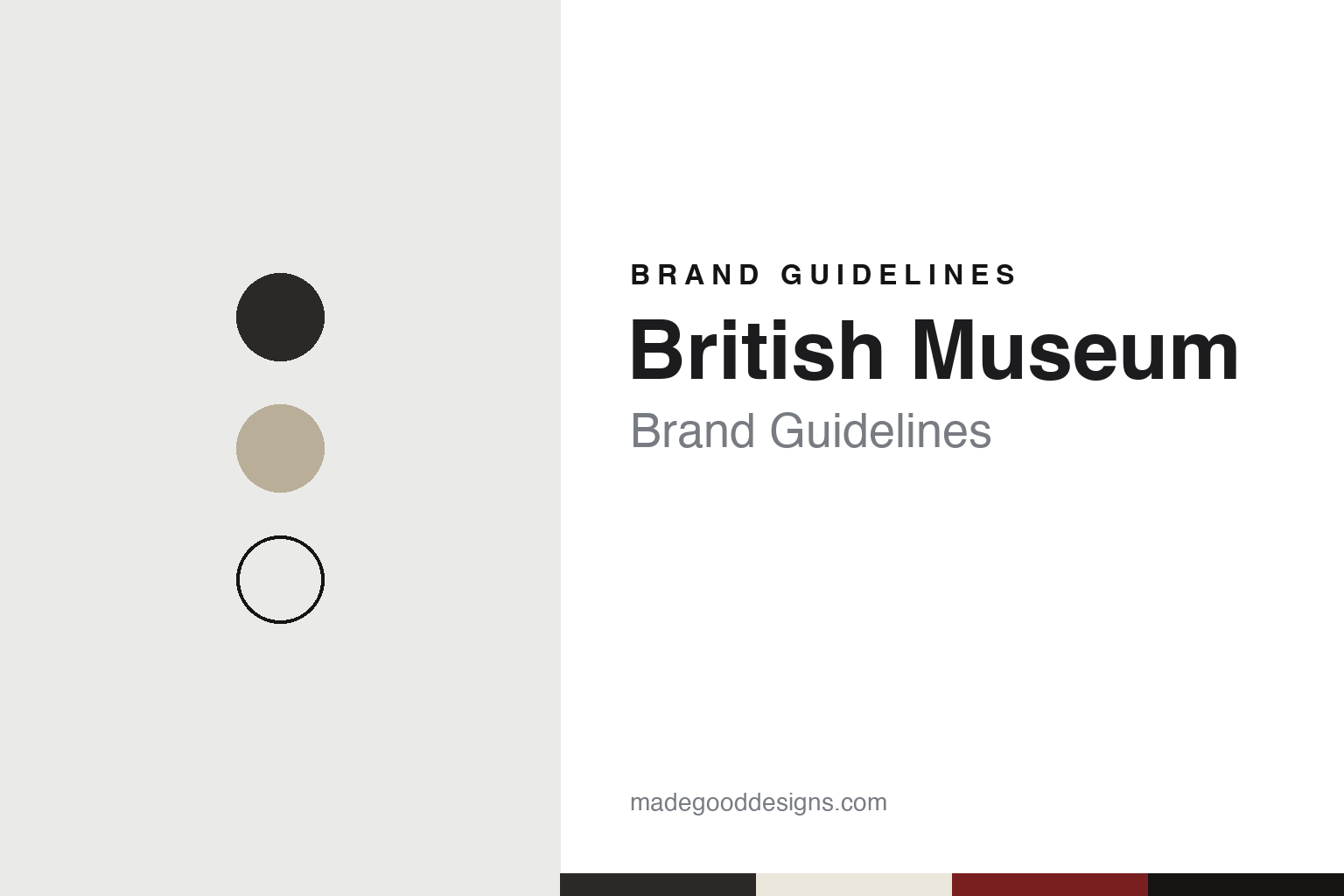
Two constants: a stone, black and deep red palette and a classical serif register. Abstract homage — not a British Museum asset; no logo, object or signage is reproduced.
Montagu House
A physician’s collection turned into a public institution by Parliament.
The British Museum was created by law. On 7 June 1753 King George II gave royal assent to the Act of Parliament that established it, English Wikipedia says, and the museum’s foundations lie in the will of the physician and naturalist Sir Hans Sloane, who left his collection to the nation. The British Museum Act of 1753 joined Sloane’s collection to two older libraries: the Cottonian Library assembled by Sir Robert Cotton and the Harleian Library of Robert Harley, Earl of Oxford. Sloane’s own collection, Wikipedia says, mixed printed books and manuscripts with dried plants and other natural history specimens, prints and drawings including works by Albrecht Dürer, and antiquities from Sudan, Egypt, Greece, Rome, the Near and Far East and the Americas.
The trustees needed a building, and they chose a converted seventeenth-century mansion in Bloomsbury, Montagu House, which they bought from the Montagu family. Wikipedia says they rejected Buckingham House, later rebuilt as Buckingham Palace, on grounds of cost and location. The galleries and a reading room for scholars opened on 15 January 1759. At that stage the library took up the majority of the ground-floor rooms and natural history occupied a whole wing upstairs, so the early museum was as much a library and a cabinet of specimens as a gallery of antiquities.
The collection changed character over the next century. From 1778 a display of objects from the South Seas, brought back from the voyages of Captain James Cook and other explorers, drew visitors, Wikipedia says. Wikipedia records that King George III presented the Rosetta Stone in 1802, and that the gift of the King’s Library, George III’s personal books, maps and drawings, in 1822 added to the pressure on space. Natural history left in the 1880s for a new building in South Kensington, today the Natural History Museum. The books stayed much longer: the national library, the British Library, did not finish its move to a new site at St Pancras until 1998.
The name has stayed constant through all of this. “British Museum” described a national institution rather than a person or a place, and it has carried the same two words through changes of building, collection and purpose since 1753.
Colour
Smirke’s portico and Foster’s roof.
The museum’s main building is largely the work of the architect Sir Robert Smirke. Asked in the 1820s to plan an eastern extension, Smirke produced a scheme for a new quadrangle. Wikipedia dates the East Wing, home of the King’s Library, to 1823–1828 and the North Wing to 1833–1838; Montagu House was demolished in 1842, and the opening of the forecourt in 1852 completed Smirke’s 1823 plan. Adjustments followed almost at once, Wikipedia says, including infill galleries for Assyrian sculptures as the collections kept growing.
The front facing Great Russell Street is a Greek Revival façade with a colonnade of 43 Ionic columns, closely based, Wikipedia says, on those of the temple of Athena Polias at Priene in Asia Minor. The pediment over the main entrance carries sculpture by Sir Richard Westmacott titled The Progress of Civilisation.
Smirke’s brother Sydney Smirke took over as architect in 1846, and his major addition was the Round Reading Room, built in 1854–1857 inside the central courtyard. Wikipedia says the reading room closed in 1997 when the British Library moved out. The empty bookstacks around it made room for the next change to the museum’s image: the Queen Elizabeth II Great Court, designed by Foster, which opened in 2000. The courtyard that had been filled with bookstacks became a public space under a glass roof.
The museum also built up design skills in-house. Wikipedia says that a full-time in-house designer and a publications officer were appointed in 1964, followed by a publishing house in 1973. The same period brought a Friends organisation in 1968 and an Education Service in 1970, Wikipedia says, after the museum had marked its bicentenary in 1953. The British Museum Act 1963 introduced administrative reforms, including making it easier to lend objects.
Typography
Signage, badges and posters.
A museum’s identity has to work across a wide range of surfaces. The wordmark appears on a banner several storeys high, on a gallery map folded into a coat pocket, on a ticket stub and on a website header, and it has to read the same way on all of them. For that reason many museum marks are built from type alone, with the letterforms doing the work that a pictorial symbol would do elsewhere.
Entrance signage sets the first impression: a name cut into stone or set in metal above a doorway tends to stay in place for decades, so the printed identity often has to sit comfortably beside lettering that is far older than it. Admission tokens add a smaller, more tactile layer. Clip-on badges, stickers and wristbands change colour by day or by season, which turns a simple proof of entry into a recognisable object in its own right.
Exhibition posters are where an identity is tested hardest. Each show brings its own imagery, so a durable system usually fixes only a few things, such as the position and size of the name, a typeface and a grid, and leaves the rest free for the artwork on display.
Aa
A classical serif — in the spirit of a Greek Revival portico. (Specimen set in Cormorant Garamond, a serif STAND-IN; NOT the British Museum logo or typeface.)
British Museum
A brand and identity review from 2025.
The museum’s visual identity is now under review. In January 2025 the museum launched a tender for a project “to review and re-imagine our brand and our visual/vocal identity,” Museums Journal, the magazine of the Museums Association, reported on 6 January 2025, quoting the museum’s brief. The report placed the project inside the museum’s masterplan, which includes new welcome facilities, a collection storage and research centre, and the redesign of a third of its gallery spaces.
The museum said in the same brief that it was “embarking on a complete transformation,” and that the masterplan and the arrival of a new director in 2024 made it the right moment to consider its vision and values and to review its brand, Museums Journal reported. That director is Nicholas Cullinan, who joined in spring 2024 from the National Portrait Gallery. His predecessor, Hartwig Fischer, resigned following the controversy over the theft of items from the collection that came to light in August 2023, according to the same report.
Whatever comes out of the review will sit alongside surfaces that have been in place for a long time: Smirke’s colonnade of the nineteenth century and Foster’s court of 2000.
For a design guide, the British Museum shows how architecture can serve as an identity long before a logo does, and how a national institution plans a brand review alongside building work. Compare Tate, which refreshed its wordmark in 2016, and the Louvre. For this guide we use stone, black and a deep red with a serif, an unofficial interpretation; no product or logo is reproduced.
Explore & save
Keep British Museum’s identity on hand — save it to a board in the Made Good inspiration library.
British Museum identity set
Pin the British Museum stone, black and deep red palette and the classical serif register to your own board.