Oklahoma City Thunder Brand Guidelines
Sky blue for the state flag, a sunset and a bison.
Aa
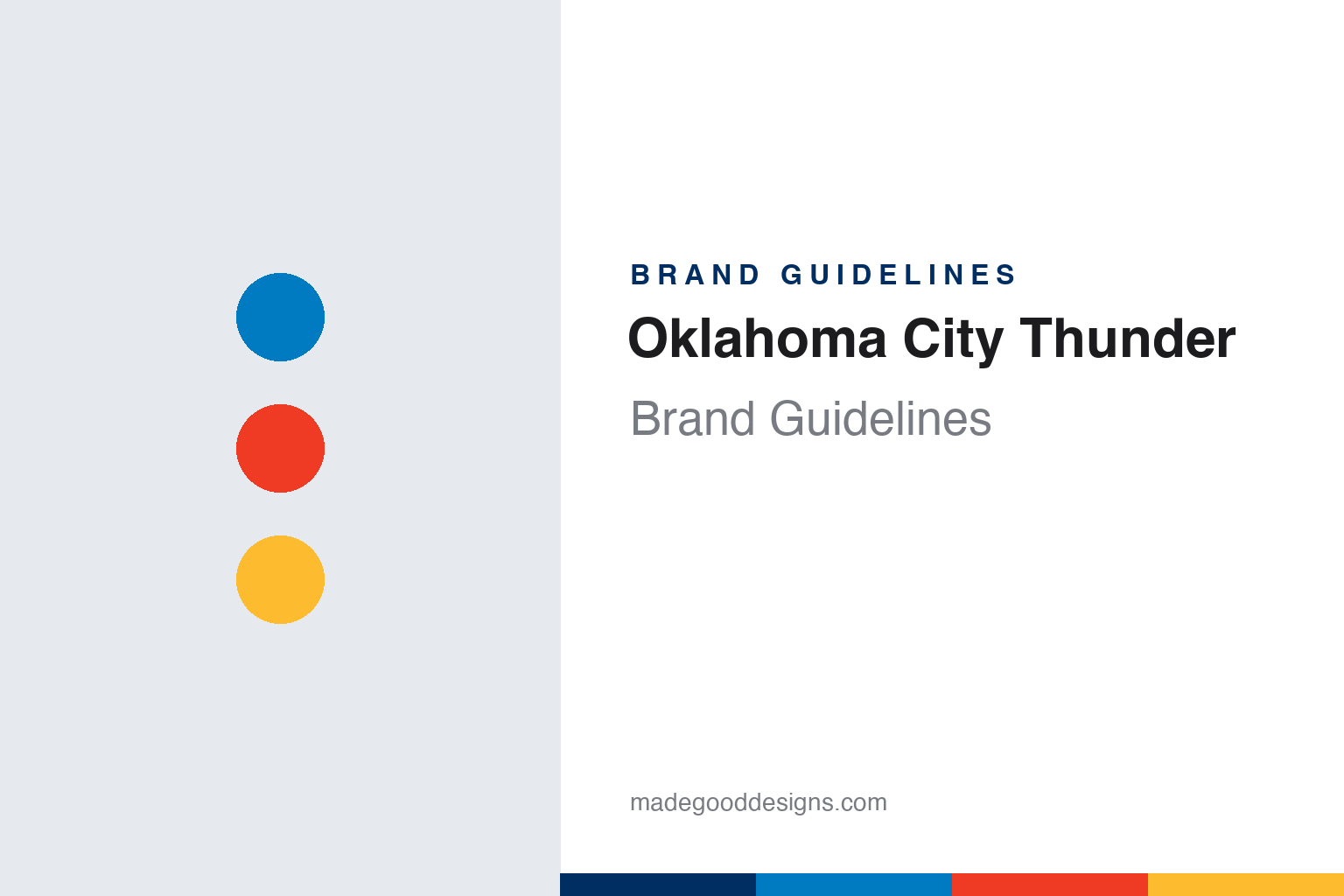
Two constants: a sky blue, sunset orange and sun yellow palette and a heavy plains sans register. Abstract homage — not an Oklahoma City Thunder mark; no logo, jersey or wordmark is reproduced.
From Seattle to the plains
A Seattle franchise, a sale and a settlement.
The Oklahoma City Thunder began life in the Pacific Northwest. English Wikipedia says the franchise was founded as the Seattle SuperSonics, an expansion team that joined the NBA for the 1967–68 season, and that it spent 41 seasons in Seattle. Wikipedia lists its owners there as Sam Schulman from 1967 to 1983, Barry Ackerley from 1983 to 2001, and then the Basketball Club of Seattle, a group headed by the Starbucks executive Howard Schultz.
The change that led to Oklahoma City came in 2006. Wikipedia says that on 18 July 2006 Schultz’s group sold the SuperSonics and their WNBA sister team, the Seattle Storm, to the Professional Basketball Club LLC, a group of Oklahoma City investors led by Clay Bennett, and that NBA owners approved the sale that October. In 2007 Bennett announced that the franchise would move to Oklahoma City once its lease at KeyArena expired. The city of Seattle sued to hold the club to the final two years of that lease, and the case went to federal court in June 2008.
The two sides settled before a ruling. Writing in The Seattle Times on 6 July 2008, Percy Allen reported that the settlement put the Sonics’ name, colours and logo “on ice”: Bennett kept possession of them but agreed not to use them. He could replicate memorabilia such as banners and retired jerseys to display in Oklahoma City, while the originals would be kept in Seattle at the Museum of History and Industry for much of the year, and Allen reported that the two cities would share the franchise’s history. Bennett agreed to return ownership of those items to Seattle should an NBA team emerge there. Wikipedia adds that the owners agreed to leave the SuperSonics name, logo, colours, banners and trophies in Seattle for a possible future franchise.
That left a club in a new city with no name and no colours. Wikipedia says the players spent the summer of 2008 in generic black and white jerseys reading “OKC-NBA” against the outline of a basketball, and that the team’s temporary practice base was a university gym in the Oklahoma City area that the New Orleans Hornets had used during their own stay in the city after Hurricane Katrina. Oklahoma City had hosted those Hornets for two seasons, Wikipedia says. The arena that would become the Thunder’s home had opened on 8 June 2002 as the Ford Center, built to allow luxury additions should a professional franchise arrive.
Colour
Sky blue for the state flag, and a sunset beneath it.
The new identity was revealed on 3 September 2008. Writing in The Oklahoman the next day, Mike Baldwin reported that there had been little suspense about the nickname Thunder, but that the choice of sky blue as the team’s main colour came as a surprise. Baldwin quoted Bennett, then the team’s chairman, explaining the palette: blue as the colour of the Oklahoma state flag, a sunset in red and orange, “not too red” and “not too orange,” and yellow for the reflected sun. Bennett told the paper that Thunder had been the favourite for a long time, a word he linked to power, strength and clarity, and the report noted that the NBA had filed trademark applications for six possible nicknames for the franchise.
The logo was a shared project. The Oklahoman reported that the club worked with the Ackerman McQueen advertising agency and the NBA to develop it, and that further logos and a mascot were still in development. Wikipedia says Bennett described the mark as taking several elements from other Oklahoma sports teams, such as the Oklahoma Sooners and the Oklahoma State Cowboys.
Uniforms followed at the end of the month. In a second report for The Oklahoman, dated 30 September 2008, Baldwin described the white home uniforms carrying the word “Thunder” and the sky blue road uniforms reading “OKLAHOMA CITY,” with the home set trimmed in orange, yellow and navy stripes. He quoted the coach P.J. Carlesimo saying that Bennett had talked about respecting the heritage of the NBA by keeping the design clean. Wikipedia says the Thunder played their debut home game at the Ford Center on 14 October 2008, a preseason meeting with the Los Angeles Clippers.
The club’s mascot arrived during that opening season. Wikipedia says Rumble the Bison was introduced on 17 February 2009, at halftime of a game against the New Orleans Hornets, citing a team release from that day. Wikipedia lists Squatch as the mascot of the Seattle years, from 1993 to 2008.
Typography
Design and documentation.
A team name is often the first piece of a basketball identity to be settled, and some clubs hand that choice to the public. A name-the-team contest or regional vote gives residents a sense of ownership before a game is played, and the shortlist usually leans on local wildlife, weather, landscape or industry so the name can be drawn as well as spoken. Once chosen, the name sets the direction for everything that follows: the animal or symbol in the primary logo, the colours and the tone of the wordmark.
Rebrands tend to arrive in cycles. A club may simplify an older, more illustrated mark into a flatter emblem that reproduces cleanly on screens, shorts and court paint, then add alternate logos, monograms and secondary badges that can stand in where space is tight. Arena names add another layer, because naming rights change hands over the years and the building’s signage, centre-court graphics and ticketing all have to follow. Colours and typefaces often stay steadier than either, carrying the identity from one logo and one arena name to the next.
Aa
A heavy plains sans — the register of a storm warning and a grain-elevator sign. (Specimen set in Archivo Black, a heavy sans STAND-IN; NOT the Oklahoma City Thunder logo or wordmark.)
Oklahoma City Thunder
Alternates, City editions and a new arena name.
Once the core look was set, the Thunder used alternates to widen it. Wikipedia says a navy alternate uniform arrived on 8 November 2012, with its wordmarks running vertically down the chest, and that a white sleeved alternate followed on 1 March 2015 with the partial logo on the chest and bolts in light blue and sunset on the shorts. On 25 September 2015 the club introduced a sunset-coloured uniform with “OKC” in navy block letters trimmed in white, and Wikipedia says the team wore it for 18 games that season, including every Sunday game.
The move to Nike in 2017 kept the white and blue uniforms almost unchanged, Wikipedia says, adding “OKC” on the beltline and shortening the shoulder stripes. A navy Statement uniform set italic “OKC” lettering in sunset orange over blue gradients meant to suggest the sound of a cheering crowd. For 2019–20 the club revised its main uniforms, putting the city name on the white set, the team name on the blue set and an outline of the state on the beltline, according to a team release cited by Wikipedia. The annual City editions turned to local stories: a turquoise 2018–19 design inspired by Oklahoma’s Native American heritage; a black and gold 2019–20 set marking the 25th anniversary of the Oklahoma City bombing; a 2020–21 design with “Oklahoma” across the chest; and a 2021–22 mashup combining the vertical “OKC” of the 2012 navy alternate with patterns from later sets and the 2008 logo on the waist.
The arena name changed over the same period. Wikipedia says the building opened as the Ford Center, later carried the name of Chesapeake Energy, and lost that name when Chesapeake ended the deal in April 2021. A team release dated 27 July 2021 announced that Paycom had acquired the naming rights, and the venue became Paycom Center. Wikipedia says Oklahoma City announced plans for a new downtown arena for the Thunder on 12 September 2023, and that city voters approved its funding in a December 2023 referendum. Bennett’s Professional Basketball Club LLC has owned the franchise since 2006.
For a design guide, the Oklahoma City Thunder show how a club that had to leave its name, colours and logo behind built a new identity from the colours of a state flag and an evening sky. Compare the Seattle Seahawks, who still play in the city the SuperSonics left, and the NBA, whose owners approved the 2006 sale. For this guide we use sky blue, sunset orange and sun yellow with a heavy sans, an unofficial interpretation; no product or logo is reproduced.
Explore & save
Keep Oklahoma City Thunder’s identity on hand — save it to a board in the Made Good inspiration library.
Oklahoma City Thunder identity set
Pin the Oklahoma City Thunder sky blue, sunset orange and sun yellow palette and the heavy plains sans register to your own board.