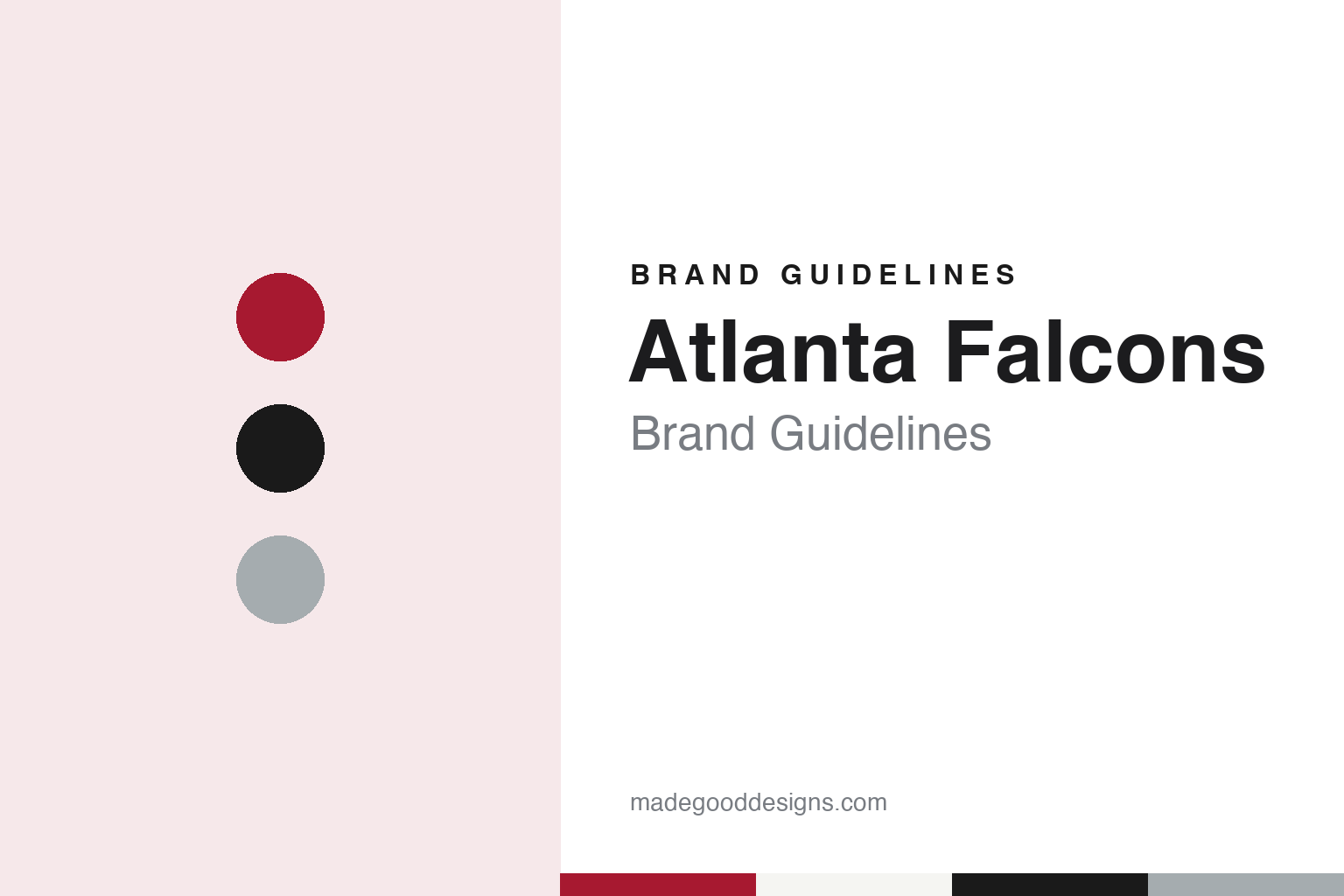
Atlanta Falcons Brand Guidelines
A contest entry about courage, a crest that became a letter F, and red and black from two college rivals.
Aa
Two constants: a falcon red, black and silver palette and a condensed athletic sans register. Abstract homage — not an Atlanta Falcons product or mark; no helmet, uniform or logo is reproduced.
A name from a fan contest
Two leagues racing for one city, and a schoolteacher’s reason for a bird of prey.
Atlanta became an NFL city in a hurry. English Wikipedia says that once the stadium later known as Atlanta–Fulton County Stadium was built in 1965, two leagues went after the city at once. A group linked to Cox Broadcasting was awarded an American Football League franchise on 8 June, contingent on securing stadium rights, and the NFL commissioner Pete Rozelle flew to Atlanta to head off the rival league. By 30 June 1965, Wikipedia says, the city had chosen the NFL and Rankin Smith, and that date is given as the club’s founding. The new team joined the league as an expansion franchise for the 1966 season, a year earlier than the NFL had planned to grow.
The name came from the public. In ESPN’s NFL Nation guide to the origins of every league team name, published on 2 February 2022, the Falcons reporter Michael Rothstein wrote that the club got its name through a contest in 1965. Several people suggested “Falcons”, but the team gives official credit to Julia Elliott because of the reasoning she sent in, which the club’s website quotes: the falcon, she wrote, “is proud and dignified with great courage and fight”, and “it never drops its prey”. Wikipedia describes Elliott as a school teacher from Griffin, Georgia. ESPN added that the club has carried the name since it began play in 1966.
The first colours borrowed from two of the state’s college programmes. Wikipedia says the Falcons took the field in 1966 in red helmets carrying a black falcon crest, with a black centre stripe flanked by gold and white stripes. The red and black stood for the Georgia Bulldogs; the white and gold stood for the Georgia Tech Yellow Jackets. The gold disappeared after a few seasons, but the white has stayed in the scheme ever since. The team wore white trousers with black or white jerseys, and the falcon crest appeared on the sleeves until a red-and-white stripe pattern replaced it four years in.
Home in those years was a shared ballpark. Wikipedia says the Falcons played at Atlanta–Fulton County Stadium alongside the Atlanta Braves until 1991, moved into the new Georgia Dome in 1992, and stayed there through the 2016 season.
Colour
The Smith family to Arthur Blank, and a dome to a retractable roof.
For its first thirty-six years the club stayed in one family. An Associated Press report carried by ESPN from New Orleans on 2 February 2002 said that when Rankin Smith died in 1997, the team was placed in trust for his son Taylor Smith and Taylor’s four siblings, and that the sale approved that day ended the family’s NFL ownership. Wikipedia says Taylor Smith had reached a preliminary agreement with the buyer on 6 December 2001.
That buyer was Arthur Blank. The same AP report said NFL owners meeting in New Orleans that day unanimously approved the sale of the Falcons to Blank, the co-founder, with Bernie Marcus, of The Home Depot in 1978. Blank told reporters he had first talked to the Smith family about buying the team in 1995, and that he planned to run it with the same emphasis on customer service he had brought to retailing. “I’m reading every e-mail from the fans,” he said. Blank has owned the Falcons since 2002.
The identity work followed quickly. Wikipedia says the club presented a new logo on 19 March 2003, a little over a year into Blank’s ownership, alongside new uniforms with red trim running down the sides of the jerseys and trousers.
A new stadium came next. Wikipedia says Blank proposed a retractable-roof stadium close to the Georgia Dome, that the Atlanta City Council voted in favour in March 2013, that ground was broken in May 2014, and that Mercedes-Benz Stadium opened in 2017 as home to both the Falcons and the new Major League Soccer club Atlanta United FC. The team’s headquarters and practice facilities, Wikipedia says, are on a site in Flowery Branch, northeast of Atlanta in Hall County.
Typography
Design and documentation.
A professional football club’s visual identity has to work at very different scales: a mark painted on the side of a helmet, a wordmark stitched across a jersey, a logo printed on a ticket, and signage that spans a stadium façade. Helmet logos in particular are designed to read from a distance and from several angles, so they tend to rely on a single bold silhouette, a limited set of colours and clear outlines that separate the mark from the shell beneath it.
When a club relocates or changes its name, designers face a choice between continuity and a clean break. Some identities carry an existing symbol to a new city and change only the place name in the wordmark; others introduce a new name, a new animal or figure, and a new palette while keeping a link to local history or geography. Regional names, which describe a state or an area rather than one city, are often chosen to widen the audience a team speaks to.
Uniform refreshes usually follow a slower rhythm. Clubs adjust outlines, update typefaces for numbers and names, introduce alternate or throwback jerseys, and refine colour values, often in partnership with the league’s uniform supplier. The guides in this round look at how those decisions show up in each club’s logo, colours and lettering.
Aa
A condensed athletic sans — the register of a jersey number and a stadium concourse sign. (Specimen set in Oswald, a sans-serif STAND-IN; NOT the Atlanta Falcons logo or wordmark.)
A crest that turned into a letter
Red helmets, black helmets, an F-shaped falcon and the ATL era.
The uniform moved through several shades of the same idea. Wikipedia says the Falcons switched from black to red jerseys in 1971, added silver trousers in 1978 and changed the numbers on the white jersey from black to red that year, when the falcon crest also returned to the sleeves. Facemasks were grey at first, white from 1978 and black from 1984. A white helmet was prototyped before the 1974 season but never worn. In 1990, Wikipedia says, the team moved to black helmets with silver trousers, and the numbers on the white jerseys turned red again in 1997.
The 2003 redesign changed the bird itself. Wikipedia describes the new logo as a more powerful, aggressive falcon with red and silver accents, drawn so that it more closely resembles the capital letter F. The black helmet stayed, a red alternate jersey with black trim arrived the same year, and in 2004 red became the primary home jersey. Throwbacks have kept the first look in circulation: Wikipedia says the club wore 1966-style uniforms for two home games in 2009, introduced a mixed throwback set in 2016, and paired it with the original red helmets again from 2022, once the league let teams use a second helmet shell.
The 2020 rebrand leaned on an abbreviation. Wikipedia says the uniforms revealed in January that year made black the primary home colour for the first time since 2003 and set “ATL” in red above the numbers, with a red-to-black gradient alternate, matte helmets carrying an enlarged falcon and grey facemasks. The gradient set left the rotation in 2023. Wikipedia says new uniforms for the 2026 season bring red back as the primary colour, borrow elements from earlier sets and add silver accents to the trouser striping, while the red-helmet throwback stays.
For a design guide, the Atlanta Falcons show how a single contest entry can fix a name for good, and how a crest can be redrawn into a letterform without losing the bird. Compare it with Atlanta Braves, the baseball club that shared the Falcons’ first stadium, and NFL. For this guide we use falcon red, black and silver with a condensed sans, an unofficial interpretation; no product or logo is reproduced.
Explore & save
Keep Atlanta Falcons’s identity on hand — save it to a board in the Made Good inspiration library.
Atlanta Falcons identity set
Pin the Atlanta Falcons red, black and silver palette and the condensed athletic sans register to your own board.