Eagle Brand Brand Guidelines
A Texas inventor’s vacuum pan, an eagle on the can and a cow called Elsie.
Aa
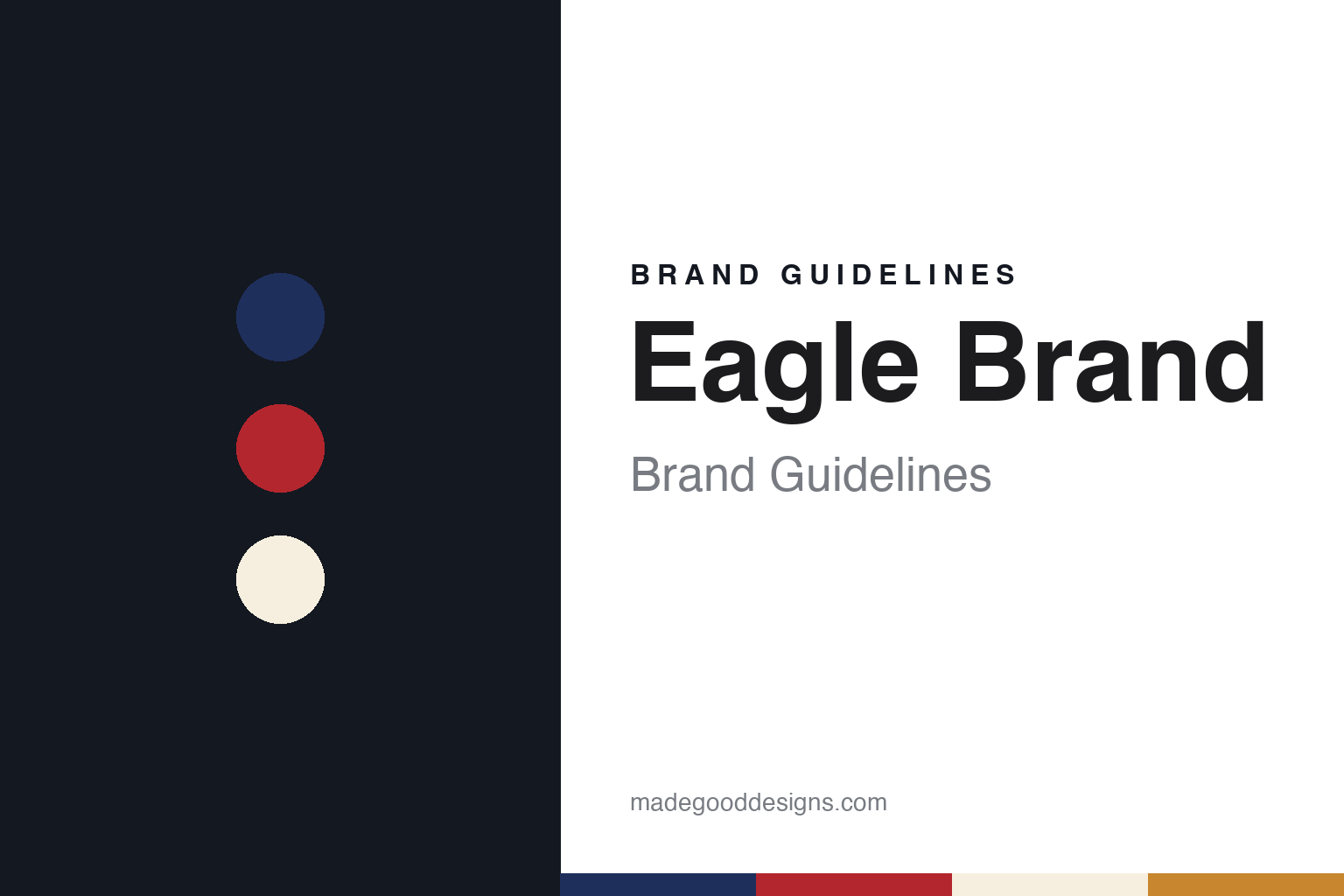
Two constants: an eagle navy, label red and milk cream palette and a transitional serif register. Abstract homage — not an Eagle Brand product or mark; no can, label or logo is reproduced.
A vacuum pan and an eagle
A Texas surveyor, a Shaker technique and three attempts at a factory.
Eagle Brand is an American brand of sweetened condensed milk, sold in cans and used mainly in baking and desserts. Its story begins with Gail Borden Jr., a surveyor and newspaper publisher in Texas who turned to food preservation. The Texas State Historical Association’s Handbook of Texas, in an entry by the historian Joe B. Frantz, says Borden sought a patent on a process for condensing milk in a vacuum in 1853, and that it was 1856 before he received American and British patents. He then dropped an earlier venture, a dehydrated “meat biscuit”, to concentrate on milk.
The process borrowed an existing technique. Smithsonian magazine reported in August 1999 that Borden used a vacuum pan like those he had seen the Shakers of New Lebanon, New York, use to condense fruit juice. A heating coil inside the pan warmed the milk slowly, the magazine explained, so the water could evaporate without the milk scorching or discolouring. It added that a copper vacuum pan, described as a relic of Borden’s process, sat in the Agricultural Hall of the Smithsonian’s National Museum of American History.
The business took several attempts. The Handbook of Texas says Borden opened a factory in Connecticut in 1856 that failed, tried and failed again in 1857, and then, with new backing from the New York financier Jeremiah Milbank, opened another Connecticut factory in 1858. Smithsonian places the plant that followed his “two false starts” at Wassaic, New York, and says Borden sold condensed milk door to door. He also set strict rules for the farmers who supplied him, the magazine said: they had to wash udders before milking, sweep their barns clean, keep manure away from the milking stalls and scald and dry their strainers morning and night.
The eagle belongs to this period. The brand’s own history page says Borden established the New York Condensed Milk Company in 1858, together with the first use of the Eagle Brand and American bald eagle trademarks. The company dates the brand itself to 1856, the year of the patent, and says Borden introduced it to address the problems of keeping milk without refrigeration. Smithsonian reported that in 1858 a committee of the Academy of Medicine was quoted as calling Borden’s milk “unequaled” in purity, durability and economy.
Colour
The Civil War, the Borden name, Smucker and Eagle Foods.
Demand grew with the Civil War. Smithsonian says the federal government ordered condensed milk as a field ration and that soldiers home on leave told their families about it. The Handbook of Texas says the war’s demand assured Borden’s success: he opened another factory in Connecticut, two in New York and one in Illinois, and licensed other firms to make the product in Pennsylvania and Maine. Eagle Brand’s history page says the New York Condensed Milk Company built the New York Milk Condensery at Brewster, New York, in 1864.
The founder’s surname became the company’s name. Eagle Brand’s history page says the Borden Condensed Milk Co. was incorporated in 1899, and for generations afterwards the condensed milk was sold as a Borden product. The company says a Borden Kitchens promotion of 1931 asked home cooks to send in recipes in which Eagle Brand made cooking “quicker, easier, and surer”, and it presents quick, reliable recipes as part of what the brand has offered ever since.
The modern chain of ownership is better documented. The trade publication just-food reported on 2 May 2007 that The J. M. Smucker Company had completed its previously announced acquisition of Eagle Family Foods Holdings, which it described as a privately held producer of condensed and evaporated milk. Eight years later the brand changed hands again. FoodNavigator-USA reported in July 2017 that Paul Smucker Wagstaff, a fifth-generation member of the Smucker family who had run the Eagle condensed-milk brands while at the company, left Smucker in 2014 to start his own food business with Jeff Boyle, an entrepreneur and investment banker. The two found a partner in the private equity firm Kelso & Company, learned that Smucker was selling its canned-milk business, and established the new Eagle Foods at the end of 2015, the article said.
Eagle Family Foods has owned Eagle Brand since then. Its history page says Eagle Family Foods Group, LLC was established in 2015 and named after the condensed milk Borden created, and lists its canned-milk brands as Eagle Brand, Magnolia, PET Milk, Milnot and Meadow Gold. FoodNavigator-USA said the company used that canned-milk business as a platform and went on to buy the ready-to-eat popcorn brand G.H. Cretors. Kelso & Company’s own website, read in October 2026, lists Eagle Foods as a current investment made in 2015, gives its headquarters as Cleveland, Ohio, and names Hamburger Helper and Suddenly Salad among its brands alongside Eagle and Magnolia.
Typography
Design and documentation.
The baking shelf of a grocery store holds a particular kind of product: condensed and evaporated milk in small cans, chocolate chips and baking chocolate in bags and bars, corn starch in a box and baking powder in a tin. They are ingredients rather than finished foods, bought to be measured into something else, and a single can or tin may sit in a kitchen cupboard for months between uses.
That shapes how their packaging works. A name, a colour and a simple device have to be recognised on a crowded shelf, and then again in a cupboard, often by someone following a recipe that names the product. Directions, measurements and recipes printed on the pack are part of the design as well, read in the kitchen with flour on the counter and the oven already warming.
Each guide separates what independent sources record from what the company says about itself — who started the brand, who owns it now, where it is made and how its labels have changed — and marks plainly what rests only on the company’s own word.
Aa
A sturdy transitional serif — the label register of a nineteenth-century grocery can. (Specimen set in Libre Baskerville, a serif STAND-IN; NOT the Eagle Brand logo.)
An eagle, a cow and a recipe can
A national bird on the label, a cartoon cow beside it and recipes passed down with the can.
The brand’s name is its first visual device. Eagle Brand says the American bald eagle trademark was first used in 1858, alongside the Eagle Brand name. The second device came from the parent company’s advertising. Eagle Brand’s history page says Elsie, the Borden Cow, made her debut in national consumer magazines in 1938 and starred in Borden’s exhibit at the New York World’s Fair in 1939, when the condensed milk was gaining promotional help from her. By the 1960s, the company says, cooks across the country were making desserts with condensed milk from “the can bearing the Elsie image”.
Elsie and Gail Borden became linked in print as well. Smithsonian’s 1999 profile of Gail Borden tied him to Elsie, the Borden Cow, and said that most readers were more likely to think of the cow, the symbol, than of the condensed milk itself. The same article said the Borden companies of the late 1990s licensed other firms to sell milk, ice cream and cheese under the Borden name. The Borden name still reaches the brand that way. The footer of Eagle Brand’s website, read in October 2026, carries a copyright line for Eagle Family Foods and states that the Borden and Elsie trademarks are used under licence.
The company also presents the brand through its recipes. It says its recipes, like the Eagle Brand can, “have been passed down generation to generation”, and its website is organised around them: cheesecakes, fudge, pies, bars and frozen desserts, with seasonal collections for Christmas and Thanksgiving and a “magic cookie bars” recipe named on its history page. Its product list is short, made up of sweetened condensed milk in a can, a resealable pouch, a fat-free version and an evaporated milk.
For a design guide, Eagle Brand shows how a heritage food brand can carry three generations of signals at once: a nineteenth-century national bird, a twentieth-century cartoon cow borrowed under licence, and a twenty-first-century recipe site that treats the can as a kitchen tool. Compare it with Carnation, the evaporated milk begun in Washington State in 1899, and Smucker’s, the family company that owned Eagle Brand from 2007 to 2015. For this guide we use eagle navy, label red, milk cream and caramel with a serif, an unofficial interpretation; no product or logo is reproduced.
Explore & save
Keep Eagle Brand’s identity on hand — save it to a board in the Made Good inspiration library.
Eagle Brand identity set
Pin the Eagle Brand navy, label red and milk cream palette and the transitional serif register to your own board.