Frangelico Brand Guidelines
The Piedmont hazelnut liqueur in a friar’s habit.
Aa
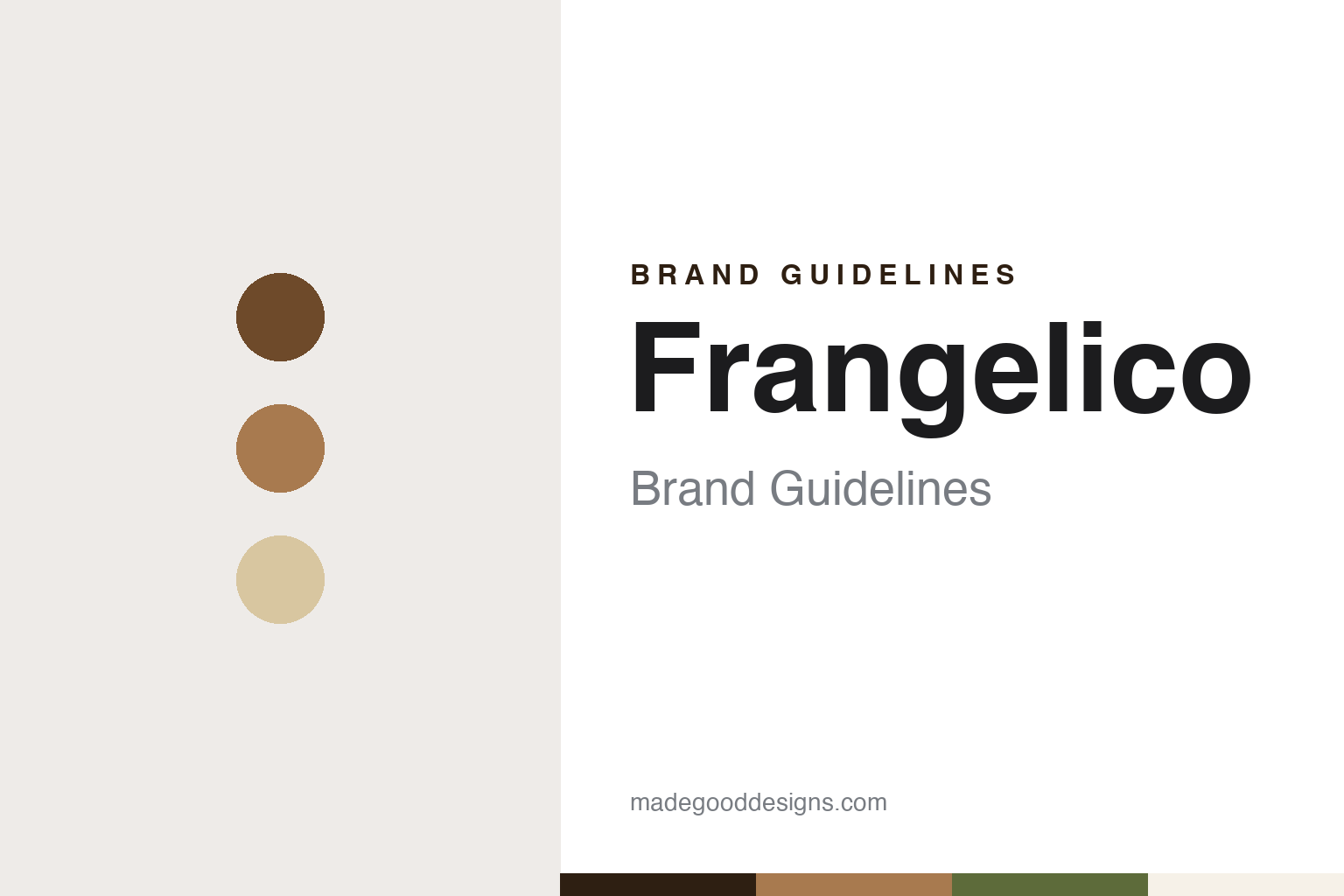
Two constants: a Frangelico hazelnut, habit brown and cord palette and a Monastic serif register. Abstract homage — not a Frangelico product or mark; no bottle, logo or label is reproduced.
Barbero of Canale
A wine and spirits family, and a monk of legend.
Frangelico is a hazelnut liqueur from Canale, a town in Piedmont in north-west Italy. Gruppo Campari, which owns it today, says the brand was created in 1978 by Barbero, which it describes as a leading family in the Italian wine and spirits business. English Wikipedia, citing the brand’s own frequently asked questions, gives Canale as the place of production.
The name comes from a legend, and Campari tells it as one. According to the company’s brand history, the liqueur’s origins go back more than 300 years to Christian monks living in the hills of Piedmont, whose skills in food and drink included distilling, especially with wild hazelnuts. “Frangelico,” the company says, is a shortening of Fra’ Angelico, a hermit monk believed to have lived in those hills in the eighteenth century; Italian Wikipedia places him in the seventeenth. The monk of the story is not the fifteenth-century Florentine painter known by the same name, from whom English Wikipedia takes care to distinguish the liqueur.
On its website today the brand talks about Italian hazelnuts and what it calls “an intriguing bottle.”
The liqueur has changed strength over the years. English Wikipedia says that under the Barbero family it was bottled at 28% ABV, later at 24%, and now at 20% ABV. Its ingredients include sugar, alcohol, hazelnut distillate, flavourings and caramel colouring, the same source says.
Colour
Tonda Gentile hazelnuts from the Langhe.
Campari describes a four-stage process. First, Piedmont hazelnuts are harvested, shelled, toasted and crushed, then steeped in a mixture of alcohol and water. That infusion is distilled to make a hazelnut distillate. The distillate is then blended with extracts and distillates of cocoa, vanilla and roasted coffee and other flavourings to make the Frangelico concentrate. Finally the concentrate is mixed with alcohol, sugar and water to bottling strength and left in vats for six to eight weeks to mellow before it is bottled, labelled and, in the company’s words, “the rope is tied.”
The company names the nut as the Tonda Gentile, grown in the Langhe, the hill country of southern Piedmont. It says these hazelnuts are bigger, plumper and more uniform than others, with a skin that comes away easily so they can be toasted without bitterness, and that the variety holds a protected status it compares to a wine appellation. The brand’s website today makes the same points in shorter form, describing Italian hazelnuts that are “perfect for toasting.” Campari’s brand history put production at more than three million bottles a year, sold around the world as well as in Italy.
Campari tastes the liqueur as clear pale gold, with intense hazelnut on the nose and hints of vanilla and dark chocolate on the palate. The brand suggests serving it over ice, over ice with fresh lime, with soda, or chilled as a shot, and it is used in cocktails.
Frangelico also had a moment in contemporary art. In his 1986 series Luxury and Degradation, about the role of alcohol in culture, Jeff Koons reproduced two Frangelico advertisements, “Stay in Tonight” and “Find a Quiet Table.” Koons said, in an interview with Flash Art, that he used the Frangelico ads to stand for the series’ highest income bracket, against works that stood for lower ones.
Typography
Design and documentation.
The seven brands in this group are all liqueurs and spirits: Drambuie, Frangelico, Malibu, Southern Comfort, Tia Maria, Pimm’s and Sheridan’s. Liqueur and spirit brands in general sit at many different points in the trade, from family firms that still carry a founder’s name to names that now belong to much larger drinks groups, and a single brand can be sold everywhere from a corner shop to an airport duty-free shelf.
A liqueur or spirit brand’s identity is usually carried less by a single recipe than by a bottle, a name and the drink or serve it promises, because the company behind the name may have changed hands, moved its production or grown far beyond the place where it started. That makes the questions behind each name worth asking plainly: who started it, who owns it now, and where its drinks are actually made and bottled.
Each guide separates what independent sources record from what the company says about itself — its founding story, its owners over time, where its drinks are made and how its packaging has changed — and marks plainly what rests only on the company’s own word.
Aa
A Monastic serif — a liqueur named for a legendary monk. (Specimen set in EB Garamond, a serif STAND-IN; NOT the Frangelico logo.)
Frangelico
A bottle dressed as a friar.
Frangelico’s most recognisable asset is its bottle. English Wikipedia describes it as designed to look like a friar in his habit, with a small cord tied round it as a cincture, the belt of a monk’s robe; it most closely resembles the habit of a Franciscan friar, the same source says. The cord is tied on as the last step of production, Campari says.
The brand has changed hands three times. In 1990 the Irish drinks company C&C Group bought Barbero and with it Frangelico, according to Campari. In 2010 C&C sold Frangelico, together with Carolans and Irish Mist, to William Grant & Sons; Campari dates that sale to March 2010, while Drinks International reported it as April. On 16 September 2010 Gruppo Campari announced that it would buy the three brands from William Grant, with completion expected on 1 October 2010. At the time, Drinks International reported, Frangelico was sold in about 90 markets, with the United States accounting for roughly half of its sales. English Wikipedia lists the brand among Campari’s, and its American website is run by Campari America.
Under Campari, Frangelico sits in a portfolio that also includes the Jamaican rum Appleton Estate. For the typeface the brand uses, see our separate note on the Frangelico font.
For a design guide, Frangelico shows how a single shape can carry a whole brand story: the legend is in the name, and the bottle dresses the liqueur as the monk. Compare Appleton Estate, another Campari spirit with a strong place story, and Ferrero Rocher, another Piedmont name built on the hazelnut. For this guide we use hazelnut brown, toasted tan, Langhe green and a cord beige with a serif, an unofficial interpretation; no product or logo is reproduced.
Explore & save
Keep Frangelico’s identity on hand — save it to a board in the Made Good inspiration library.
Frangelico identity set
Pin the Frangelico hazelnut, habit brown and cord palette and the Monastic serif register to your own board.