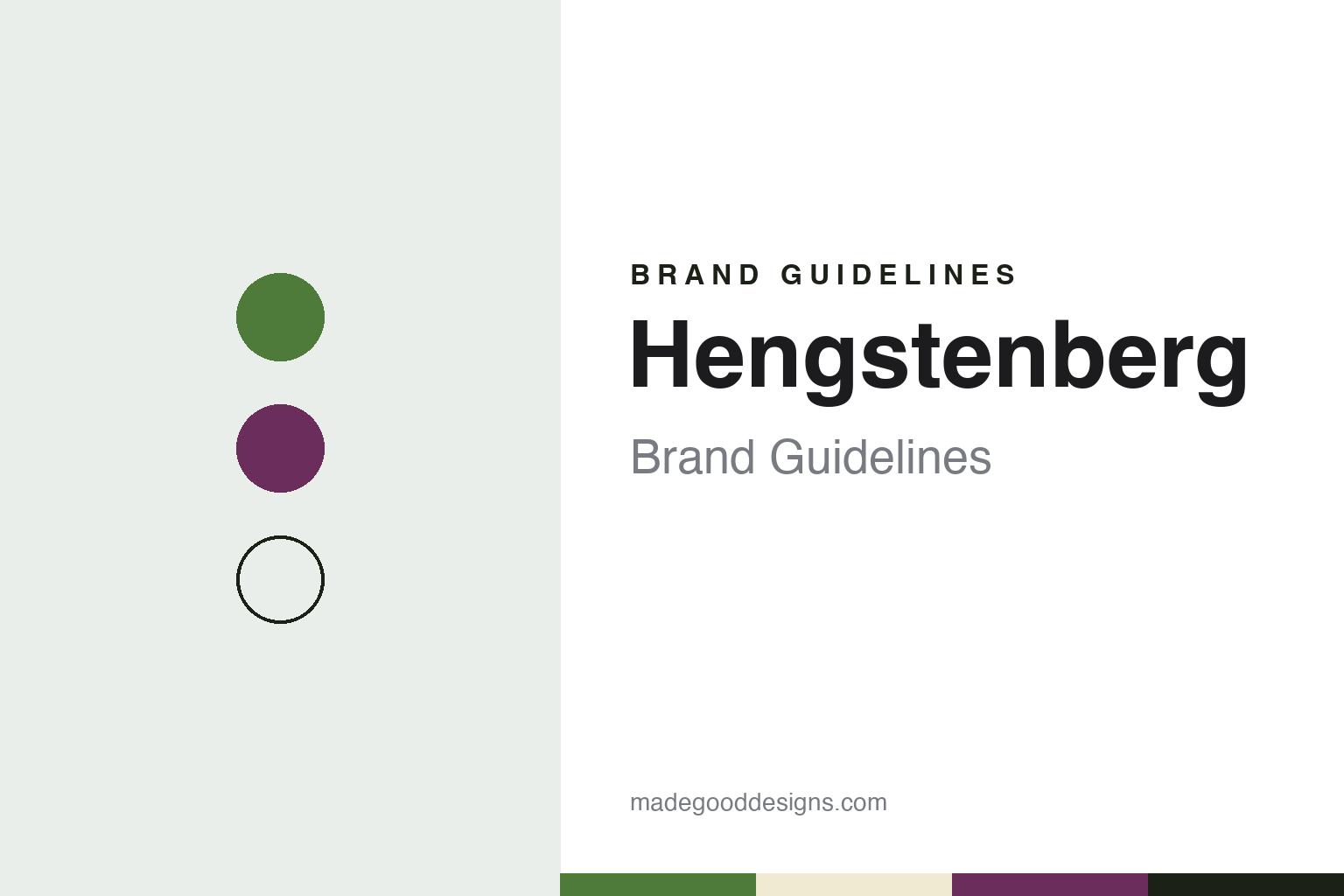
Hengstenberg Brand Guidelines
The Esslingen vinegar works behind Mildessa sauerkraut.
Aa
Two constants: a Hengstenberg green, cream and red-cabbage palette and a Swabian serif register. Abstract homage — not a Hengstenberg product or mark; no jar, label or logo is reproduced.
A vinegar works
A dowry, a partnership and a move to the edge of town.
Hengstenberg began with a stake in a small factory. In 1876 Richard Alfried Hengstenberg bought into a vinegar works in Esslingen am Neckar, in Württemberg, putting in 18,000 marks — the whole of his wife’s dowry, German Wikipedia says. The firm traded as Kallhardt & Hengstenberg; two years later the partner withdrew and Hengstenberg carried on alone.
The company says its first products were vinegar and gherkins, with mustard added later; German Wikipedia lists gherkins, vinegar and mustard together as the first range. The company also credits the founder with a “purity law” for vinegar that, it says, helped shape German food law and still holds in principle — its own account.
Growth forced a move. In 1895 the firm left its site in Esslingen’s old town for larger grounds on the Mettinger Straße, at the edge of the town, where the headquarters stands today. A year later, the company says, the Hengstenberg family coat of arms was registered as a trademark.
The next generation turned the name into a brand. In 1926, according to the company’s history, Carl Hengstenberg replaced the coat of arms with modern lettering, so that the company name itself became a single, consistent mark; the same year a tomato seasoning, in jar and tube, joined the range. In the 1930s Dr. Richard Hengstenberg extended the range further, and in 1932 the firm launched what both the company and German Wikipedia describe as the world’s first pasteurised sauerkraut.
Colour
Altmeister, Mildessa, Rotessa and STiCKSi.
Hengstenberg built its post-war business on named products. In 1950, as German grocers began to move to self-service, it started bottling vinegar in household sizes under the name Altmeister — the house’s first branded product, the company says. The sauerkraut followed in 1953 as Mildessa, a name the company explains as a blend of the words for “mild sauerkraut,” and red cabbage in 1964 as Rotessa, which the company presents as a continuation of the policy begun with Altmeister: familiar tastes in convenient packs.
More names followed. Since 1967, German Wikipedia says, the company has sold Mediterranean tomato products under Oro di Parma. In 1972 came STiCKSi gherkin quarters, which the company calls its own invention, and in 1995 the KNAX gherkins. In 2006, the company says, it became the first major branded maker of pickled goods to launch a complete organic range.
German Wikipedia counts about 140 products, sold in roughly 40 countries, with ranges adapted to particular markets — a “Bavarian Style Sauerkraut,” for example, for the United States and Japan. It also describes Hengstenberg, citing manager magazin in 2007, as the German market leader in sauerkraut. Because the traditional lines offer less growth, the company has added Asian- and Italian-style products, which accounted for about a tenth of its 2025 result, according to the Lebensmittel Zeitung as cited by German Wikipedia; its current range includes a kimchi.
The brand’s words changed too. In 2024, the company says, a repositioning replaced its long-running claim “Aus Gutem das Beste” (“the best from the good”) with “Das Gute weitergeben” (“passing on the good”), alongside a product relaunch and packaging it describes as more environmentally friendly.
Typography
Design and documentation.
The seven brands in this group all make food, and all of them come from Germany or France: Dr. Oetker, Hengstenberg, Leibniz, Kühne, Seitenbacher, Bonduelle and Lesieur. German and French food brands in general sit at many different points in the trade, from family firms that still carry a founder’s surname to names that now belong to much larger food groups, and a single brand can be sold everywhere from a village grocer to a supermarket shelf.
A food brand’s identity is usually carried less by a single product than by a pack, a name and the meal or snack it promises, because the company behind the name may have changed hands, moved its factory or grown far beyond the town where it started. That makes the questions behind each name worth asking plainly: who started it, who owns it now, and where its food is actually made and packed.
Each guide separates what independent sources record from what the company says about itself — its founding story, its owners over time, where its products are made and how its packaging has changed — and marks plainly what rests only on the company’s own word.
Aa
A sturdy display serif — the register of a lettered name that replaced a coat of arms. (Specimen set in DM Serif Display, a serif STAND-IN; NOT the Hengstenberg logo.)
Hengstenberg
Two plants near the cabbage fields.
The company says the Mettinger Straße site is now used only for administration; German Wikipedia says a small part of vinegar production remained there until 2010. Between 2009 and 2016 the site was renovated and the headquarters moved to Esslingen-Zell, returning in 2016; the half-timbered house on the grounds is the former Hengstenberg family villa, the company says.
Production takes place at two plants. Bad Friedrichshall, with 180 staff according to the company, makes gherkins, sauerkraut, red cabbage and vinegar, with the emphasis on gherkins and vinegar. Fritzlar, in northern Hesse, with 157 staff, makes sauerkraut, red cabbage and gherkins; the company calls it the largest sauerkraut plant in Europe. Both lie near vegetable-growing areas, and the company says its gherkins, red cabbage and sauerkraut come entirely from German farms. A sales office in Wels, Austria, handles the Austrian market.
The company’s history also records the drought summer of 2018: it says losses exceeded 30 per cent for white cabbage and 40 per cent for red cabbage, and the season ended with a historically small production run of Mildessa cabbage products.
Hengstenberg describes itself as a family company. Its history records that Henri Pillot, a manager from within the firm, became commercial managing director at the start of 2017, and that in April 2018 Andreas Reimer became chairman of the management, while Steffen Hengstenberg moved to the company’s administrative board and Philipp Hengstenberg kept responsibility for the supply chain. In July 2026 the company announced that its managing director, Aymeric de La Fouchardière, was leaving; it said his successor had been chosen but would be named later, and that managing director Sebastian Neubert would coordinate the business in the meantime.
For a design guide, Hengstenberg shows how a family firm turned a coat of arms into lettering and a list of invented product names. Compare Kühne, another German vinegar and pickles maker, and Develey, the Munich mustard house. For this guide we use gherkin green, cream and a red-cabbage purple with a serif, an unofficial interpretation; no product or logo is reproduced.
Explore & save
Keep Hengstenberg’s identity on hand — save it to a board in the Made Good inspiration library.
Hengstenberg identity set
Pin the Hengstenberg green, cream and red-cabbage palette and the Swabian serif register to your own board.