Hummel Brand Guidelines
The Hamburg bumblebee that became a Danish sportswear brand.
Aa
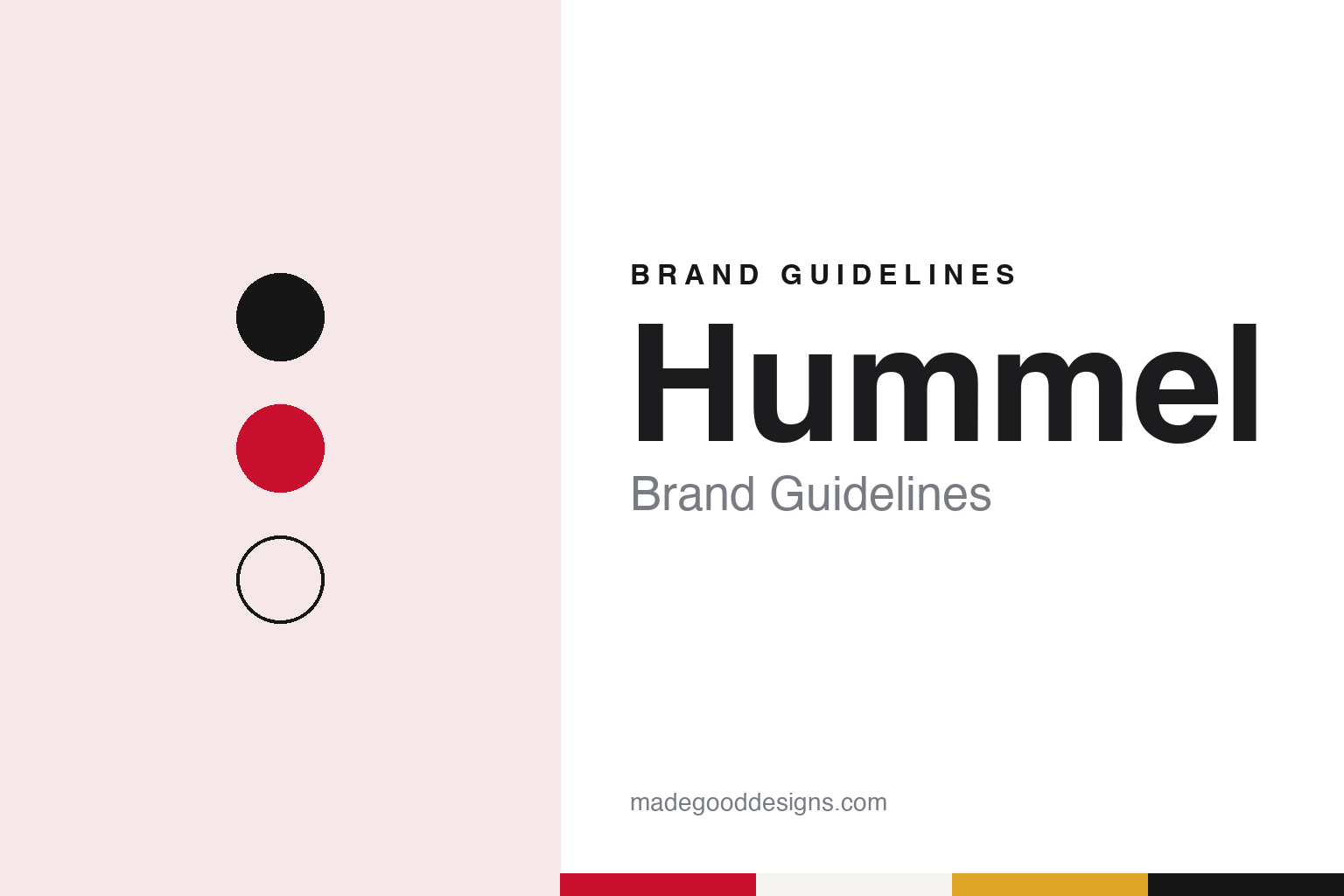
Two constants: a kit red, chevron white and bee amber palette and a chevron sport sans register. Abstract homage — not a Hummel product or mark; no bumblebee, chevron or logo is reproduced.
Messmer & Co
A Hamburg family, a football boot and a bumblebee.
Hummel began in Hamburg. English Wikipedia says the company was founded in 1923 by Max Albrecht Ludwig Messmer and his father Michael Messmer under the name Messmer & Co, and the company’s own history page tells the same story: father and son set up the business and brought a football shoe to market under the name “HUMMEL”. Danish Wikipedia places the Messmer workshop in Eppendorf, near Hamburg, and dates it to 1919, with the hummel name first used for sports goods in 1923, when the family launched football boots alongside shoes for cycling, athletics and handball.
The name is itself part of the identity. Hummel is German for bumblebee, and English Wikipedia describes the logo as a stylised bumblebee. The company’s history page builds its whole story around the insect, describing the bumblebee as a creature that flies against logic and presenting the brand as one of “dreamers and doers”. The company writes its own name in lower case, as hummel, on its website.
The early decades were hard. German Wikipedia says the production site was almost entirely destroyed during the Second World War, and the company says Hummel survived three turbulent decades of new owners and names, a faltering economy, wartime bombing and growing competition. Danish Wikipedia says that after the war the business moved outside Hamburg and made football boots, handball shoes and skates.
The modern brand took shape under Bernhard Weckenbrock. German Wikipedia says he took over the Hummel brand in 1956 and moved production to Kevelaer on the Lower Rhine; the company’s own history dates his purchase to the early 1960s and says he modernised the business completely, deciding that the product had to become a brand with a personality athletes could identify with. As handball moved indoors and grew in popularity from the 1960s, German Wikipedia says, many players took to the court in shoes from what was then a small brand. Danish Wikipedia records that Hummel’s first clothing collection followed in 1969.
Colour
From German importers’ brand to a Danish company.
Hummel’s move north began through its Danish distributors. Danish Wikipedia says that in 1973 Jørgen Vodsgaard and Max Nielsen set up VN Sport to sell hummel in Denmark, and that a year later they also gained the right to make Hummel products. German Wikipedia says the company was taken over by its former Danish importers in 1975, making the brand Danish; Danish Wikipedia dates the full Danish takeover by Vodsgaard and his partners to 1980; and the company says the brand became Danish-owned in the early 1980s, naming Vodsgaard and Nielsen as owners, with the footballers Frank Arnesen, Allan Simonsen and Henning Jensen as part owners.
Football made the brand visible. The company dates its partnership with the Danish Football Association to 1979, and German Wikipedia lists clubs Hummel outfitted in the 1980s and 1990s, including Benfica, Real Madrid, Tottenham Hotspur, Feyenoord and Brøndby IF. The company says Denmark’s win at the 1992 European Championship, in red and white Hummel shirts, made the jersey something every Danish fan wanted, but adds that the business itself was struggling at the time because it had expanded too far, too quickly.
In 1999 the Danish businessman Christian Stadil took over. German Wikipedia describes him as chief executive of the Thornico Group, and English Wikipedia says Hummel has been part of the Danish Thornico Group, founded by Christian and Thor Stadil, since 1999. The company calls Stadil its current owner and says he relaunched original sports styles from its archive and named the business area “Sport Fashion”. Thornico’s own site lists hummel within its sport-fashion business, and the company says its Aarhus flagship store brings together the brands it owns: hummel, HALO, Newline and Sometime Soon.
German Wikipedia says Hummel was announced in 2016 as the Danish national team’s outfitter again, from the Olympic Games that year. The company marked its centenary in 2023 under the theme “History is What We Do Now”, reissuing archive designs led by the Denmark shirt from the 1986 World Cup. Hummel’s headquarters are in Aarhus, Denmark.
Typography
Design and documentation.
A sportswear mark has to work at very small sizes and at a distance. On a shirt it usually sits on the chest, opposite a club crest or a national badge, and it has to read on a pitch, in a photograph and on a television screen as clearly as it does on a swing tag or a shoebox. That is why so many sportswear identities pair a compact symbol with a wordmark that can be dropped when space runs out.
Many brands also repeat the mark beyond the chest: as a tape running down the sleeve or the side seam, as a band of stripes or shapes on a cuff, or as a pattern woven into the fabric itself. On a team kit those placements share the shirt with the club’s own crest and with a sponsor’s name across the front, so the sportswear brand’s marks have to sit alongside other people’s identities without competing with them.
Each guide below looks at how one brand’s symbol, wordmark and repeated details have changed over time, who has owned the name, and what the documented record says about its history.
Aa
A heavy sport sans — the register of a shirt number and a sleeve tape. (Specimen set in Archivo, a sans-serif STAND-IN; NOT the Hummel logo.)
Hummel
A bumblebee, two chevrons and a shirt that could fade them out.
Hummel’s identity is built from two marks that work in different ways. The bumblebee is the logo: a small symbol that sits on the chest and, through the name itself, tells the brand’s story in one word. The chevrons are a pattern rather than a badge. The company says they emerged under Bernhard Weckenbrock as two V-shaped lines standing for team spirit, progression and the drive to win, and Danish Wikipedia says they first appeared on footwear before being printed on clothing from 1969, the year it dates the first bumblebee logo, which it describes as rounder than the current version.
On Denmark’s shirts the chevrons became part of the kit itself. nss magazine describes Denmark’s shirt from the European Championship before the 1986 World Cup as having white sleeves and a zigzag chevron along the shoulders, and the 1986 World Cup shirt itself as split vertically into two mirrored halves, one in thin red and white stripes and the other in darker red stripes, with the pattern carried onto the sleeves and shorts and a thin blue seam line. The same article says FIFA asked only that the shorts be changed to plain white or red.
The two marks were put to a different use in 2022. Sky Sports reported in September 2022 that Hummel had released Denmark’s World Cup shirts for Qatar in all-red, all-white and all-black versions, with the national badge, the Hummel logo and the white chevrons faded into the same single colour as the shirt. Hummel said the kits paid tribute to Denmark’s 1992 European Championship team and were also a protest against the host country’s human-rights record, and that it had toned down all the details, including its logo and chevrons; it called the black shirt the colour of mourning. Qatar’s Supreme Committee disputed Hummel’s statement, Sky Sports reported.
For a design guide, Hummel shows how a name, a small animal symbol and a repeatable pattern can each do a separate job on a team shirt, and how a brand can make a statement by taking its own marks away. Compare it with Adidas, another German-founded brand built on a repeated stripe, and Umbro, whose double diamond plays a similar role on football kits. For this guide we use kit red, chevron white and bee amber with a sans, an unofficial interpretation; no product or logo is reproduced.
Explore & save
Keep Hummel’s identity on hand — save it to a board in the Made Good inspiration library.
Hummel identity set
Pin the Hummel kit red, chevron white and bee amber palette and the chevron sport sans register to your own board.