International Trucks Brand Guidelines
A harvester company’s name, kept on the trucks and given back to the company.
Aa
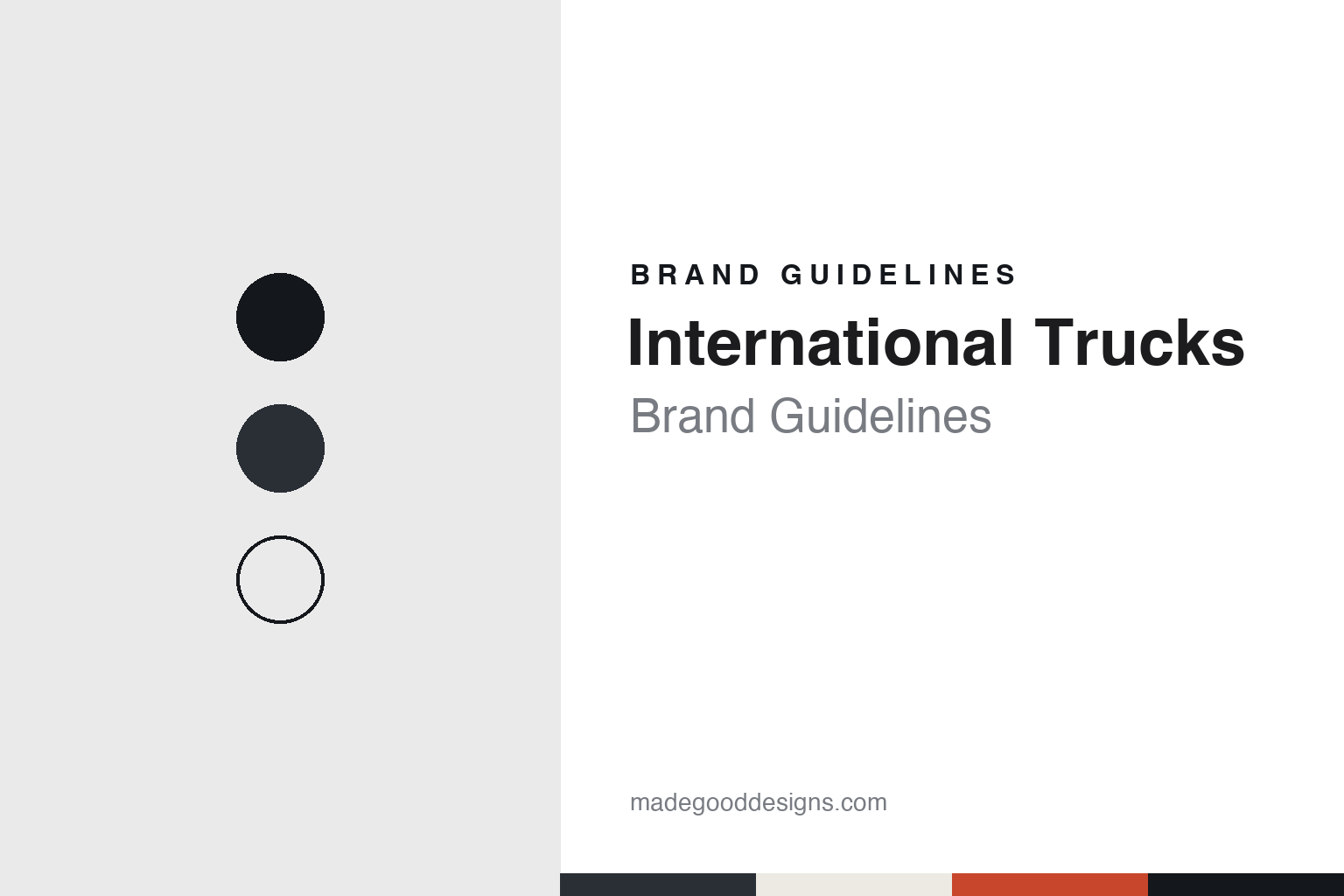
Two constants: an asphalt, lane-line and tail-light red palette and a condensed sans register. Abstract homage — not an International product or mark; no truck, badge or logo is reproduced.
International Harvester
A Chicago merger of reaper makers.
The International name on today’s trucks goes back to a merger of farm-machinery makers. English Wikipedia says the International Harvester Company was formed in 1902 from the McCormick Harvesting Machine Company, the Deering Harvester Company and three smaller manufacturers — Milwaukee, Plano, and Warder, Bushnell and Glessner, maker of the Champion brand — with financing from the banker J. P. Morgan. It lists Charles Deering, Cyrus Hall McCormick Jr. and George Walbridge Perkins as founders and Chicago as its headquarters.
The McCormick side had deep Chicago roots. Wikipedia says Cyrus Hall McCormick demonstrated his horse-drawn reaper in 1831, patented it in 1834, and moved to Chicago with his brother Leander in 1847, where they founded the McCormick Harvesting Machine Company.
The merged company did not immediately use a single name in its showrooms. From 1902 to the early 1920s, according to Wikipedia, the McCormick and Deering dealerships kept their original branding, with Mogul tractors sold by McCormick dealers and Titan tractors by Deering dealers, because the old rivals were still competing. Later product names included McCormick-Deering, which Wikipedia dates from 1922 to 1947, and Farmall, the tractor line introduced in 1924. Wikipedia lists “International” as one of the company’s brand names from 1902 to 1985, and says the company was often abbreviated as IH or simply International.
Vehicles came early. Wikipedia’s article on the truck business says IH introduced the Auto Wagon in 1908, a precursor of the pickup truck, and that over the decades the company built everything from farm machinery and lawn equipment to consumer-grade and heavy commercial trucks. English Wikipedia also says that in 1937 IH engaged the designer Raymond Loewy to revamp its product line and logo, and that Loewy styled the Farmall “letter series” tractors for the 1939 model year.
Colour
Selling the farm business, keeping the truck name.
The company that makes International trucks today is what remained after the rest of International Harvester was sold. Wikipedia says that in the early 1980s IH faced financial difficulty after a poor agricultural economy and a strike in 1979 and 1980, and that the company sold its construction-equipment division to Dresser Industries in 1982. In November 1984, Wikipedia says, IH agreed to sell its farm-equipment division to Tenneco, parent of the rival Case Corporation.
That sale split the name. According to Wikipedia, the IHC name and logo went with the farm business, and Tenneco created the Case IH brand. The truck and engine divisions that remained were renamed Navistar International Corporation on 20 February 1986, Wikipedia says, combining “Navi-” for navigation with “Star”; School Transportation News, in a September 2024 report, dates the Navistar name to 1990. Either way, the trucks kept the International name: Wikipedia says the truck and engine division continued to use the International brand after 1986.
The company also added a school-bus maker. Wikipedia says Navistar became the parent of AmTran in the early 1990s, acquired it entirely in 1995, and renamed it IC Bus in 2002. Headquarters moved too: Wikipedia says Navistar announced plans in 2000 to move from Chicago to Warrenville, Illinois, and in 2010 revived plans to move to Lisle, Illinois, where the company is still based.
Then came a German owner. Wikipedia dates a strategic alliance with the Volkswagen Group’s truck business, Traton, to 2016. Traton announced a proposal to buy the rest of Navistar on 30 January 2020, according to Wikipedia, and completed the acquisition on 1 July 2021, after which Navistar International Corporation was renamed Navistar, Inc.
Typography
Grille, cab and dealership.
A truck maker’s identity lives in places a car badge rarely reaches. The mark on a heavy truck usually sits on or above the grille, where it has to read from a distance, from a mirror and from the cab of the vehicle behind, so badges on this kind of vehicle tend to be large, simple and often three-dimensional, in chrome, brushed metal or moulded plastic rather than in print.
Truck brands can also carry a nameplate or wordmark across the front of the cab or the hood, and a model name on the doors or the sleeper. On fleet vehicles, though, the maker’s mark shares the cab with the operator’s livery: the haulier’s colours, name and fleet number usually dominate the paintwork, and the manufacturer’s badge becomes the one constant from fleet to fleet.
The third surface is the dealer network. Pylon signs, service-bay fascias, parts counters and workshop uniforms repeat the mark at a scale closer to retail signage, and they are where a change of logo or owner tends to show first. For a designer, these three settings — grille, cab and dealership — are the useful test of any truck identity: does the mark hold up in metal, alongside someone else’s colours, and on a sign seen from the road?
Aa
A condensed sans for a name carried on cabs since the harvester era. (Specimen set in Barlow, a sans STAND-IN; NOT the International logo.)
International Motors
The company takes the brand’s name.
In 2024 the company took the name its trucks had carried all along. On 25 September 2024, Navistar, Inc. announced from Lisle that it would rename itself International Motors, LLC, effective 1 October, and that it had “debuted a refreshed logo and distinct visual identity.” The company said the change was driven by a shift in strategy towards becoming a “solutions provider,” with parts, maintenance, financing, connectivity and charging alongside its trucks and buses. Tobias Glitterstam, its chief strategy and transformation officer, said the company was “choosing to return to our roots as International.”
The company described the design idea directly. Its announcement says the logo, colour palette, typography, photography and iconography “take inspiration from the intricate choreography that occurs daily on streets, highways, and roads,” reflecting “the ebbs and flows of traffic.” It said the identity would extend beyond future vehicles to “all digital touchpoints and dealer network locations,” and that a new website, International.com, was the place to start. Its captive finance arm would go to market as International Financial, and existing digital tools would be gathered under a customer interface called My International.
School Transportation News reported the rebrand on 26 September 2024, noting the new logo and that the company would continue to operate the IC Bus brand. It described the change as part of a transformation under owner Traton Group, which it said was formerly known as Volkswagen Truck and Bus. President and chief executive Mathias Carlbaum, the publication reported, called the return to International “an acknowledgment of our rich heritage.” Truck & Bus Builder reported on 2 October 2024 that the Traton subsidiary, based in Lisle, Illinois, had rebranded as International Motors LLC.
For a design guide, International shows how a brand name can outlast the company that created it, pass through a holding name, and then become the company name again. Compare Volkswagen, whose group owns International through Traton, and Mack Trucks, another North American truck name. For this guide we use asphalt grey, a lane-line off-white and a tail-light red with a sans, an unofficial interpretation; no product or logo is reproduced.
Explore & save
Keep International Trucks’s identity on hand — save it to a board in the Made Good inspiration library.
International identity set
Pin the International asphalt, lane-line and tail-light red palette and the condensed sans register to your own board.