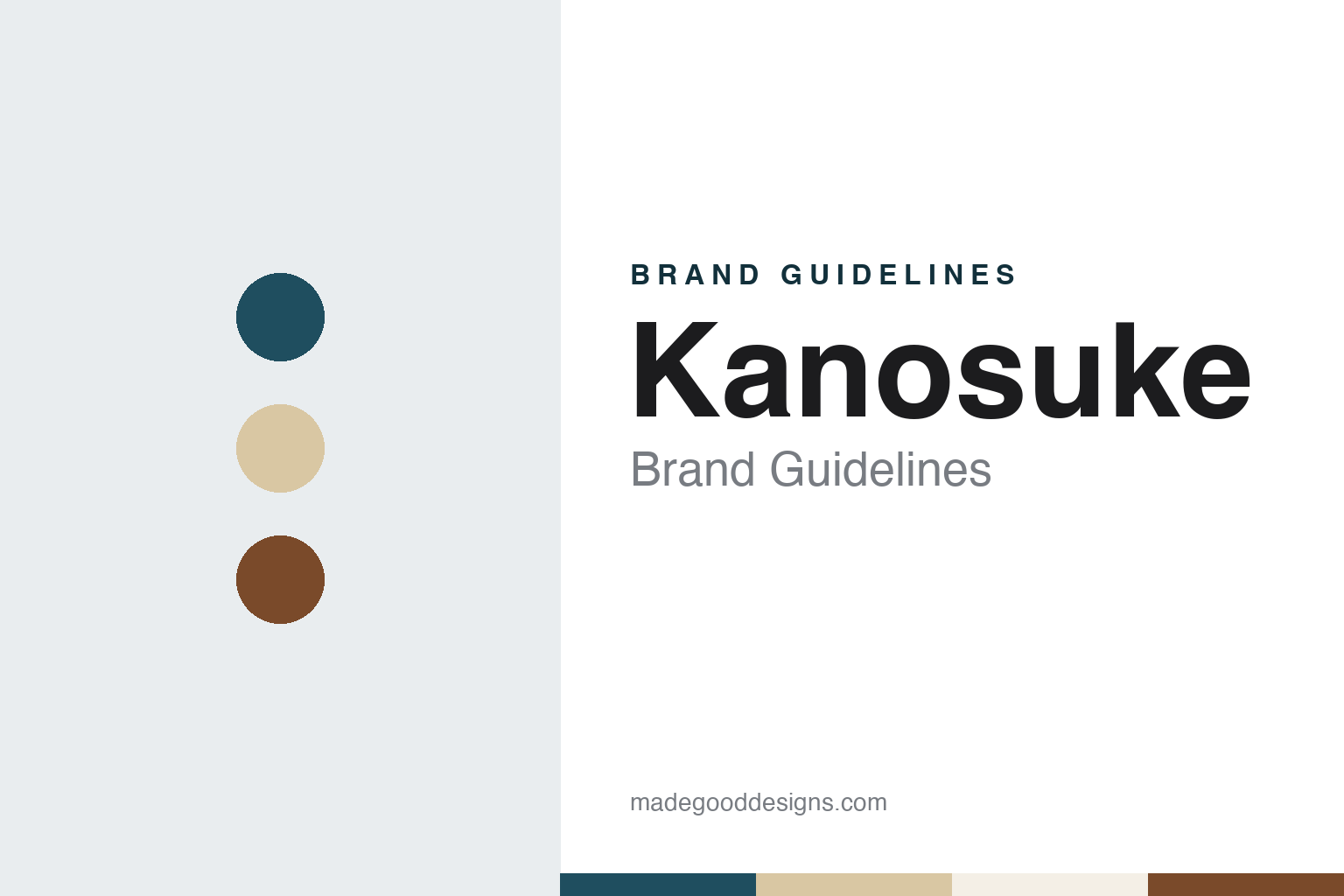
Kanosuke Brand Guidelines
The Komasa family’s seaside whisky distillery at Hioki, founded 2017.
Aa
Two constants: an East China Sea, Fukiage sand and shochu-cask palette and a Japanese Mincho serif register. Abstract homage — not a Kanosuke product or mark; no label, logo or bottle is reproduced.
A shochu house turns to malt
A family that began with shrine sake in 1883.
Kanosuke is a whisky distillery, but it grew out of a much older drinks business. Its founding family runs Komasa Jyozo, a shochu maker in Kagoshima Prefecture, on the southern Japanese island of Kyushu. Whisky Magazine, in an interview by Stefan van Eycken published in November 2023, dated the company to 1883 and noted its 140th anniversary that year; the distillery’s own history says the family began by making sacred sake for the Hachiman shrine in Hiyoshi, Kagoshima, and that the first-generation master distiller, Ichisuke, specialised in rice shochu.
The name on the bottle belongs to the second generation. Kanosuke Komasa, the company says, returned from the war and joined the shochu business, and in 1957 released Mellowed Kozuru, a rice shochu aged for six years in oak casks. The company calls it Japan’s first long-term cask-aged rice shochu, and Whisky Magazine described it as the first shochu aged in oak. Kanosuke Komasa built warehouses for that shochu beside Fukiagehama, a long beach on the west coast of the Satsuma Peninsula facing the East China Sea. According to Whisky Magazine, plans drawn up in 1982 for a brand home for Mellowed Kozuru on the same plot were never built in his lifetime.
His grandson Yoshitsugu Komasa is the fourth generation to lead the family business. Whisky Magazine reported that he studied fermentation and liquor production at the Tokyo University of Agriculture, and that a trip to Scotland in 2014, made to sell shochu, persuaded him that whisky would travel more easily than shochu. He trained at distilleries in Scotland and the United States before the family obtained a whisky licence. The magazine dated the start of construction to March 2017 and the first distillation to 13 November 2017, and said the distillery opened to visitors in spring 2018. It stands beside the three old shochu warehouses, and it took the grandfather’s name.
Colour
Three stills, two kinds of cask and a beach.
The distillery describes itself through its setting. Its English-language site places it in Hioki, on Kagoshima’s west coast, between the mountains, including Mt. Yahazudake, and Fukiagehama beach, which the company says runs for nearly 50 kilometres. A 2024 press release from the company described the site as roughly 9,000 square metres on the Fukiage coast, with a visitor centre and a tasting bar.
The equipment is built for variety. The company says Kanosuke runs three pot stills, each with a different neck shape and lyne-arm angle, operated individually to make different styles of spirit. For maturation it uses re-charred casks that once held rice shochu, a link back to Mellowed Kozuru, alongside ex-bourbon barrels and other cask types, and it ages spirit in several places, including semi-subterranean and beachside warehouses.
Releases came in steps. Whisky Magazine listed New Make and New Born spirit bottlings from 2017 onward, the Kanosuke 2021 First Edition, the distillery’s first single malt, on 16 June 2021, a Second Edition that autumn, an Artist Edition series in 2022, and a core Single Malt Kanosuke from January 2023.
The family also makes whisky at a second site. Whisky Magazine reported that a whisky licence was obtained in 2020 for the Hioki Distillery, the family’s shochu distillery about ten minutes’ drive from Kanosuke, where barley spirit is distilled under vacuum in stainless-steel shochu stills; the magazine described it as grain whisky. In April 2024 the company released Kanosuke Double Distillery, a blend of Kanosuke single malt and the Hioki whisky, which the release called Hioki Pot Still.
Typography
Design and documentation.
The seven brands in this group are all whisky distilleries from India, Japan and Australia: Paul John, Rampur, Indri, Chichibu, Kanosuke, Starward and Lark. Whisky distilleries in general sit at many different points in the trade, from small houses that still carry a founder’s name to labels that now belong to much larger drinks groups, and a single brand can be sold everywhere from a corner shop to a bar list.
A whisky brand’s identity is usually carried less by a single bottle than by a label, a name and the place it promises, because the company behind the name may have changed hands, moved its production or grown far beyond the place where it started. That makes the questions behind each name worth asking plainly: who started it, who owns it now, and where its whisky is actually distilled and bottled.
Each guide separates what independent sources record from what the company says about itself — its founding story, its owners over time, where its whisky is made and how its labels have changed — and marks plainly what rests only on the company’s own word.
Aa
A Mincho serif for a whisky named after a shochu-making grandfather. (Specimen set in Shippori Mincho, a serif STAND-IN; NOT the Kanosuke logo.)
Kanosuke
A spin-off company, and a stake from Diageo.
The whisky business soon became a company of its own. A profile of Yoshitsugu Komasa published by Japan Airlines’ Skyward+ magazine in June 2025 says the distillery was spun off from Komasa Jyozo in August 2021 as Komasa Kanosuke Distillery Co., Ltd., with Yoshitsugu Komasa as president and master blender. The Hioki Distillery remains with Komasa Jyozo, which the 2024 release listed as a separate company led by Tomohisa Komasa.
Outside money followed within weeks. On 8 September 2021 Diageo announced that it had made a minority investment in the company through Distill Ventures, its drinks accelerator. The release said the founders, Komasa Jyozo, would keep majority ownership and control, and that the deal provided for a move to a 50:50 joint-venture ownership structure with Diageo subject to future performance. It said the money would fund more whisky production, new products and a larger international sales and marketing team, and it placed Kanosuke in a whisky portfolio alongside Stauning of Denmark, Westward of Oregon and Starward of Melbourne.
The family thread runs through the whole business. Yoshitsugu Komasa is named in the 2021 Diageo release as founder and chief executive of the distillery; the shochu company his family has run since 1883 still makes spirit at Hioki; and the distillery itself carries the given name of the grandfather whose oak-aged shochu, released in 1957, first put Komasa spirit into wood. The distillery’s official site is kanosuke.com.
For a design guide, Kanosuke shows how a young whisky can borrow its depth from an older family trade, carrying a grandfather’s name, his shochu casks and his stretch of coast into a new category. Compare Nikka, Masataka Taketsuru’s whisky maker of 1934, and Akashi, the whisky of the sake house Eigashima Shuzo. For this guide we use East China Sea blue, Fukiage sand and shochu-cask brown with a Mincho serif, an unofficial interpretation; no product or logo is reproduced.
Explore & save
Keep Kanosuke’s identity on hand — save it to a board in the Made Good inspiration library.
Kanosuke identity set
Pin the Kanosuke East China Sea, Fukiage sand and shochu-cask palette and the Japanese Mincho serif register to your own board.