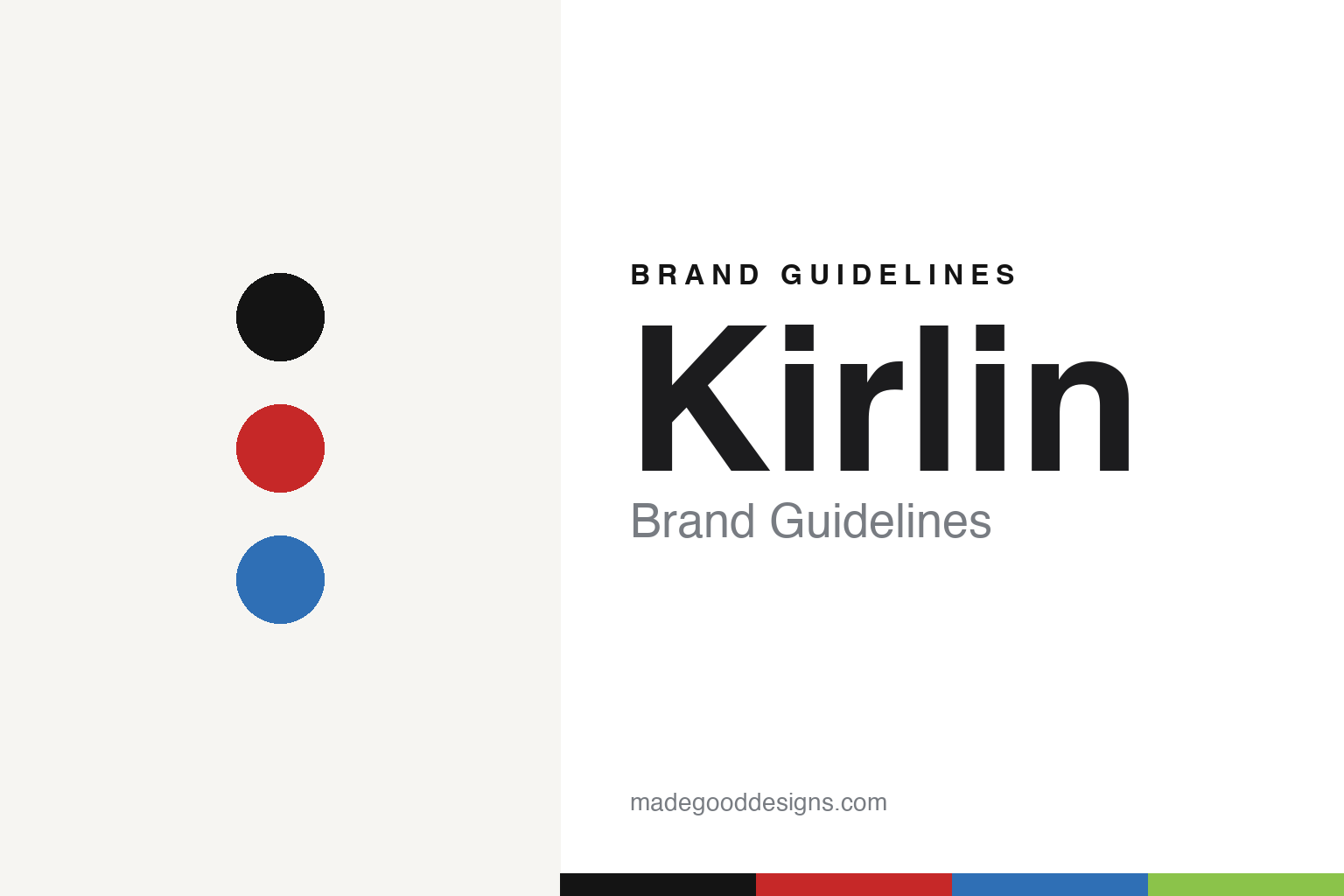
Kirlin Brand Guidelines
The 1997 California cable brand with a paint-chart of jackets.
Aa
Two constants: a Kirlin black, red and jacket-colour palette and a geometric sans register. Abstract homage — not a Kirlin product or mark; no cable, logo or packaging is reproduced.
Kirlin Industries
A 1997 cable company east of Los Angeles.
Kirlin is the cable brand of Kirlin Industries, Inc., which the company says was founded in 1997. Its website today greets visitors with “Since 1997, From Los Angeles to Your Studio,” and gives the company’s address as Ontario, California, a city in the Inland Empire east of Los Angeles; the same Ontario address appears on archived versions of its contact page from 2011 onward. The company does not name its founders on its website, past or present, and we found no independent source that does, so we leave them unnamed.
The firm’s own account is brief. An archived “About” page from December 2007 said Kirlin had “recently celebrated our 10-year anniversary” and described a business “directed by professionals who have over two decades of pro audio production experience.” It named two companies behind the brand: Kirlin Industries and KL Digital Cable Company. By June 2011 the page was more specific: “In 2006, Kunshan KL Digital Cable Co., Ltd. was formed, which merged into Changzhou Kirlin Electronics Co., Ltd in 2008.” Kunshan and Changzhou are both manufacturing cities in Jiangsu province, in eastern China, and the 2011 contact page listed Changzhou Kirlin Electronics alongside the California office, with separate sales desks for export and for the Chinese domestic market.
That two-country structure is the key fact about the brand. Kirlin presents itself as a California company, and its archived pages also show manufacturing roots in China. The current website does not say where its cables are made, and later versions of the contact page list only the Ontario address, so we describe the Changzhou company as what the 2011 site named, not as a confirmed current factory.
Colour
Ten tiers and a lot of colour.
Kirlin sells a broad range: instrument, microphone, speaker, patch, Y and interconnect cables; MIDI, DMX, USB and HDMI cables; multicore snakes, some with stage boxes or reels; bulk wire; and connectors from quarter-inch plugs to XLR, RCA and Speakon. Its instrument cables are sorted into ten named tiers — Basic, Select, Select+, Original, Original+, Premium, Premium+, Premium Coil, Stage and Studio — which run, on the company’s own product pages, from budget conductors to copper ones with denser shields and longer warranties.
The product pages make the ladder plain. The entry-level Basic 24 instrument cable uses a 24-gauge copper-clad aluminium-magnesium (CCAM) conductor with 90% spiral shielding and a one-year warranty. The Original 20 microphone cable moves to two 20-gauge copper conductors under a 95% copper braid, with a five-year warranty, and the Premium+ and Premium Coil cables with gold-plated contacts carry a limited lifetime warranty.
What stands out for a design guide is colour. Kirlin names its jackets the way a paint company might. The Basic and Select 24 cables come in Atoll, Lemon, Lilac, Mango, Rose and Spring; the glow-in-the-dark Premium cable in Kiwi Pop, Ocean Mist, Rose Glow, Royal Sapphire, Solar Pop and Starry Plum; the Premium+ hemp-jacket cable in Espresso, Mocha, Sage and Green; and the Gradient Collection in blue, sunburst, purple and a pink-to-orange fade. The Premium Coil cable — a coiled lead 9.1 metres long — comes in Red-frost and Green-frost, and a woven Select+ cable is offered in eight colours. There is engineering too: the Premium Silent cable has a plug that, the company says, “automatically mutes (shorts)” the cable so that swapping a guitar does not send pops and squeals through the amplifier.
Typography
Design and documentation.
An instrument cable looks like the simplest thing on a stage, yet the brands that make them differ widely in age, ownership and in what they say about where their cables are made. Six of the seven in this guide are based in the United States and the seventh belongs to a North American group; they fall into three rough groups.
The catalogue suppliers are the largest. Hosa was founded in 1984 by Sho Sato, who had moved to the United States from Japan, and he has since handed it to his daughter, Mayumi Allison; it is based in Buena Park, California, the company says. Kirlin says Kirlin Industries was founded in 1997 and sells in 35 countries and regions from Ontario, California. Pig Hog, of Petaluma, California, dates itself to 2011 lists more than 300 cables, adapters and accessories, and appears among the brands of Ace Products Group, which also owns Reunion Blues.
The specialists sell on engineering. George L’s, the Madison, Tennessee, company of George L. Lewis, built its name on a solderless system: cut the low-capacitance cable and tighten on the plug, its website said in 2005. Evidence Audio was founded by Tony Farinella and says its cables are hand-built in the USA from American-made material. Lava Cable is now a brand of ACT Entertainment, whose other names include RapcoHorizon and ProCo, and which says Lava brings boutique materials to a wider audience.
The braided cable has its own claimant. Spectraflex says it has made its nylon-braided “Original Braided Cables” since 1988; its website gave an address in Clifton, New Jersey, in 1996.
This guide sets out what can be checked about each brand — who founded it, who owns it, and what it says about where its products are made — and marks clearly what rests only on the company’s own word.
Aa
A geometric sans for a colour-led cable brand. (Specimen set in Montserrat, a sans STAND-IN; NOT the Kirlin logo.)
Kirlin
A California brand with a trade-show calendar.
Kirlin’s public life runs through trade fairs. Its news page lists stands at the NAMM Show in Anaheim — the 2017, 2018, 2019, 2020, 2024 and 2025 editions — and at Music China in Shanghai in most years since 2016, with a stand booked for October 2026. In 2026 it also exhibited at Prolight + Sound in Bangkok, and an archived 2008 notice shows it at the Palm Expo in Beijing under the name “KL Digital Cable Co. (Kirlin Cable).” The company says its cables are sold in 35 countries and regions; its dealer list runs from Argentina and Australia to the United Kingdom and Zimbabwe. Its artists page is a roll of working guitarists, bassists, producers and DJs rather than stadium names. Its tagline, “Trusted by the legends of 1997, built for the stars of 2026,” is the company’s own phrase.
We found no Wikipedia article and, in the sources we could check, no independent trade-press profile of the company, so this guide rests on Kirlin’s own pages, current and archived. Nor is any logo specification, typeface or brand colour published. Its website is set in web fonts including Montserrat, Epilogue and Mulish, which tells us about the site, not about the wordmark.
For a design guide, Kirlin shows how a value cable brand can sell personality through colour names and finishes rather than through a founder story. Compare Mogami, the Japanese cable maker known for studio wire, and D’Addario, whose accessories range includes instrument cables. For this guide we use jack black, signal red and a gradient blue with a geometric sans, an unofficial interpretation; no product or logo is reproduced.
Explore & save
Keep Kirlin’s identity on hand — save it to a board in the Made Good inspiration library.
Kirlin identity set
Pin the Kirlin black, red and jacket-colour palette and the geometric sans register to your own board.