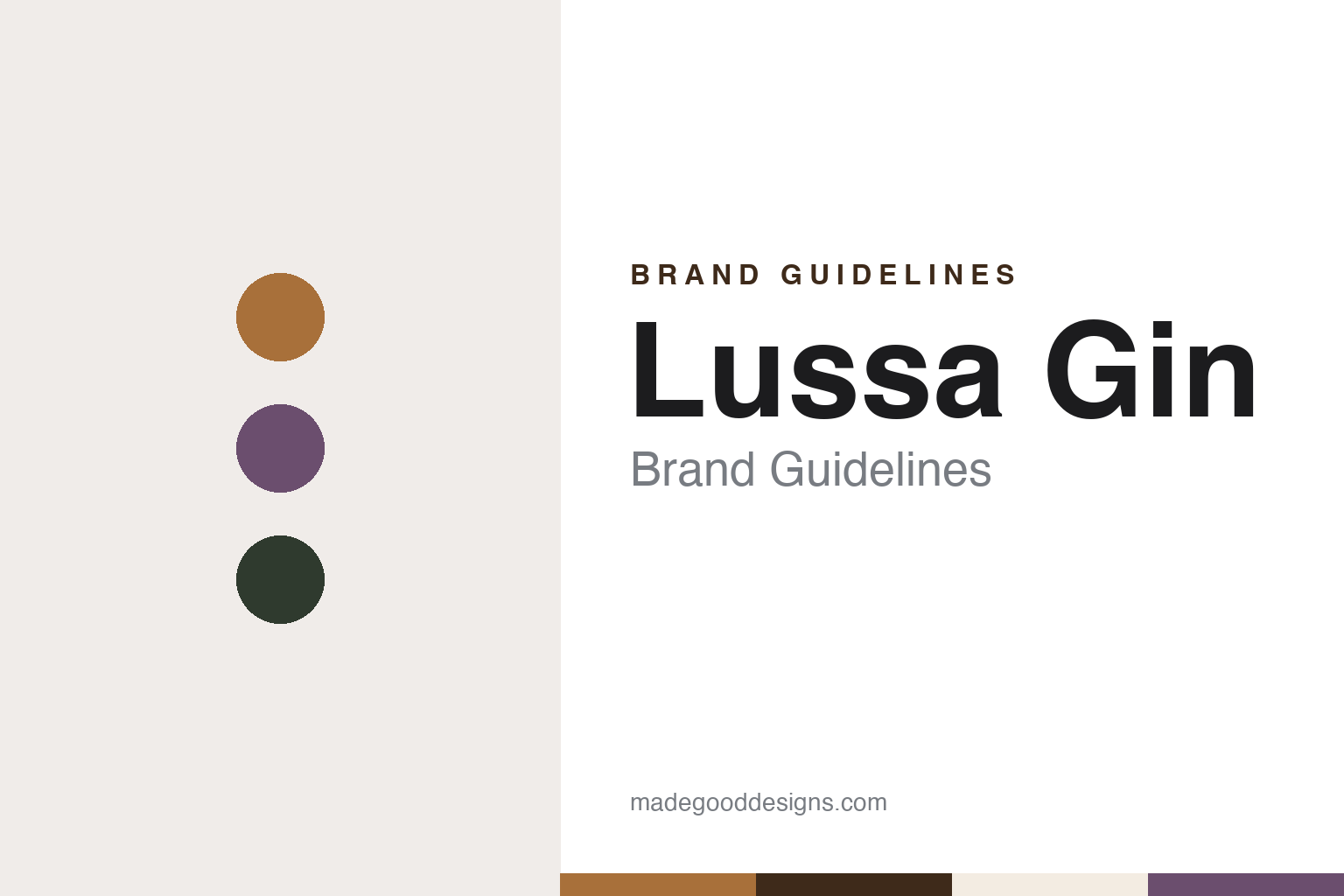
Lussa Gin Brand Guidelines
An Isle of Jura gin made at Ardlussa since 2015.
Aa
Two constants: a hill bronze, deer brown and heather palette and an ultra-condensed sans register. Abstract homage — not a Lussa Gin product or mark; no label, logo or bottle is reproduced.
Three neighbours at the end of the road
A gin started in a kitchen at the north end of Jura.
Lussa Gin comes from the far end of a small island. The company is based at Ardlussa, at the north end of the Isle of Jura in the Inner Hebrides; its own site places the distillery 25 miles along the single-track road from the Jura ferry. The landowning body Scottish Land & Estates, in a case study of the business, says it was set up in 2015 by Claire Fletcher, Georgina Kitching and Alicia MacInnes, and that it is based on the Ardlussa Estate, which is owned by Claire Fletcher’s husband.
The Scottish Gin Society described the three in January 2020 as neighbours who began experimenting in 2015 with a 10-litre still called Jim. The ferry operator CalMac, in a listing dated March 2025, says the business began in a kitchen before moving into renovated old stables, which now house a 200-litre still named Hamish. The company describes Hamish as a handmade Portuguese alembic copper pot still. A profile on the website of the island’s whisky distillery, Jura, says the team made more than 4,000 bottles on the kitchen still and held a blind tasting in the village hall before launch; that page introduces the team as Georgina Kitching, Claire Fletcher and Sofie Fletcher, with Georgina Kitching, who has a science and teaching background, leading operations and distilling.
Claire Fletcher told the Jura distillery that the island’s wilderness meant the team “had to think differently and do things differently,” and that in such a small community “everyone wears more than one ‘hat’ and we run everything ourselves.” The Scottish Gin Society said the sea lettuce in the gin is gathered by small boat, and that the botanicals are grown or hand-foraged on Jura by the team or by neighbours.
Colour
Hills that change with the level in the bottle.
The bottle was designed by Front Page, an agency in Glasgow. The Dieline featured the work in January 2017, and the agency’s statement, published by the World Brand Design Society in January 2017, sets out the thinking in detail.
The statement opens with the setting: Ardlussa, it says, is where the terrain is tough and the weather unforgiving, and the botanicals are either foraged from that wilderness or grown at home by the founders. Front Page said the island itself informed the design: a traditional, hand-drawn pen-and-ink-style illustration of the Ardlussa hills, a bronze colour palette inspired by the heather and deer of Jura, and a bespoke tartan “drip catcher” at the neck. The agency said the logotype and its lock-up are set in an ultra-condensed Univers to mirror the slender bottle.
Two details carry most of the story. To mark that the gin was made by women without, in the agency’s words, appearing gimmicky, Front Page used the distillers’ signatures, a device it said is more common on whisky labels. And the hills are drawn to change with the contents: the agency said the illustration is magnified to its correct proportion when the bottle is full and reverts to a more condensed shape when it is empty.
The botanicals are the other half of the brand. The company says Lussa uses 15 botanicals: ten gathered wild on Jura, five grown on the estate, and four bought in from suppliers because they cannot yet be grown in enough quantity. Scottish Land & Estates names sea lettuce, lifted from near the seabed with a long boat hook, and flowers from the estate’s lime trees, and says the founders have planted juniper. CalMac’s 2025 listing says the botanicals are frozen rather than dried, which the Jura distillery’s profile says is done to capture their lighter flavours, and that the team was building a Lussa Juniper Garden to show its plants.
Typography
Design and documentation.
The seven brands in this group are all Scottish gins: Caorunn, Pickering’s, Rock Rose, Daffy’s, Eden Mill, Lussa and Arbikie. Scottish gins in general come from many different kinds of producer, from whisky distilleries that make a gin alongside their malt to small independent distilleries, family farms and island businesses, and a single bottle can be sold everywhere from a local shop to a bar list abroad.
A gin brand’s identity is usually carried less by the spirit itself than by a name, a bottle, a label and the place it promises, because gin needs no long ageing and can be distilled almost anywhere. The company behind a name may have changed hands, moved its stills or had its gin made under contract somewhere else. That makes the questions behind each name worth asking plainly: who started it, who owns it now, and where its gin is actually distilled and bottled.
Each guide separates what independent sources record from what the company says about itself — its founding story, its owners over time, where its gin is made, which botanicals it says come from its own surroundings and how its labels have changed — and marks plainly what rests only on the company’s own word.
Aa
An ultra-condensed sans for a slender island bottle. (Specimen set in Oswald, a condensed sans-serif STAND-IN; NOT the Lussa Gin logotype, which the agency says is set in Univers.)
Lussa Gin
A small distillery that sells close to home.
Scottish Land & Estates says the founders make up about a tenth of the tiny community at Lussa, that about three-quarters of sales go directly to consumers and smaller outlets, and that the business turned down approaches from two supermarket chains. The distillery is open for tours on weekdays, which the company says take about 45 minutes, and CalMac lists Lussa among the things to do on Jura. The same listing calls Jura the eighth-largest Scottish island and puts its population at about 250 people and its red deer at about 6,000, the animals whose colouring Front Page said it drew on, with the heather, for the bronze palette.
Lussa shares the island with an older drinks name: Jura single malt, whose distillery’s profile of Lussa describes the gin distillery as lying beyond it, along the island’s only road.
For a design guide, Lussa Gin shows how a remote producer can put its place and its people on the bottle in two quiet devices: a landscape that changes as the gin is poured and the signatures of the people who make it. Compare Isle of Harris, the Tarbert distillery behind Harris Gin, and The Botanist, Bruichladdich’s Islay gin. For this guide we use hill bronze, deer brown and heather with a condensed sans, an unofficial interpretation; no product or logo is reproduced.
Explore & save
Keep Lussa Gin’s identity on hand — save it to a board in the Made Good inspiration library.
Lussa Gin identity set
Pin the Lussa Gin hill bronze, deer brown and heather palette and the ultra-condensed sans register to your own board.


