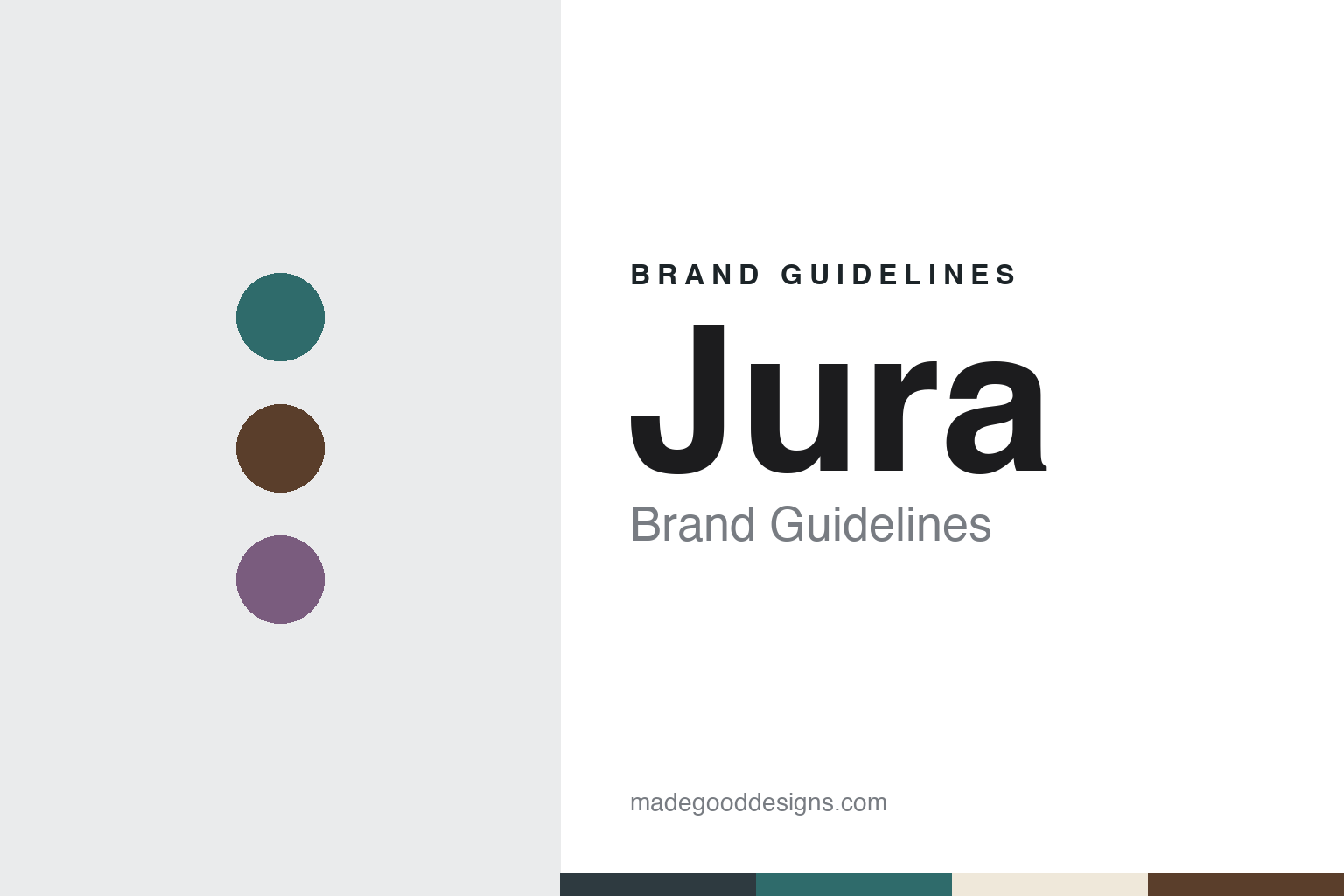
Jura Brand Guidelines
The Hebridean island malt, founded 1810 and rebuilt in 1963.
Aa
Two constants: a Hebridean slate, sea teal and peat brown palette and a geometric sans register. Abstract homage — not a Jura product or mark; no label, logo or bottle is reproduced.
A laird’s distillery, lost and rebuilt
From an 1810 still house to a 1960s revival.
Jura is a single malt Scotch whisky made at the only distillery on the Isle of Jura, in the Inner Hebrides off the west coast of Scotland, English Wikipedia says. The island has one road, one pub and one distillery, the same source notes, and its people are known by the Gaelic name Diurachs. Reaching it usually means a ferry to Islay and a second, smaller ferry across the sound; George Orwell, who wrote Nineteen Eighty-Four on the island, called it “extremely unget-at-able” in 1946.
English Wikipedia says the distillery was founded in 1810 by the Laird of Jura, Archibald Campbell. It fell into disrepair, was restored in 1884, and around 1900 was out of use again and dismantled. Ownership passed through several hands in the nineteenth century, from the Campbells to Norman Buchanan, J & K Orr and James Ferguson & Sons, according to the timeline English Wikipedia draws from Scotchwhisky.com.
The modern distillery is a post-war revival. In the 1950s two island estate owners, Robin Fletcher and Tony Riley-Smith, set out to restart the local economy and had the distillery rebuilt and enlarged by the architects Lothian, Barclay, Jarvis & Boys, with advice from the distillery designer William Delmé-Evans; the work was finished in 1963 and included taller stills, English Wikipedia says, citing the Dictionary of Scottish Architects and The Guardian. Scottish & Newcastle Breweries owned the distillery from 1960, and in 1985 Invergordon Distillers bought it, the Aberdeen Evening Express reported that October.
Colour
A blender’s portfolio, then a Philippine parent.
Jura joined Whyte & Mackay when the whisky company bought Invergordon Distillers, with its Jura, Bruichladdich and Tullibardine distilleries, in 1993, The Independent reported in October of that year. Whyte & Mackay itself changed hands several times: English Wikipedia says Fortune Brands sold it to its management in 2001, and in 2007 the business was sold to India’s United Spirits.
That sale set up the next one. When Diageo took control of United Spirits, Diageo agreed to sell Whyte & Mackay over competition concerns, The Independent reported in November 2013. The buyer was Emperador, the drinks arm of the Philippine conglomerate Alliance Global; the BBC reported the agreement in May 2014, and English Wikipedia dates completion to 31 October 2014. Whyte & Mackay’s single malts now include The Dalmore, Fettercairn and Tamnavulin alongside Jura.
The island itself has supplied most of the brand’s names. English Wikipedia says the expression Two-One-Two was named after the island’s 212 inhabitants, and the heavily peated Prophecy took its name from a local legend about a seer evicted by the Campbells in the early 1700s, who foretold that the last Campbell to leave Jura would be one-eyed and leave with his belongings on a cart pulled by a white horse.
The most design-led release drew on Orwell. Food Ingredients First reported that the agency Jones Knowles Ritchie designed the bottle, box and campaign for Jura 1984 Vintage, a single malt distilled in 1984 and released thirty years later in an edition of 1,984 bottles. The outer box was die-cut so that it “censored” the text on the bottle inside, under the line “Nothing is what it seems,” and Sean Thomas, a creative director at the agency, said the redacted text was meant to convey a sense of oppression and mistrust.
Typography
Design and documentation.
The seven brands in this group are all whisky, gin, grappa, calvados and rosé names: Tomatin, Jura, Edinburgh Gin, Roku, Poli, Boulard and Minuty. Spirits and wine brands in general sit at many different points in the trade, from family houses that still carry a founder’s name to labels that now belong to much larger drinks groups, and a single brand can be sold everywhere from a corner shop to a restaurant list.
A spirit or wine brand’s identity is usually carried less by a single bottle than by a label, a name and the place it promises, because the company behind the name may have changed hands, moved its production or grown far beyond the place where it started. That makes the questions behind each name worth asking plainly: who started it, who owns it now, and where its spirit or wine is actually made and bottled.
Each guide separates what independent sources record from what the company says about itself — its founding story, its owners over time, where its spirit or wine is made and how its labels have changed — and marks plainly what rests only on the company’s own word.
Aa
A geometric sans for a short island name in capitals. (Specimen set in Josefin Sans, a sans-serif STAND-IN; NOT the Jura logo.)
Jura
Three resets of the core range in seven years.
The core range has been rebuilt more than once. Scotchwhisky.com reported in March 2018 that Origin, Superstition, Diurachs’ Own 16 and Prophecy would be withdrawn from April that year in favour of five new bottlings, Journey, a 10 and a 12 Year Old, Seven Wood and an 18 Year Old, built on a house style that pairs subtle smoke with sweetness from American white oak and sold in a redesigned bottle. Whyte & Mackay called it the biggest launch in the brand’s history, and Kirsteen Beeston, Jura’s global head of brand, described it as a “new dawn.” The Scottish trade paper SLTN reported that a campaign titled “A Long Way From Ordinary” would tell the story of the island, its community and its whisky.
Two further changes followed. Drinks Intel reported in March 2023 that Jura Bourbon Cask was replacing Journey as the entry-level malt in all markets. In September 2025 the whisky site Whisky Monkeys reported that a 12 Year Old would replace the 10 Year Old as the entry age statement, starting in the United Kingdom, and that the new packs carry a flavour scale for fruit, smoke and spice, with a colour label for each of the main bottles. In 2024 a biomass boiler was installed to power the distillery, English Wikipedia says.
The name needs a little care online. Jura is also a mountain range on the border of France and Switzerland, a Swiss canton and a French department, and the brand of a Swiss maker of coffee machines; the whisky’s own site is jurawhisky.com.
For a design guide, Jura shows how an island’s stories, from a Campbell prophecy to Orwell’s novel, can name and dress a single malt, and how a core range can be redrawn around flavour cues. Compare Drambuie, the whisky liqueur tied to the Isle of Skye, and The Macallan, the Speyside single malt. For this guide we use Hebridean slate, sea teal and peat brown with a geometric sans, an unofficial interpretation; no product or logo is reproduced.
Explore & save
Keep Jura’s identity on hand — save it to a board in the Made Good inspiration library.
Jura identity set
Pin the Jura Hebridean slate, sea teal and peat brown palette and the geometric sans register to your own board.