Drambuie Brand Guidelines
The Skye whisky liqueur the MacKinnons kept for a century.
Aa
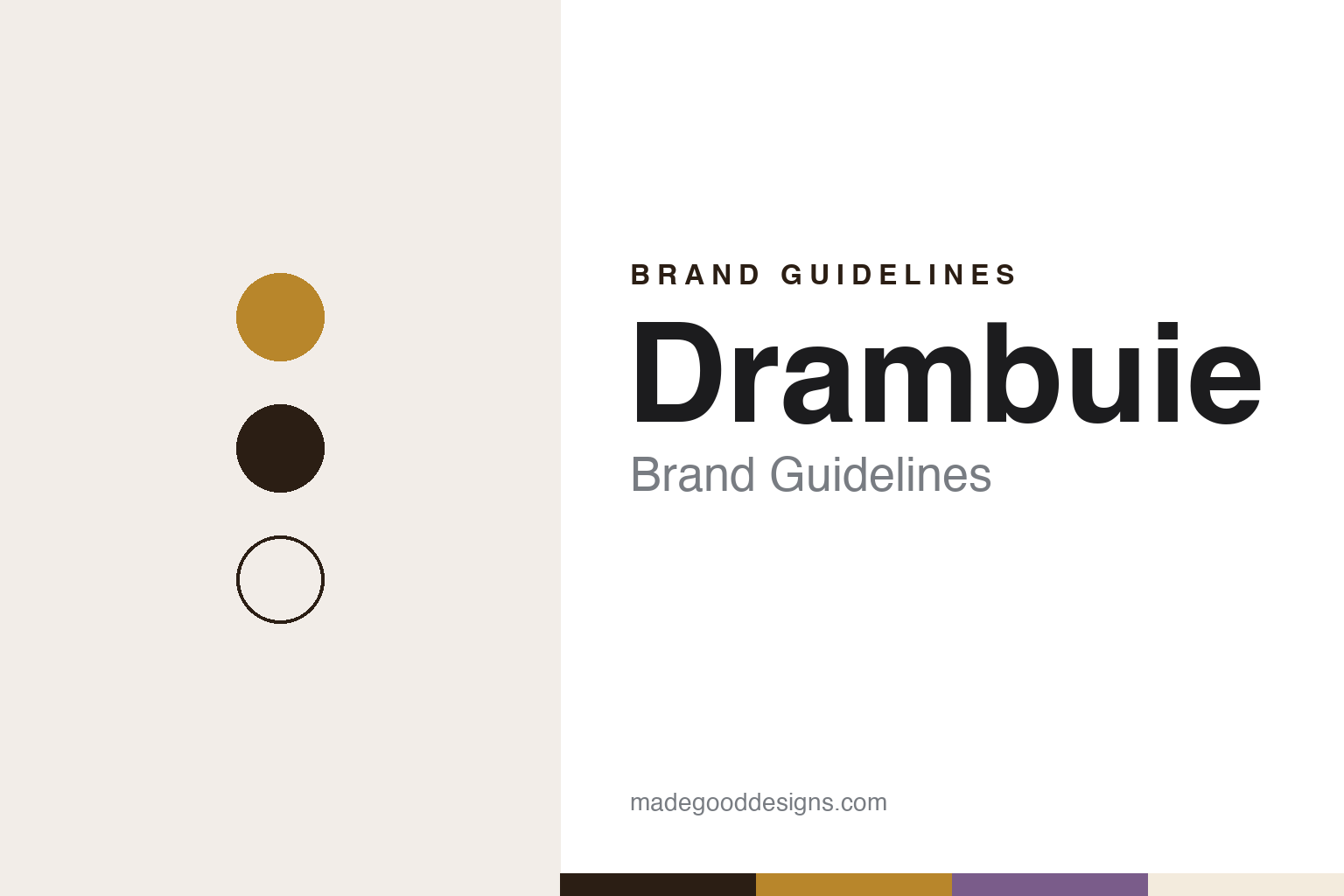
Two constants: a Drambuie gold, peat and heather palette and a Highland serif register. Abstract homage — not a Drambuie product or mark; no bottle, logo or label is reproduced.
From Skye to Edinburgh
A hotel keeper, a widow and a family firm.
Drambuie is a golden liqueur made from Scotch whisky, heather honey, herbs and spices, bottled at 40% ABV. Its story starts with a legend the brand has long told. After the Battle of Culloden in 1746, Prince Charles Edward Stuart, Bonnie Prince Charlie, fled to the Isle of Skye, where Captain John MacKinnon of Clan MacKinnon sheltered him; according to MacKinnon family legend, the prince repaid him with the recipe for a prized drink. Historians dispute this, and the novelist Iain Banks, in his 2003 whisky book Raw Spirit, is among those cited for the view that the story was made up to sell the liqueur.
The documented history begins on Skye in the nineteenth century. English Wikipedia, citing the drinks writer Jim Murray’s 1983 account The Secret History of Drambuie, says the recipe passed to John Ross, and that from 1879 his son James Ross, who ran the Broadford Hotel on Skye, began working on it. In the 1880s Ross changed the base spirit from brandy to Scotch whisky, made the drink for friends and then for hotel guests, and gave it the name Drambuie. He registered the name as a trademark in 1893, the company says. The name may come from the Scottish Gaelic an dram buidheach, “the drink that satisfies,” a reading the original maker put forward.
Later, James Ross’s widow, Eleanor Ross, sold the recipe to pay for her children’s education. Malcolm “Calum” MacKinnon worked with her to keep making the drink. By 1912 his employers, Macbeth & Son, had bought the recipe, but that business ran into trouble, and in 1914 MacKinnon, encouraged by his fiancée Gina Russell Davidson, bought it and set up the Drambuie liqueur company. The couple married in 1915, and Gina MacKinnon became keeper of the recipe, mixing it in her own kitchen. From 1945 she was chair and grew the business, particularly its exports to the United States, as a British Pathé film of the period records. The MacKinnon family went on to own Drambuie for about a hundred years.
Colour
Edinburgh, Leith, Kirkliston, Glasgow.
Drambuie was first produced commercially on Union Street in Edinburgh in 1910, and only twelve cases were sold at first, Difford’s Guide reports. The same source says that in 1916 Drambuie became the first liqueur admitted to the cellars of the House of Lords, and that it began to ship to British Army officers’ messes around the world.
The company moved several times as it grew. Around 1940 it took bonded premises in Dublin Street Lane, where the liqueur was compounded — the whisky flavoured and sweetened — and bottled, with its office in York Place. After a short spell at Broughton Market it moved in 1955 to the foot of Easter Road in Leith, and in 1959 to purpose-built premises on the western edge of Kirkliston.
That site was vacated in 2001, and production was contracted out from then on: first to Glenmorangie’s bottling plant at Broxburn, then, from 2010, to Morrison Bowmore Distillers at Springburn Bond in Glasgow, The Scotsman reported. In 2019, under its new owner, production moved to the William Grant & Sons bottling facility.
Drambuie has also widened its range. In 2009 it launched The Royal Legacy of 1745, a malt whisky liqueur at 40% ABV, which won the Drinks International Travel Retail Award for best travel retail drinks launch at the TFWA show in Cannes in October 2009. The core liqueur remains best known in mixed drinks, above all the Rusty Nail and its variations, and the Royal Rob Roy. Its website today also links it with cranachan, which it calls the “uncontested king of Scottish desserts”, and describes the drink as a blend of aged Scotch whisky, heather honey and aromatic herbs and spices.
Typography
Design and documentation.
The seven brands in this group are all liqueurs and spirits: Drambuie, Frangelico, Malibu, Southern Comfort, Tia Maria, Pimm’s and Sheridan’s. Liqueur and spirit brands in general sit at many different points in the trade, from family firms that still carry a founder’s name to names that now belong to much larger drinks groups, and a single brand can be sold everywhere from a corner shop to an airport duty-free shelf.
A liqueur or spirit brand’s identity is usually carried less by a single recipe than by a bottle, a name and the drink or serve it promises, because the company behind the name may have changed hands, moved its production or grown far beyond the place where it started. That makes the questions behind each name worth asking plainly: who started it, who owns it now, and where its drinks are actually made and bottled.
Each guide separates what independent sources record from what the company says about itself — its founding story, its owners over time, where its drinks are made and how its packaging has changed — and marks plainly what rests only on the company’s own word.
Aa
A Highland serif — a legend-led whisky liqueur. (Specimen set in Cormorant Garamond, a serif STAND-IN; NOT the Drambuie logo.)
Drambuie
A clear bottle and an interlocking DD.
The brand went through a period of rebuilding in the 2000s. A PR consultancy that worked on it described efforts from 2007 to restore its reputation after a fall in popularity and sales. For the centenary of Drambuie’s first Edinburgh bottling, in 2010, the company introduced a new bottle with television and print advertising. The new bottle was clear, so the colour of the liqueur could be seen, and carried a new interlocking “DD” icon behind the brand name, repeated on the neck, The Repository of Canton, Ohio, reported in August 2010.
Four years later the family business changed hands. In May 2014 the MacKinnon family put Drambuie up for sale, and on 8 September 2014 William Grant & Sons, the family-owned Scottish distiller behind Glenfiddich, announced that it had bought The Drambuie Liqueur Company. The price was not disclosed. Trade press at the time reported that Suntory had also been interested. Drambuie’s website now describes the brand as fully owned by William Grant & Sons, which it calls a fifth-generation Scottish family distiller, and the company remains registered in Scotland.
The result is a brand whose history has two layers. One is the Jacobite legend of 1746, which Drambuie has used to tell its story and which historians treat as legend. The other is the recorded story of a Skye hotel keeper, a widow, and an Edinburgh couple who turned a local drink into an export, and who kept it in one family for about a century before selling it to another Scottish family firm. For the typeface the brand uses, see our separate note on the Drambuie font.
For a design guide, Drambuie shows how a liqueur can lean on a story while letting the drink itself — gold through a clear bottle — do much of the visual work. Compare Unicum, another family herbal liqueur with a long recipe story, and Appenzeller Alpenbitter. For this guide we use gold, peat brown and heather purple with a serif, an unofficial interpretation; no product or logo is reproduced.
Explore & save
Keep Drambuie’s identity on hand — save it to a board in the Made Good inspiration library.
Drambuie identity set
Pin the Drambuie gold, peat and heather palette and the Highland serif register to your own board.