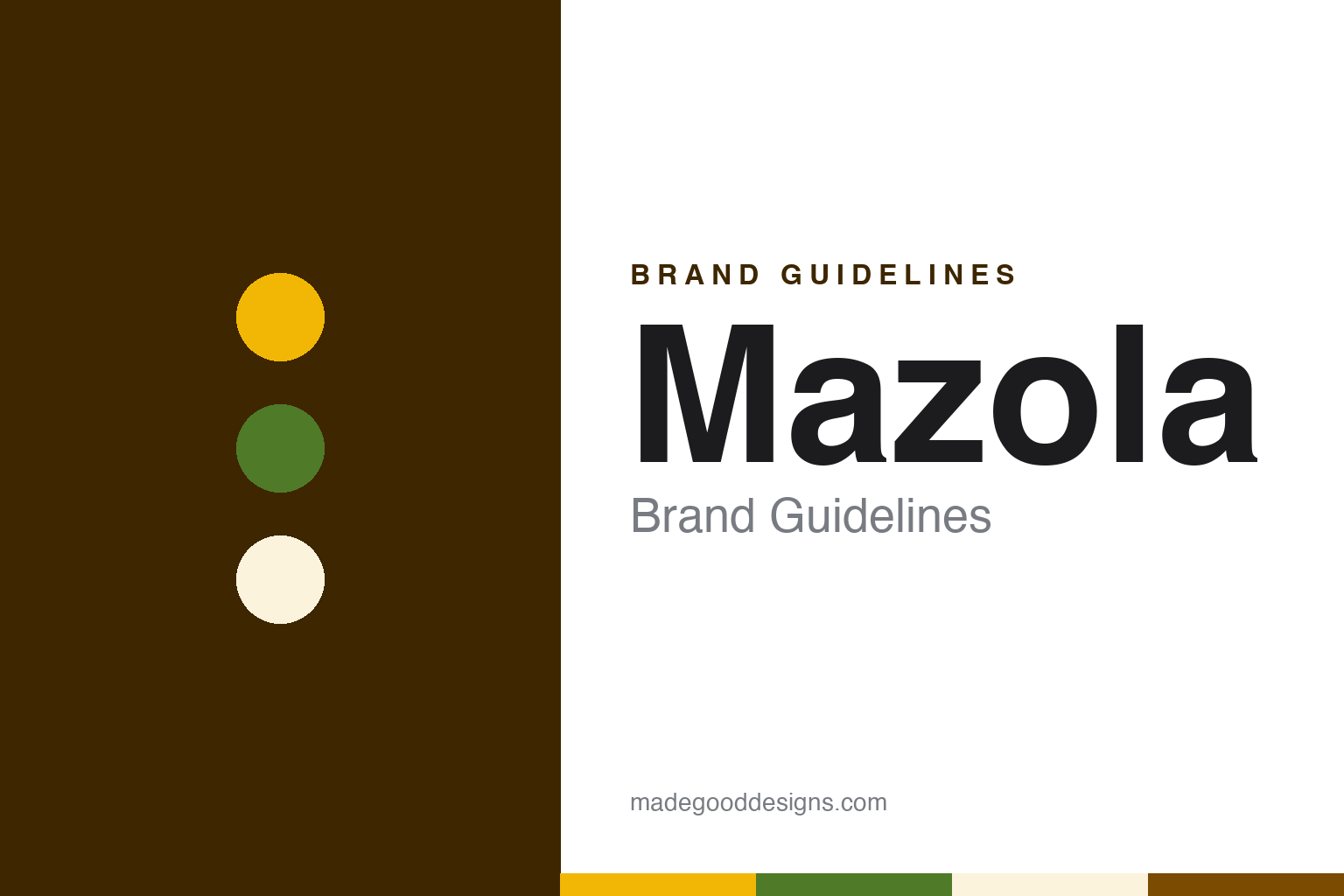
Mazola Brand Guidelines
A corn-starch combine, a word built from maize and oil, and a century of cookbooks.
Aa
Two constants: a kernel gold, husk green and cream palette and a high-contrast display serif register. Abstract homage — not a Mazola product or mark; no bottle, label or logo is reproduced.
A corn refiner’s oil
Rival refiners, a 1906 merger and an oil pressed from the germ of the corn.
Mazola is an American brand of corn oil, sold today with other cooking oils and cooking sprays by ACH Food Companies. It began as a sideline of a corn refiner. The International Directory of Company Histories (St. James Press, 1998), in its history of Bestfoods, says three corn businesses merged in 1902 to form the Corn Products Company, with C. H. Matthiessen as president. A year earlier, the directory says, Edward T. Bedford, an executive of Standard Oil of New Jersey, had organised a rival, the New York Glucose Company.
The rivals combined in January 1906. According to the directory, the Corn Products Company, the New York Glucose Company and the Warner Sugar Refining Company merged that month as the Corn Products Refining Company, headquartered in New York City, with Bedford as president. The new company made corn starch, corn syrup and corn oil, opened sales offices in Germany and the United Kingdom, and in 1908 began building a large refining plant near Summit, Illinois.
The refiner already had a branded syrup: the company’s Karo corn syrup dated from before the 1906 merger. The directory says Corn Products introduced Mazola corn oil in 1911, at a time when it was also packing syrups, jams, and edible and laundry starches, and when much of its output went to wholesalers for sale under private labels.
The name joins two words. The Gjenvick-Gjønvik Archives, which catalogue a 1921 Mazola advertisement placed by the Corn Products Refining Co., say the refined oil was named Mazola in 1912 from “maize” and “oil”, and that it was sold first to makers of salad dressings before being offered to home cooks. The 1921 advertisement itself recommends the oil for general cooking and for salad dressings, and presents it as an oil made from golden corn.
The parent company spent its early years in court. The directory says the federal government sued Corn Products under the Sherman Antitrust Act in 1913, and that in 1919, after long litigation, the Supreme Court ordered it to divest several properties without dissolving the company. That same year, the directory says, it bought a plant in Germany.
Colour
Corn Products, CPC International, Bestfoods, Unilever and ACH.
Mazola then moved through a series of corporate names. The directory says Corn Products Refining merged with The Best Foods, Inc., a consumer food company, in May 1959, forming the Corn Products Company. The combined business put the Mazola name on a second product, introducing Mazola margarine in the United States in 1961.
The renaming continued. In April 1969, the directory says, Corn Products Company became CPC International Inc., a change meant to play down its corn refining. That refining business was spun off to shareholders as Corn Products International on 31 December 1997, and on 1 January 1998 CPC International changed its own name to Bestfoods. Mazola remained with Bestfoods.
Bestfoods did not stay independent for long. A Unilever announcement of 23 April 2002 says Unilever had acquired Bestfoods in October 2000. In that announcement Unilever said it had signed an agreement to sell a group of food brands sold across North America to ACH Food Companies, Inc., of Memphis, Tennessee, a subsidiary of Associated British Foods plc. The major brands were Mazola cooking oil products, Argo and Kingsford’s corn starches, Karo and Golden Griddle syrups and Henri’s salad dressing, sold in the United States, Puerto Rico and Canada, and the deal included a manufacturing facility in Argo, Illinois. Patrick Cescau, Unilever’s foods director, said the brands “simply fall outside of our brand focus”.
The sale went through that summer. Unilever announced on 2 July 2002 that it had completed the sale to ACH, which it again described as a subsidiary of the London-based Associated British Foods, and said it would assist ACH with day-to-day operations during a transition period. ACH Food Companies has owned Mazola in North America since 2002, and the brand’s current website carries an ACH Food Companies copyright. Karo, Mazola’s stablemate from the Corn Products years, moved to ACH in the same deal.
Typography
Design and documentation.
The brands in this group sell three of the plainest things in an American kitchen: sugar, cooking oil and fruit spread. Each sits on a different shelf, in a different kind of pack. Sugar usually travels in a paper bag or a carton, oil in a clear or tinted bottle, and fruit spread in a glass jar with a lid, so the look of the brand is carried by a label, a name, a colour and the shape of the container.
Many names on these shelves have also outlived their first owners. A refinery, a press or a family kitchen may have started the brand, and a different company may now make, bottle or pack it, sometimes far from where it began. That makes the plain questions worth asking: who started it, who owns it now, and where it is made.
Each guide separates what independent sources record from what the company says about itself — its founding story, its owners over time, where its products are made and how its packs and labels have changed — and marks plainly what rests only on the company’s own word.
Aa
A high-contrast display serif — the recipe-booklet register of an early twentieth-century kitchen brand. (Specimen set in DM Serif Display, a serif STAND-IN; NOT the Mazola logo.)
Golden corn, salad bowls and a television tagline
Magazine advertising, a shelf of recipe booklets and a 1970s line about maize.
Mazola’s early advertising leaned on the corn itself. The Gjenvick-Gjønvik Archives’ 1921 example offers a cake recipe under the headline “The Richest Cake I Ever Tasted” and urges readers to cook with Mazola. A 1919 Corn Products advertisement for Mazola, catalogued by the University of Richmond Race & Racism Project from a copy held by the Virginia Baptist Historical Society, shows a drawing of the product in its top corner with descriptive copy, together with a drawing of a Native American woman holding a spear whose body is drawn as corn; the project describes the image as presenting her as a commodity.
Recipe booklets carried the brand into kitchens. A finding aid from the Special Collections and University Archives of Virginia Tech, for a collection of Corn Products Refining Company pamphlets, lists titles including The Mazola Salad Bowl (1939), Jane Ashley’s Mazola Menu Magic (1951) and a Corn Products Cook Book, alongside Karo cookbooks. The finding aid notes that later Mazola pamphlets are filed under Best Foods, the name the business took on after its 1959 merger.
One line came from television. JSTOR Daily reported in November 2023 that in the mid-1970s Mazola corn-oil margarine was advertised on television with the tagline “You call it corn. We call it maize.” The writer, Matthew Wills, says the “we” in the advertisements was meant to be Indigenous Americans, that the pitch tied together nature, naturalness and Native authenticity, and that the line was remembered long enough to be quoted by a young Bart Simpson. The tagline also restates the brand’s own name, which joins the words maize and oil.
The modern brand speaks to cooks in two languages. The Mazola website has English and Spanish versions and pairs its oils and cooking sprays with recipes, including a seasonal feature of dishes for the Day of the Dead. Its products sit within an ACH portfolio that, according to the site’s own links, also includes Argo starch, Karo syrup and Fleischmann’s yeast.
For a design guide, Mazola shows how a coined word can carry a product from a corn refiner’s price list through a succession of parent companies while the ingredient stays in the name. Compare it with Karo, its sibling from the Corn Products Refining Company, and Crisco, another American cooking fat. For this guide we use kernel gold, husk green, maize amber and cream with a serif, an unofficial interpretation; no product or logo is reproduced.
Explore & save
Keep Mazola’s identity on hand — save it to a board in the Made Good inspiration library.
Mazola identity set
Pin the Mazola kernel gold, husk green and cream palette and the high-contrast display serif register to your own board.


