Mikesell’s Brand Guidelines
A Dayton dried-beef shop that turned to potato chips.
Aa
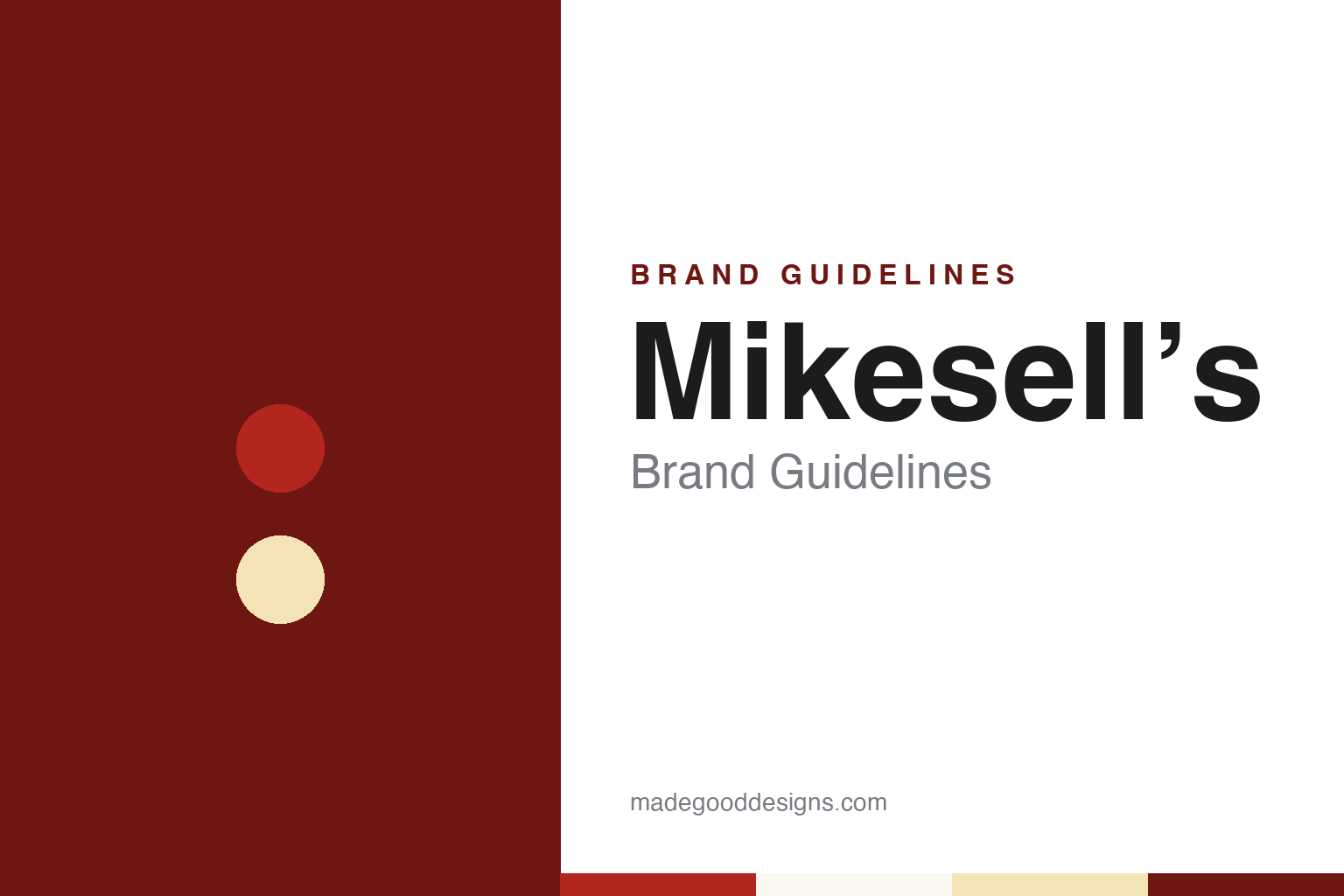
Two constants: a Dayton red, kettle brown and chip gold palette and a slab serif register. Abstract homage — not a Mikesell’s product or mark; no bag or logo is reproduced.
A slicer, a bicycle and a kettle
From dried beef to Saratoga Chips in Dayton.
Mikesell’s began as a one-man food business in Dayton, Ohio. The International Directory of Company Histories (volume 15, St. James Press, 1996) says the company was incorporated in 1910 as D.W. Mikesell & Company and that its founder, Daniel W. Mikesell, had moved to Dayton in 1906 wanting to start a business of his own. After working for a dry-goods store and as a collector for the Home Telephone Company, the directory says, he saw a used dried-beef slicing machine advertised in a newspaper, bought it and set up a small meat shop in two rooms next to his home, selling dried beef and sausage. English Wikipedia gives the same founder, place and year and says the business soon began producing “Saratoga Chips”, an early name for potato chips.
The chips came from a chance to buy frying equipment. According to the directory, Mikesell and his wife made the early batches with a few cooking kettles, baskets and stirrers, peeling, slicing, frying, packing and delivering the chips themselves, and the couple later had their four children peeling potatoes. Deliveries went out at the start by bicycle and then by horse and buggy. Ohio Magazine, in a March 2006 article by Laura Taxel, wrote that when Mikesell’s bicycle broke down he took it to the Wright brothers, who lived down the street, for repairs, and that he introduced people in the Dayton area to Saratoga Chips around 1910.
The family also sold at fairs. The directory says the Mikesells ran a D.W. Mikesell Co. booth at county and state fairs in the summer, living in a tent and scooping chips from a glass case into nickel bags. In 1913 Mikesell bought a Ford delivery truck lettered “D.W. Mikesell Co. Food Specialties”. The same year a flood in the Dayton area in March 1913 forced him to rebuild, and in 1915, the directory says, a fire destroyed the company’s premises and he rebuilt again. Ohio Magazine adds that in 1931, at the inaugural convention of the Ohio Potato Chip Institute at the Hollenden House hotel in Cleveland, Daniel Mikesell was elected treasurer of the new trade group.
Colour
A trademark in 1925, a licence in 2023.
The name on the bag dates from the 1920s. The International Directory of Company Histories says that in 1925 the company settled on the “Mike-Sell’s” trademark, which it used for more than 70 years, and that in the 1930s it began selling under that name outside Dayton. English Wikipedia says the Mikesell’s name and logo were adopted in 1925. The directory says the business built a new manufacturing plant in 1955, and that Leslie C. Mapp, who had been named chief administrative officer in 1952, became president and chief executive in 1965.
Under Mapp, according to the directory, Mike-Sell’s extended distribution to Columbus in 1971, Cincinnati in 1977, Lexington and Huntington in 1978 and Louisville in 1983, and then to Charleston, West Virginia. For about ten years from 1972 the company and the Dayton Coca-Cola Bottling Company were joined through a holding company, an arrangement that ended in 1982. In 1986 it opened a distribution centre beside its Dayton plant and offices, and in 1987 a second plant in Indianapolis, which initially made a new line called Mike-Sell’s Old Fashioned Potato Chips. Mapp’s own history of the firm, A Common Thing Done Uncommonly Well, was published by the Newcomen Society of the United States in 1985.
The Dayton business closed in 2023. On 1 February 2023 WKEF reported that Mikesell’s said it was liquidating its assets and would transition its brand and intellectual-property rights to another snack maker. On 13 February 2023 WDTN reported that Conn’s Potato Chip Co. had reached a brand licensing agreement with Mikesell’s and would produce Mikesell’s-branded snacks at its facilities in Zanesville, Ohio, restocking potato chips and puffcorn as a priority. WDTN quoted Jonathan George, owner and president of Conn’s, saying the licence would let Conn’s use “the decades old recipes and traditions of Mikesell’s”, with distribution by independent operators in Ohio, Kentucky and Indiana. Two days later WDTN reported that Conn’s had started producing Mikesell’s products in Zanesville and had posted a photograph of the opening bag off the line. Conn’s Potato Chip Co. has made Mikesell’s-branded snacks under licence since February 2023, and the brand’s website now carries a Conn’s copyright line with a Zanesville address.
Typography
Design and documentation.
The brands in this group sit on three different shelves of the grocery aisle: olive oil, pancake and baking mix, and the salty snacks of pretzels and potato chips. Each category has its own packaging habits, and a brand’s identity is often carried less by the food itself than by the tin, bottle, box or bag that holds it, and by the name printed across the front.
An olive-oil tin or bottle tends to lean on a family name, a place and a sense of origin. A pancake-mix box is built around a front panel that has to be read at a glance, with a picture of the finished stack and instructions on the side or back. A pretzel or chip bag has to work as a flat, printed surface that is folded, sealed and stacked, so colour, a wordmark and a window or photograph of the contents do much of the work.
Each guide separates what independent sources record from what the company says about itself — who started the business, who owns it now, where its products are made and how its packaging has changed — and marks plainly what rests only on the company’s own word.
Aa
A slab serif — the sturdy, local register of a regional chip bag. (Specimen set in Rokkitt, a slab serif STAND-IN; NOT the Mikesell’s logo.)
Groovy, Original, Old Fashioned
A hyphenated trademark, foil bags and ridged chips.
The brand has carried two spellings. The trademark the company adopted in 1925, according to the International Directory of Company Histories, was written Mike-Sell’s, splitting the founder’s surname into two words, and the directory and Ohio Magazine both use that form; English Wikipedia and the current brand website use Mikesell’s, the family name written as one word. The directory says the 1913 delivery truck carried the earlier name “D.W. Mikesell Co. Food Specialties”.
Packaging has been part of the company’s own story. The directory says Mike-Sell’s used automatic machines that formed a bag, filled it with chips, sealed it and placed twin bags in an outer covering, and that in the early 1970s, under Mapp, it introduced packaging equipment that handled aluminium foil, packing much of its output in foil through the 1970s and 1980s. By the late 1980s, the directory says, the core line was foil bags of chips and its “groovy”, or ridged, potato chips, sold in flavours including barbecue, green onion, sour cream and onion, and mesquite bacon.
Those names have lasted. Ohio Magazine wrote in 2006 that the unseasoned varieties — Groovy, Original and Old-fashioned — were fried in peanut oil. English Wikipedia lists Original, Groovy and Old Fashioned among current chips, together with the company’s hull-less Puffcorn Delites, and says the Dayton confectioner Esther Price sells Mikesell’s chips coated in chocolate. The same Ohio Magazine article described how, at the 2003 Ohio State Fair, chipmakers including Ballreich’s, Conn’s, Jones and Mike-Sells joined volunteers from the Ohio Department of Agriculture to cook and pack an outsize sack of chips. Conn’s, the Zanesville company that now makes Mikesell’s under licence, was on that list.
For a design guide, Mikesell’s shows how a regional snack name can travel from a founder’s surname to a hyphenated trademark and on to another company’s production line while keeping its recipes and variety names. Compare it with Ballreich’s, another Ohio potato-chip maker, and Lay’s, a national American chip brand. For this guide we use Dayton red and kettle brown on chip gold with a slab serif, an unofficial interpretation; no product or logo is reproduced.
Explore & save
Keep Mikesell’s’s identity on hand — save it to a board in the Made Good inspiration library.
Mikesell’s identity set
Pin the Mikesell’s Dayton red, kettle brown and chip-gold palette and the slab serif register to your own board.