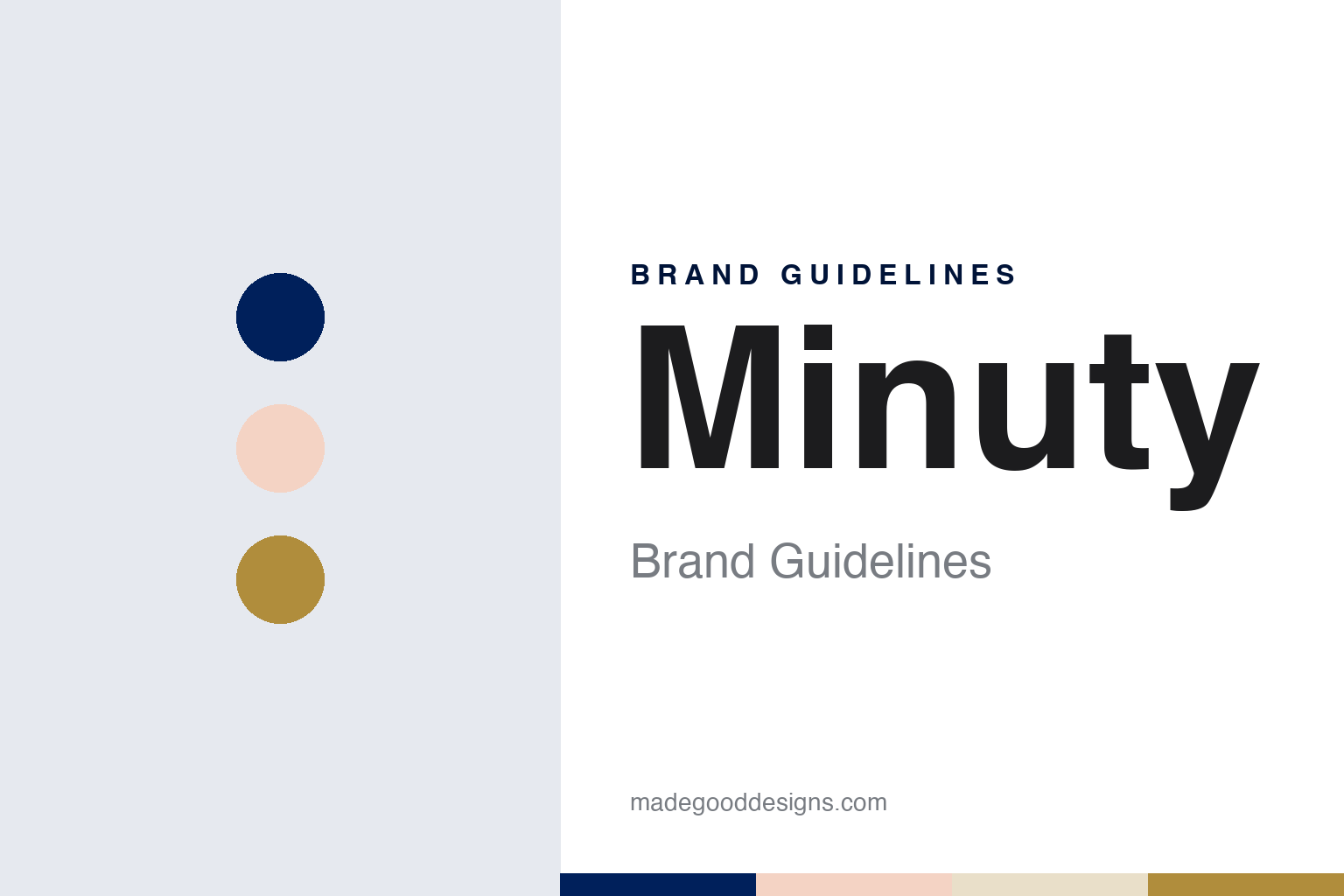
Minuty Brand Guidelines
A Saint-Tropez peninsula rosé estate, in one family since 1936.
Aa
Two constants: a Mistral navy, pale rosé and muted gold palette and a classical serif register. Abstract homage — not a Minuty product or mark; no label, logo or bottle is reproduced.
A place name in Gassin
A wine merchant, a vineyard and a chapel above the gulf.
Minuty was a place before it was a wine. French Wikipedia says a land register of 1691 already records the vines of one Joseph Minuty, whose name passed to the district and then to the château. The estate sits in Gassin, on the hills of the Saint-Tropez peninsula in the Var, looking over the Gulf of Saint-Tropez. Its private chapel was built in 1865 and has Second Empire furnishings, French Wikipedia says; the estate’s top-of-range Cuvée de l’Oratoire was later named after it.
The family story starts in 1936. The company says the wine merchant Gabriel Farnet, who already worked about 20 hectares at the Domaine de Châteauneuf in Vidauban, came across a 17-hectare vineyard at Minuty with a nineteenth-century château and chapel, and bought it from the family that owned it. French Wikipedia notes that Farnet had already, in 1933, helped set up an association of Var winegrowers to defend the Côtes de Provence name. The company says Gabriel and his wife, Jeanne, settled at the estate after the Second World War and replanted a vineyard left untended during the occupation with Grenache Noir, Cinsault, Syrah and Mourvèdre, making red and rosé wines.
Recognition came quickly. In 1955 Château Minuty was one of the 23 estates named crus classés of the Côtes de Provence, a status English and French Wikipedia both record. In 1960, the company says, Farnet’s daughter Monique joined the estate with her husband, Étienne Matton, then a notary in Paris. They renovated the cellars, replanted with the local Tibouren and Rolle grapes and held down yields. French Wikipedia records that Étienne Matton sat in 1967 on the regional committee working on the reform of the appellations; the company says he was vice-president of the growers’ syndicate when the Côtes de Provence appellation was created in 1977, and led the association of the crus classés from 1975 to 1997.
Colour
A corset-flute bottle and a blue named after its Pantone number.
Minuty’s best-known design asset is a shape rather than a logo. The company says Monique Matton designed the bottle it calls the “corset flute” — a tall flute pinched at the waist — which is now used for its M de Minuty rosé and which, the company says, has become emblematic of the Côtes de Provence. The shape gives the range a silhouette that reads before any label does.
The other famous Minuty bottle is far more recent and has a named designer. In a May 2019 interview with The Drinks Business at Vinexpo Bordeaux, François Matton, co-owner and managing director, said he had wanted a luxury bottle for the estate’s top rosé, made mostly from old Grenache vines, and approached Hubert de Malherbe, the perfume-bottle designer best known for Dior’s J’adore. Matton said the wine is called 281 after the Pantone number of the royal blue that drips down the side of the bottle, a colour inspired by the deep blue of the Provence sky when the Mistral blows; it looks like wax, he said, but is not. Because rosé is so often served from an ice bucket, he added, the neck was designed to make an impact on its own. The Drinks Business repeated his account in July 2020 in a feature on “designer” rosés by Lucy Shaw.
The range is arranged in two tiers. The company’s own site separates its estate wines — Château Minuty Gabriel, 281, Rose et Or and Rouge et Or — from its branded wines, Minuty Prestige and M de Minuty, which carry the Minuty name rather than the château’s. In the same 2019 interview Matton said he wanted Provence rosé to move toward the prestige of Champagne, and that his aim was for Minuty to become the leading rosé brand in the world.
Typography
Design and documentation.
The seven brands in this group are all whisky, gin, grappa, calvados and rosé names: Tomatin, Jura, Edinburgh Gin, Roku, Poli, Boulard and Minuty. Spirits and wine brands in general sit at many different points in the trade, from family houses that still carry a founder’s name to labels that now belong to much larger drinks groups, and a single brand can be sold everywhere from a corner shop to a restaurant list.
A spirit or wine brand’s identity is usually carried less by a single bottle than by a label, a name and the place it promises, because the company behind the name may have changed hands, moved its production or grown far beyond the place where it started. That makes the questions behind each name worth asking plainly: who started it, who owns it now, and where its spirit or wine is actually made and bottled.
Each guide separates what independent sources record from what the company says about itself — its founding story, its owners over time, where its spirit or wine is made and how its labels have changed — and marks plainly what rests only on the company’s own word.
Aa
A classical high-contrast serif for an estate name with a long Provençal history. (Specimen set in Cormorant Garamond, a serif STAND-IN; NOT the Minuty logo.)
Minuty
Three generations of Mattons, then a drinks group.
The third generation took over in the 1990s. French Wikipedia and the company both say Monique and Étienne’s sons, Jean-Étienne and François Matton, took charge of the estate in that decade; the company credits them with reworking its winemaking around pale, delicate rosés and with extending distribution to more than 100 countries. In 2012, the company says, the estate rebuilt its tasting cellar and added a second barrel cellar, and in 2022 Jean-Étienne’s daughter Anne-Victoire Matton joined her father and uncle in running it, a fourth generation also reported by Paris Match and Le Figaro in 2022, French Wikipedia notes.
Ownership changed in February 2023, when Moët Hennessy, the wine and spirits arm of LVMH, announced it had acquired a majority stake in Château Minuty, Decanter and The Beverage Journal reported. The announcement said Jean-Étienne and François Matton would continue to manage the estate, and Moët Hennessy’s chief executive Philippe Schaus described the deal as a new step in a relationship built over the previous two years through the group’s distribution of Minuty wines in the Asia-Pacific region. The trade press noted that the group already owned Château Galoupet and held a majority of Château d’Esclans, maker of Whispering Angel, so Minuty became its third Provence rosé house. The company said at the time that it had sold more than nine million bottles in the previous year.
The estate today, the company says, covers about 200 hectares: 65 in a single block at Gassin, 15 in the Val de Rian at Ramatuelle facing Pampelonne bay, and the rest at Le Cannet-des-Maures and Vidauban, where the Domaine de Châteauneuf lies. Grenache makes up about 60 per cent of the planting. The company says the vineyard has held France’s HVE environmental certification since 2019, that 15 hectares have been certified organic since 2023, and that the harvest is entirely by hand. Searchers should note that “minuty” is also the Polish and Czech word for minutes; the estate’s own site is minuty.com.
For a design guide, Minuty shows how a single bottle shape, drawn within the family, and a blue identified by its Pantone number can carry a Provence estate from a 17-hectare vineyard to shelves around the world. Compare Moët & Chandon and Veuve Clicquot, two Champagne houses in the same Moët Hennessy group. For this guide we use Mistral navy, pale rosé and muted gold with a serif, an unofficial interpretation; no product or logo is reproduced.
Explore & save
Keep Minuty’s identity on hand — save it to a board in the Made Good inspiration library.
Minuty identity set
Pin the Minuty Mistral navy, pale rosé and muted gold palette and the classical serif register to your own board.