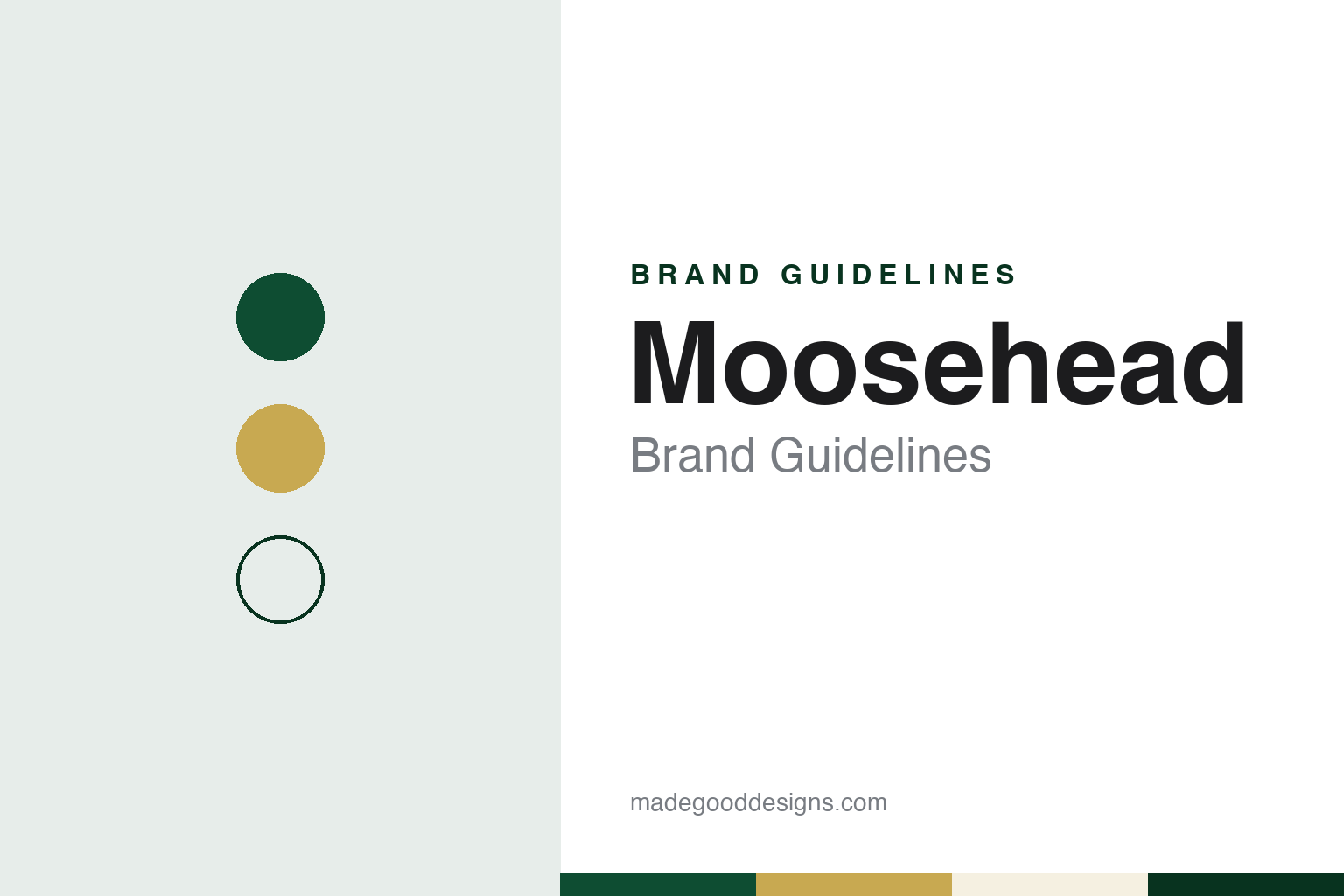
Moosehead Brand Guidelines
The Oland family brewery of Saint John, founded 1867.
Aa
Two constants: a forest green, antler gold and label cream palette and a sturdy slab serif register. Abstract homage — not a Moosehead product or mark; no label, logo or bottle is reproduced.
A backyard brewery in Dartmouth
From Susannah Oland’s garden to a brewery in Saint John.
Moosehead Breweries Limited of Saint John, New Brunswick, is owned and run by the Oland family. English Wikipedia calls it Canada’s oldest independent brewery, and the company itself says it is “the last major brewery in Canada still owned by Canadians.” Both trace the business to 1867, the year of Canadian Confederation, and to Susannah Oland, an Englishwoman who had come to Nova Scotia with her family.
The company’s history says Susannah Oland began brewing in her backyard in Dartmouth, across the harbour from Halifax. English Wikipedia’s article on her says the brewery was set up in the garden shed behind the family’s rented home and incorporated in August 1867 as the Turtle Grove Brewery, named after its district, with her husband John as manager. From 1870 it traded as the Army and Navy Brewery, a name taken from its best customers, and in 1877 Susannah Oland bought out the other partners and renamed it S. Oland, Sons and Co., according to both the company and English Wikipedia. The brewery survived fires in those years, and control later passed to her youngest son, George W. C. Oland.
The next century began badly. The company says that in 1895, under the pressure of the temperance movement, the business was sold to a British syndicate, and that George W. C. Oland bought a Halifax brewery in 1909 to start again. The Halifax Explosion of 6 December 1917 destroyed that brewery. The family then looked west to New Brunswick: the company says George W. C. Oland bought the Red Ball Brewery in Saint John in 1918 and sent his eldest son, George B. Oland, to run it, while English Wikipedia dates the purchase of a larger Saint John brewery, on the site of today’s plant, to 1928.
Colour
A moose, a green label and a lager made for export.
The moose came from the archives. The company says George B. Oland found the name “Moosehead” in old records and created Moosehead Pale Ale after buying the James Ready Brewery in 1928; English Wikipedia dates the launch of the pale ale, and the arrival of the moose symbol, to 1931. The beer did well enough that in 1947 the family renamed the company Moosehead Breweries Limited, a date both sources agree on. The company also says that in 1937 George B.’s son P. W. Oland secretly brewed the first batches of Alpine Lager while his father was out of the country; Alpine Lager is still in Moosehead’s range, English Wikipedia’s brand list shows.
Export made the name. English Wikipedia says the brewery launched Moosehead Lager in the United States in 1978, and the company credits the fifth-generation Derek Oland, who became president in the early 1980s, with leading its development. English Wikipedia, citing the Chicago Tribune in 1986, says Moosehead was then a popular premium import in the US, distributed by RJR Nabisco, and the actor Michael J. Fox recalled in his memoir Lucky Man (Hyperion, 2003) that after he told Jay Leno on The Tonight Show that he drank Moosehead, a Moosehead truck arrived at his house with a delivery of beer.
The look has been brought into line more recently. Strategy reported in April 2018 that Moosehead had repackaged its four product lines to give them more consistent branding, aiming at younger drinkers without losing older ones; the magazine put the brewer’s share of the Canadian market at about four per cent.
Medals have followed the lager. English Wikipedia says Moosehead Lager won bronze at the World Beer Cup in 2002 and again in 2004, and that at the Canadian Brewing Awards Moosehead won gold for its pale ale in 2015 and, in 2016, gold for Alpine Lager and silver for Cracked Canoe. The company says Moosehead Lager also took a gold medal at the Monde Selection in 2005.
Typography
Design and documentation.
The seven brands in this group are all Canadian beer and whisky names: Molson Canadian, Labatt Blue, Sleeman, Moosehead, Kokanee, Alexander Keith’s and J.P. Wiser’s. Beer and whisky brands in general sit at many different points in the trade, from family companies that still carry a founder’s name to labels that now belong to much larger drinks groups, and a single brand can be sold everywhere from a corner store to a bar rail.
A beer or whisky brand’s identity is usually carried less by a single bottle than by a label, a name and the place it promises, because the company behind the name may have changed hands, moved its production or grown far beyond the place where it started. That makes the questions behind each name worth asking plainly: who started it, who owns it now, and where its beer or whisky is actually made.
Each guide separates what independent sources record from what the company says about itself — its founding story, its owners over time, where its beer or whisky is made and how its labels have changed — and marks plainly what rests only on the company’s own word.
Aa
A sturdy slab serif for a Maritime brewer’s green labels. (Specimen set in Zilla Slab, a slab-serif STAND-IN; NOT the Moosehead logo.)
Moosehead
Six generations, one family and a brewery that stayed independent.
The family has kept control through six generations. English Wikipedia, citing TEC Canada in 2016, says Andrew Oland, a son of Derek Oland, became president in 2008 and chief executive in 2013, and the company says Andrew and his brother Patrick Oland lead it today. Moosehead sells its beer across Canada, in the United States and in other countries, English Wikipedia says, and it owns the Niagara Falls Brewing Company in Ontario. With its subsidiary the Premium Beer Company it also markets other brewers’ beers in Canada, among them Estrella Damm of Barcelona.
Independence has set Moosehead apart from its rivals. English Wikipedia says all of its major Canadian competitors are owned by multinationals, making Moosehead the largest fully Canadian-owned brewer, and notes that when the Canadian Brewing Awards limited entries to fully Canadian-owned breweries for 2017, Moosehead was among those still eligible. In 2019 the Canadian Premier League, the national professional soccer league, named Moosehead its official domestic brewery.
The brand’s best-known news story was a theft. In August 2004 a truckload of Moosehead beer bound for a supermarket chain in Mexico went missing in New Brunswick; CBC News reported that local residents joined the search, that police found the driver later that month and that, in October, cans from the load turned up in the woods with bite marks from a bear. Truck News reported in 2005 that the driver was convicted.
For a design guide, Moosehead shows how one animal and one family name can carry a regional brewery from a Dartmouth garden to bars across North America. Compare Sleeman, the Guelph brewer revived from a family recipe book, and Alexander Keith’s, the Halifax brewery across the harbour from the Olands’ first one. For this guide we use forest green, antler gold and label cream with a slab serif, an unofficial interpretation; no product or logo is reproduced.
Explore & save
Keep Moosehead’s identity on hand — save it to a board in the Made Good inspiration library.
Moosehead identity set
Pin the Moosehead forest green, antler gold and label cream palette and the sturdy slab serif register to your own board.