Radiotopia Brand Guidelines
Seven shows, one collective and a bolt line set at six degrees.
Aa
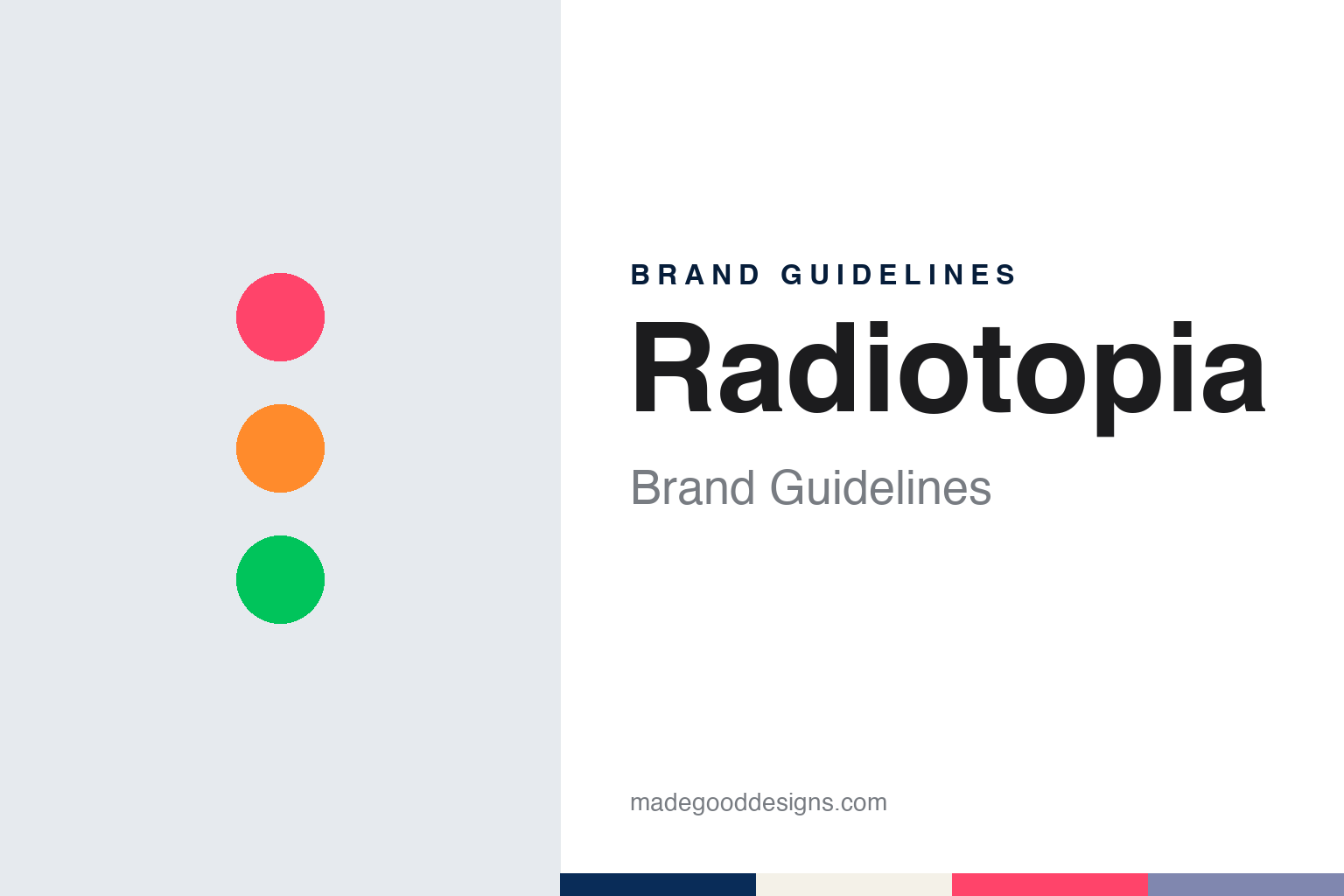
Two constants: Radiotopia’s published navy, pomegranate, orange and green palette and a Light-and-semibold humanist sans register. Abstract homage — not a Radiotopia or PRX asset or mark; no logo, Zag, cover art or wordmark is reproduced.
Strength in numbers
A podcaster’s plan and a public radio distributor, 2014.
Radiotopia began with a podcaster’s plan. On 4 February 2014, Nieman Lab’s Justin Ellis reported that PRX, the Public Radio Exchange, had launched a new podcast network that morning, bringing together seven story-driven shows, among them Roman Mars’s 99% Invisible, Radio Diaries and Benjamin Walker’s Theory of Everything. The network was backed by the Knight Foundation and by Kickstarter donors, and Mailchimp signed on as launch sponsor. Ellis quoted the text Mars had written during his Kickstarter campaign the previous autumn, in which he said he had been scheming with PRX for a couple of years to create a collective of exceptional radio shows modelled on 99% Invisible, and added: “We call it Radiotopia.” Wikipedia completes the founding seven with The Truth, Strangers, Love and Radio and Fugitive Waves, later renamed The Kitchen Sisters Present.
PRX was not new to the shows it had in mind. Ellis noted that, as a technology maker and distributor for public media, it had worked with Radiolab, This American Life and The Moth, and that the previous summer it had launched the PRX Remix app, a continuous stream of stories curated from PRX shows by Mars. Mars told Nieman Lab that the path to success for an independent public radio producer could be murky, whereas a podcast could launch on small, direct donations from fans.
The idea, Ellis wrote, was strength in numbers. The shows would act as a collective, marketing one another, sharing technical guidance and passing on lessons about growing audiences, while Radiotopia provided a framework for grants, Kickstarter campaigns, network-wide sponsorship and shared revenue. PRX’s chief executive, Jake Shapiro, told Nieman Lab that the network would need to find the right balance between leveraging the group and letting each show’s identity flourish. Mars said he wanted a place where high-quality, story-driven work could live and its makers could make a go of it. English-language Wikipedia quotes PRX describing the venture as somewhat like an independent record label. Ellis offered his own comparison: a public-radio counterpart to what Earwolf was to comedy podcasts, a mothership offering support, resources and a launching pad.
Colour
Arrivals, departures and a feed for limited series.
The roster grew quickly. Wikipedia says the network expanded from seven shows to eleven in February 2015, adding The Heart, Criminal, The Allusionist and Mortified, and that Song Exploder and The Memory Palace joined in June 2015. The Knight Foundation backed the network again in May 2015, and Julie Shapiro was hired as executive producer in September 2015. A showcase feed for limited series followed in 2017 after an open call, and Wikipedia says it was renamed Radiotopia Presents in 2020; a short-form feed for financial supporters, Radiotopia Plus, launched in 2018. Other additions included The Bugle, which joined in September 2016, and Trump Con Law, launched in June 2017.
Shows have also moved on. Wikipedia dates the end of Millennial, the first Radiotopia show to finish its run, to 16 August 2017, and records Love and Radio leaving for Luminary in May 2019 and The Allusionist leaving in October 2020, while the last Strangers episode on the network appeared on 12 December 2017 and Criminal left in 2021. Another change touched the founder’s own show. On 26 April 2021, RAIN News reported that SiriusXM had acquired 99% Invisible Inc., the company behind Mars’s podcast, which would join SiriusXM’s Stitcher network; the report described Radiotopia as the collective Mars had co-founded with PRX.
Radiotopia now describes itself as the first network of its kind created specifically for independent podcasts, made in 2014 through a partnership between PRX and Mars. Its website names Audrey Mardavich as executive producer, leading the network with Yooree Losordo, its director of network operations.
Typography
A collective with a published visual system.
A podcast’s visual identity usually begins with one square. Listening apps show cover art as a small tile in a grid of other shows, often no larger than a thumbnail on a phone, so the artwork has to stay legible when it is reduced to the size of a fingertip. That pushes many designers towards a short title in heavy letters, a single strong colour field or one simple image, with fine detail and long subtitles kept for larger formats. Because the same square is also cropped into circles, banners and episode cards, a cover that works at small size tends to become the anchor for everything else, from the website header to social posts announcing a new season.
Much of the identity, though, is heard rather than seen. A recurring theme tune or a short sonic logo at the start of each episode tells a listener which show is playing within a few seconds, and the same music often returns under transitions and closing credits. Host voices work in a similar way: the tone, pace and phrasing of the people speaking become as recognisable as any wordmark, and many shows keep the same opening line from episode to episode. Shows that belong to a network often add a small badge or a spoken introduction naming that network, which ties a family of programmes together without changing each cover. Live recordings, stage tours and merchandise such as tote bags, mugs and T-shirts carry the cover art and catchphrases off the screen, giving listeners a physical version of a show they otherwise only hear.
Aa
Light-and-semibold humanist sans — after the ultralight and semibold weights Radiotopia specifies for headlines and body copy. (Specimen set in Barlow, a sans STAND-IN; NOT the Radiotopia wordmark, Outage Cut, Sigmund Pro or any Radiotopia lettering.)
Radiotopia
A skewed wordmark, the Zag and five published colours.
Radiotopia publishes its visual rules on its own website. Its brand-assets page, captured by the Internet Archive from October 2023, says the primary identifier is a wordmark set in Outage Cut and skewed at a 6° angle, and that Outage is reserved for the wordmark alone; headlines, sub-headlines and body copy are set in Sigmund Pro, in ultralight and semibold. The minimum clear space around the wordmark is half its height.
A secondary element, called the Zag, borrows the geometry and 6° angle of the bolt line in the wordmark. The page says it can sit inside a circular container as a stamp or badge, in navy or white or in combinations of the accent colours, and that it may appear on its own only as a social-media avatar, close to the spelled-out name, or as a favicon.
The palette is published with exact values: Navy #092C58, Blue/Gray #8087AF, Green #00C45B, Orange #FF8B2C and Pomegranate #FF446A. Radiotopia says the colours form a spectrum that audiences may recognise from sunsets or from images of the Northern Lights, evoking a sense of place and the “utopian warmth” the network aspires to.
For a design guide, Radiotopia shows how a network can keep a compact system — one skewed wordmark, one angled device and five colours — while, as Jake Shapiro put it in 2014, letting each show’s identity flourish. Compare 99% Invisible, the design podcast whose host co-founded the network, and Song Exploder, which joined the roster in 2015. For this guide we use Radiotopia’s published navy, pomegranate, orange and green with a sans; the colours are the network’s own, but no product or logo is reproduced.
Explore & save
Keep Radiotopia’s identity on hand — save it to a board in the Made Good inspiration library.
Radiotopia identity set
Pin the Radiotopia navy, pomegranate, orange and green palette and the Light-and-semibold humanist sans register to your own board.