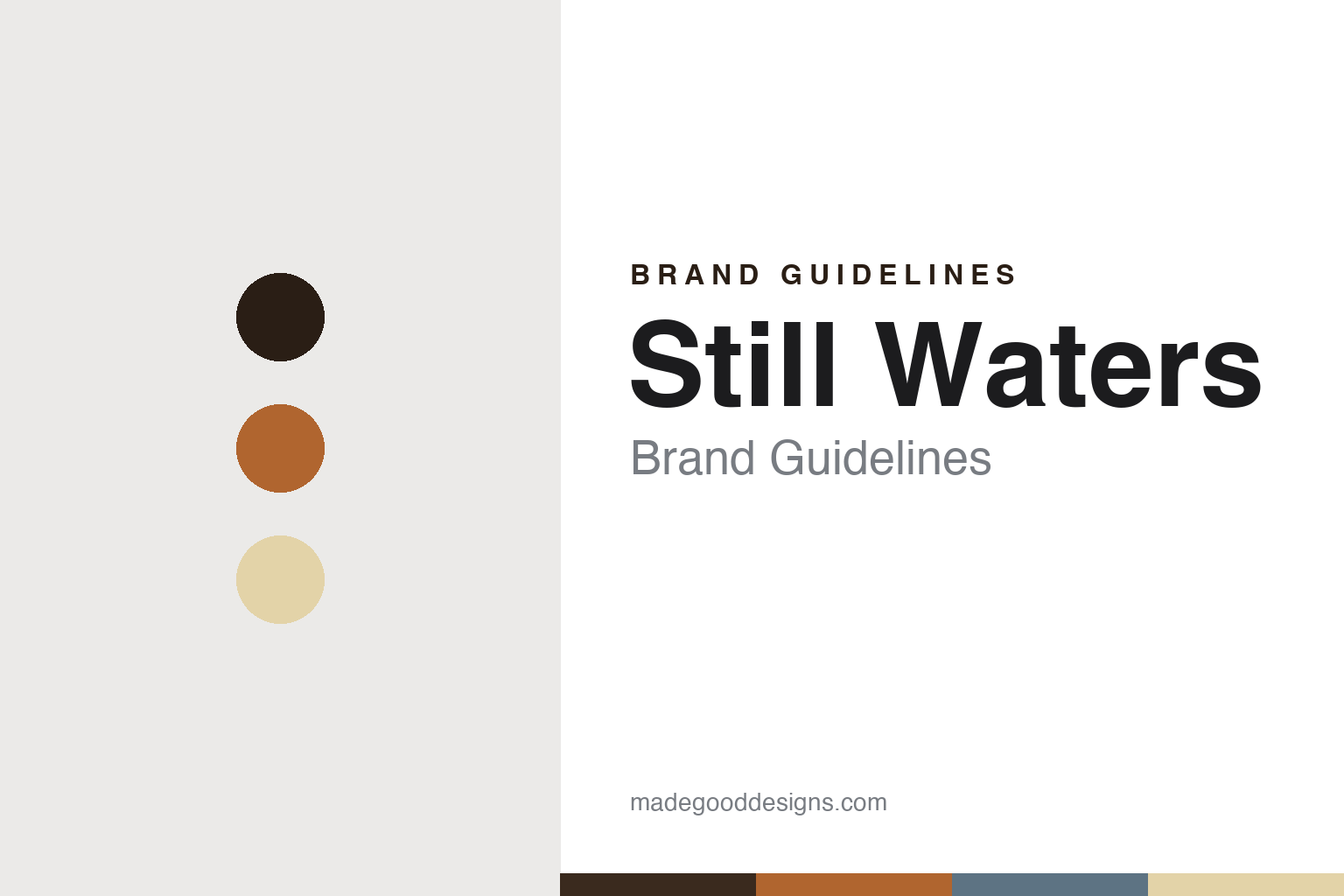
Still Waters Brand Guidelines
Two friends, a copper still and an industrial unit north of Toronto.
Aa
Two constants: an oak, copper and grain palette and a workshop sans register. Abstract homage — not a Still Waters product or mark; no bottle, label or logo is reproduced.
Two Barrys
Friends who turned a love of whisky into a distillery.
Still Waters was started by two friends who shared a first name. Barry Stein and Barry Bernstein, described by the whisky website Canadian Whisky in November 2011 as “long-time chums,” left business careers to make spirits; whisky, it said, was the partners’ first love. Before they distilled anything, the same report says, they imported and bottled Scotch single malts under their own Premium Bottlers label.
The distillery is in an industrial unit in Concord, Ontario, just north of Toronto. The company’s website, as archived in 2022, said the two Barrys established what it called Ontario’s first micro-distillery and began production in March 2009, and that they were involved in every part of running it and personally oversaw each batch.
The equipment came from Germany. Canadian Whisky reported in 2011 that the founders engaged the still maker Christian Carl to design a distillery to their specification: three linked copper distillation chambers — a pot, a four-plate column and a 12-plate column — with a 450-litre copper pot at the heart of the single malt operation. It said the unfiltered wort went straight into the pot still rather than into a beer still, and the new-make whisky spirit was double distilled to about 70 per cent alcohol. The founders also planned a rye whisky made from 80 per cent rye grain and 20 per cent malted barley, the report said. The distillery opened a shop on site at the end of 2011, the same website reported.
Colour
Vodka first, then Stalk & Barrel.
Still Waters sold vodka while its whisky matured. Canadian Whisky described its single malt vodka in 2011 as triple distilled to 95 per cent alcohol and charcoal filtered. At the same time nearly a dozen barrels of single malt were ageing, in ex-bourbon casks and in new oak barrels made for the distillery by a wine cooper in Prince Edward County, Ontario. The founders were also working on blends, buying aged whiskies from other Canadian distillers and blending them with their own malt spirit; the report says focus groups at Toronto’s Whisky Live event liked two of them.
The whisky arrived in 2013 under the name Stalk & Barrel. A press release published by Canadian Whisky in April 2013 announced that the first Stalk & Barrel Single Malt would be released on 27 April 2013, drawn from the first casks made at the distillery in 2009. It said the whisky was made by hand from 100 per cent Canadian two-row malted barley in small batches in a custom-built copper pot still, and called Still Waters Ontario’s first grain-to-glass micro-distillery. Each release was a single cask, bottled at full cask strength in individually numbered bottles without chill-filtering or added colouring, after about four years in wood. The first bottles were sold only at the distillery’s own shop, with some online sales to Ontario residents, because most of the whisky had been allocated to markets outside Ontario, including the United States and Sweden. “We set out to restore the tradition of small batch craft distilling in Ontario,” Bernstein said in the release. The company’s archived 2022 website grouped its range under single malt, rye and vodka, and offered contract production for other businesses.
Stalk & Barrel now has its own website, which writes the name as one word joined by an ampersand and describes the brand as the official Canadian whisky of Golf Canada, the RBC Canadian Open and the CP Women’s Open. It says the whisky “found its roots in Ontario,” and STYLE Canada wrote in December 2022 that the brand was 100 per cent Canadian-owned and operated in Ontario.
Typography
Design and documentation.
The six brands in this group are all Canadian whisky names: Pike Creek, Shelter Point, Still Waters, Dillon’s, Okanagan Spirits and Canadian Mist. They range from labels that belong to large international drinks groups to independent distilleries in Ontario and British Columbia, and a single bottle can be sold everywhere from a provincial liquor store to a bar rail on the other side of the border.
A whisky brand’s identity is usually carried less by the spirit itself than by a label, a name and the place it promises, because the company behind the name may have changed hands, the distillery may have changed owners, and the bottling may happen somewhere other than where the whisky was made. That makes the questions behind each name worth asking plainly: who started it, who owns it now, and where its whisky is actually distilled, aged and bottled.
Each guide separates what independent sources record from what the company says about itself — its founding story, its owners over time, where its whisky is made and how its labels have changed — and marks plainly what rests only on the company’s own word.
Aa
A workshop sans — copper, oak and grain. (Specimen set in Archivo, a sans STAND-IN; NOT the Still Waters logo.)
Still Waters
New owners and a new name on the bottle.
The distillery has since changed hands. Its website now says it is led by distillers Kelly and Lucas, who “took ownership from the Barrys” with the aim of protecting what made the distillery special and improving on it. They say they have strengthened day-to-day operations, improved barrel storage and handling, introduced new finishing techniques and started an ageing programme that supports other distilleries.
The website presents Still Waters as the home of Buck Hill, a whisky line whose name, the company says, comes from local folklore out of Barry’s Bay about a man who walked the forest by lantern light. The range it lists includes Buck 3, a Canadian rye made from Ontario rye; Buck 8, a straight corn whisky aged eight years; and Buck 77, a cask-strength bottling, alongside Loaded Donkey editions and a vodka and rum collection. The website gives the same Concord address and offers contract production and bulk spirits to other businesses.
For a design guide, Still Waters shows how a small distillery can carry more than one whisky brand from the same stills over its life. Compare Forty Creek, another Ontario whisky started by an independent maker, and Shelter Point, a craft distillery that also started with single malt. For this guide we use oak brown, copper and a pale grain tone with a sans, an unofficial interpretation; no product or logo is reproduced.
Explore & save
Keep Still Waters’s identity on hand — save it to a board in the Made Good inspiration library.
Still Waters identity set
Pin the Still Waters oak, copper and grain palette and the workshop sans register to your own board.


